



by Jim Carrier
When Joan Conover arrives at Fiddler’s Green, the promised land for departed mariners, she’ll look back on an earth better for her having sailed it.
Long before she took the helm of the Seven Seas Cruising Association, Conover was practicing one of SSCA’s founding principles — leave a clean wake. On board, on land, and on the air, few have done as much as Conover to marshal the better angels of our privileged fleet.
On her first transatlantic in 2005 she and daughter Christina took daily dips of marine life — 160 samples — all the way to Portugal. They froze and shipped them to Old Dominion University to establish an ocean-wide baseline to gauge signs of degradation. Christina, a high school graduate at the time, became an oceanographer.
In years since, amid 35,000 cruising miles, Joan and husband, Greg, have helped organize sailors to improve lives, harbors, and communities in Haiti, Guatemala, Honduras, Dominica — tropical getaways that suffer from storms, flooding, bad sanitation, poverty, poor health, and the social and environmental impacts of first-world yachts.
In 2007, eleven years after joining SSCA, Joan took over administering Clean Wake and has made it a core focus of her presidency. “I liked their philosophy, written before any of the green or climate change issues were raised. It was obvious you need to protect the earth because we have a tendency to mess things up.” The California sailors who launched SSCA in 1952 created Clean Wake Projects to promote both environmental and social stewardship.
Conover first went to sea as a 12-year-old crewing on her Norwegian grandfather’s salmon fishing boat in Puget Sound. “I’m not afraid of big seas — not if you’ve been in an old leaky wooden trawler.” After marrying Greg, an Army tank officer, adopting a special needs child who found water comforting, and being assigned to Fort Hood, she told him, “I’d like to get a sailboat because it would be a family activity we could all do — in the middle of Texas. Greg, who had not sailed before, called it ‘the craziest thing.’ Two weeks later we had a sailboat. Josh loved it.” Stillhouse Hollow Lake, an Army Corps reservoir that borders the base, was ideal for their 22-foot daysailer.
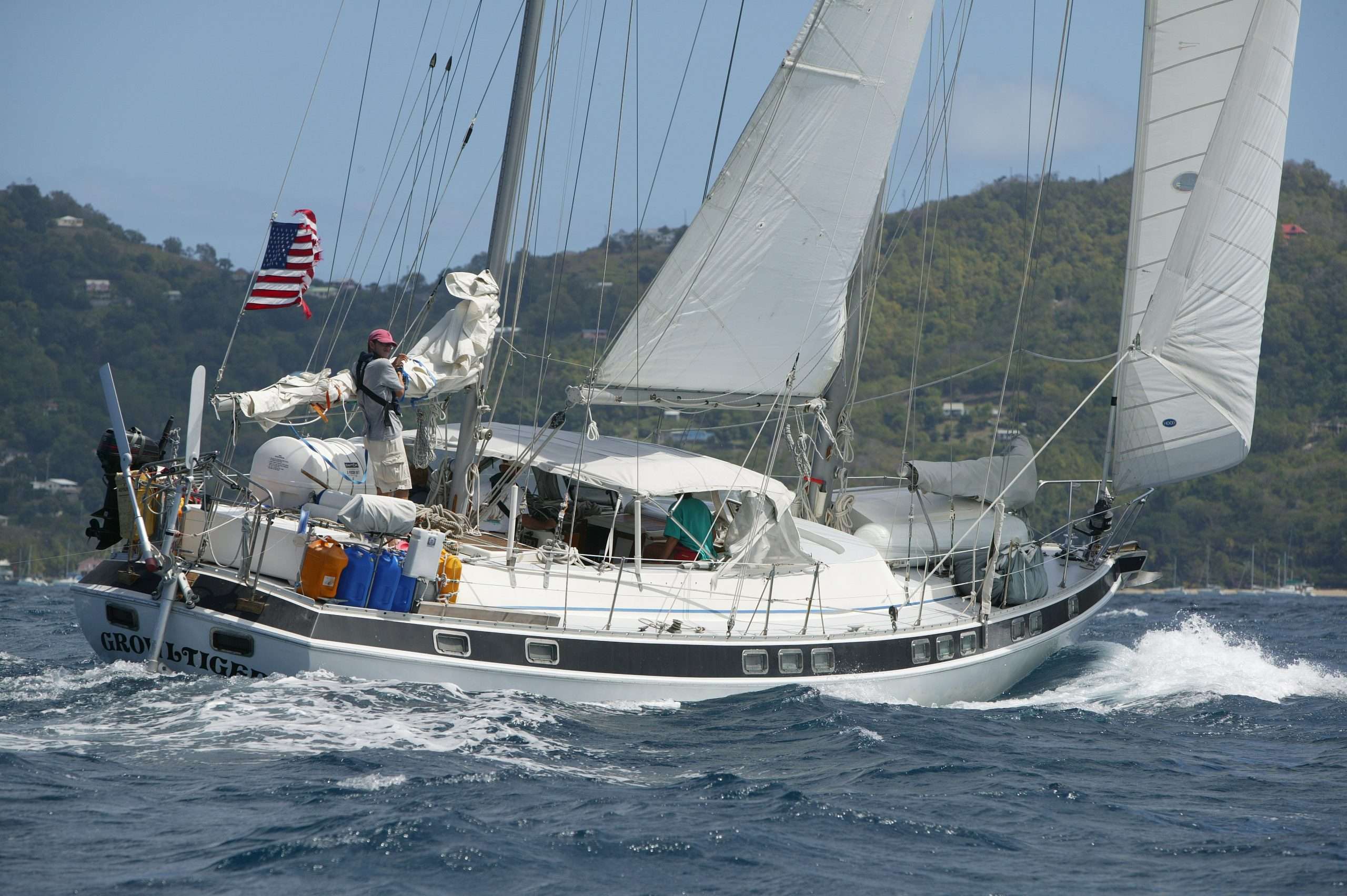
Reassigned to the East Coast, they bought a used Morgan 41 and got their sea legs on the Chesapeake. In 1989 after Hurricane Hugo tossed around a 1976 Morgan Out Island 51 in the Isle of Palms marina in Charleston, S.C., they traded up for her with $50,000 in cash.
“Let me tell you a 1970s shag carpet is not good on a boat. It was orange and green — you’d get seasick when you came in.” So they renamed her after a colorful, disheveled character in the musical Cats.
Built like a tank, so roomy it had a tub, Growltiger underwent a major refit: a 700-gallon-a-day water maker, a washer-dryer, autopilot, a generator, big house batteries, a replaced electric system and new running rigging before setting out on a transatlantic with their two college-age children and a mate in 2005. Over the years, they’ve rebuilt the engine, replaced ports with stainless steel, replaced the hatches, sails, standing rigging, and, more recently, the entire deck. The tub, she hastens to add, is used to store stuff.
With a home port in Hampton, Virginia, and healthy retirement and savings accounts, the Conovers have been sailing back and forth seasonally to the Caribbean for 15 years. Josh and their Havanese show-dogs go with them. But unlike most cruising conversations that focus on Caribbean delights, a talk with Joan is peppered with good deeds they’ve had a hand in:
Moorings in Dominica’s Saint Rupert Bay to reduce coral destruction. Water filters, paint, shovels, stoves, and a Braille keyboard for a blind boy in Rio Dulce, Guatemala. Acting as a “pickup truck” to ferry supplies from Antigua to Dominica after Hurricane Maria. When a 2010 earthquake devastated Haiti, she used the internet, cell phones and her HAM radio to coordinate sailors who traveled there to help.
Joan, a plain-spoken woman with a broad smile, struggles to articulate where the drive to help comes from. But she speaks movingly of looking into the eyes of poor children — “kindred souls. They should be in advanced degree programs, and you know that’s not going to happen.”
Back home, her tall SSB antenna behind the house beams communications with SSCA’s port hosts worldwide. And every fall, as cruisers gather around Cape Hatteras before heading south, she becomes a mother-hen/drill-instructor/geek-squad-expert to keep them safe. As a patent-holding systems engineer facile with radios, weather and terrain, she briefs rallies, and then stands by on various e-platforms to respond to inevitable calls for help.
Every year, boats set sail with “new-to-them” equipment — “wonderful little toys from a boat show” that Joan, from her radio room, helps troubleshoot. “I decided my give-back was to help people stay connected — if that meant the best satellite or tracking system, be it Iridium, inReach, Zoleo, Starlink, SSB, PredictWind — whatever they had — to make sure they could stay in touch. I don’t think people realize how important it is from Hatteras down to the Virgin Islands to at least be in touch. Or be tracked.”
In her seventies, Joan realizes she is getting to the end of her sailing years, and is working to pass the clean wake philosophy to a new generation of cruisers.
“I guess it’s the human drive. A lot of us have it. Some don’t. If we didn’t have a focus of going in, and [finding] what we might do when we arrived, I don’t know that I would be interested in going. I don’t go just for the passage. I go for the experience after you get there.”
Click here for a list of sanctioned SSCA Clean Wake projects.
This article originally appeared in Cruising World magazine.