



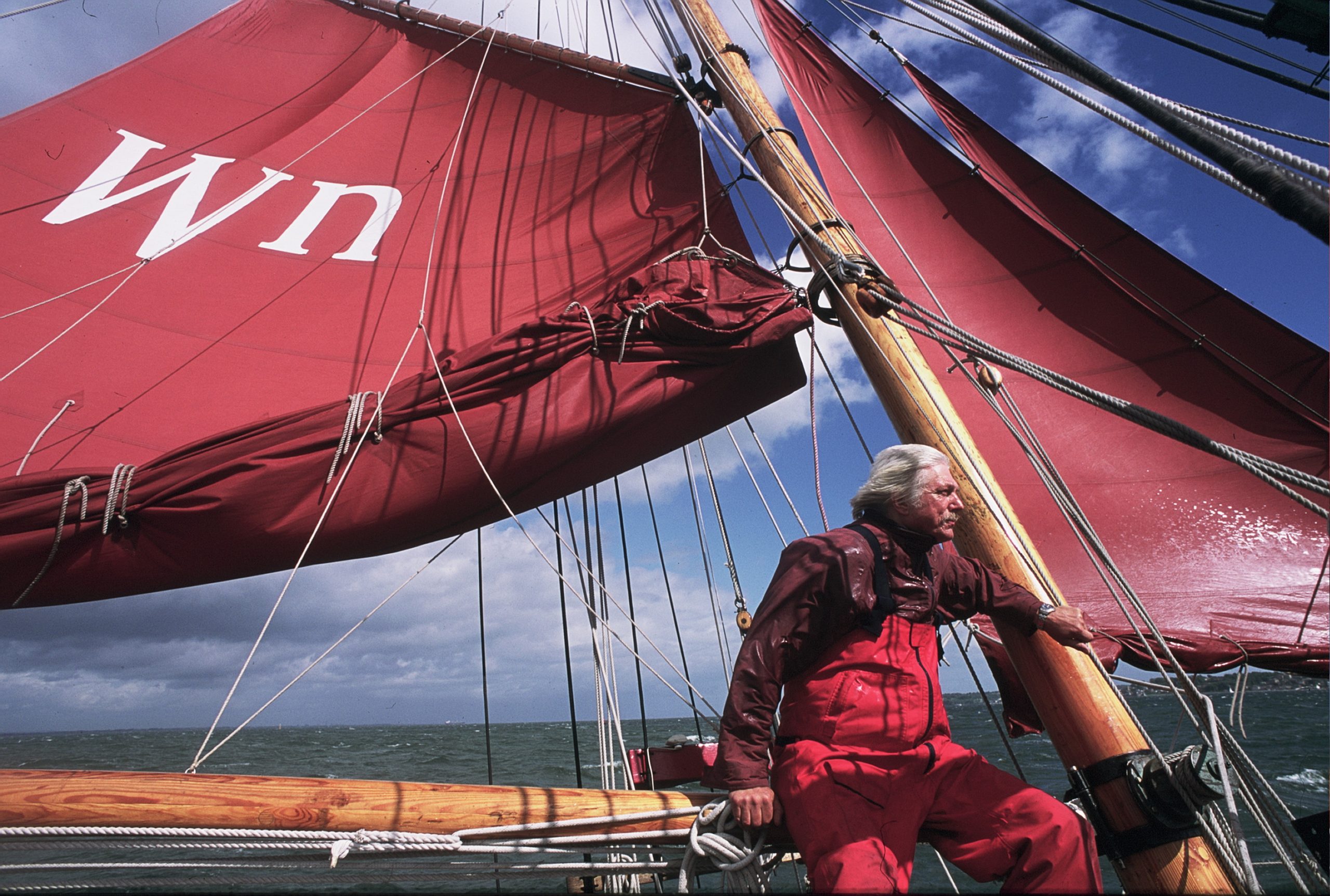

Excerpt from a novel by Tom Cunliffe
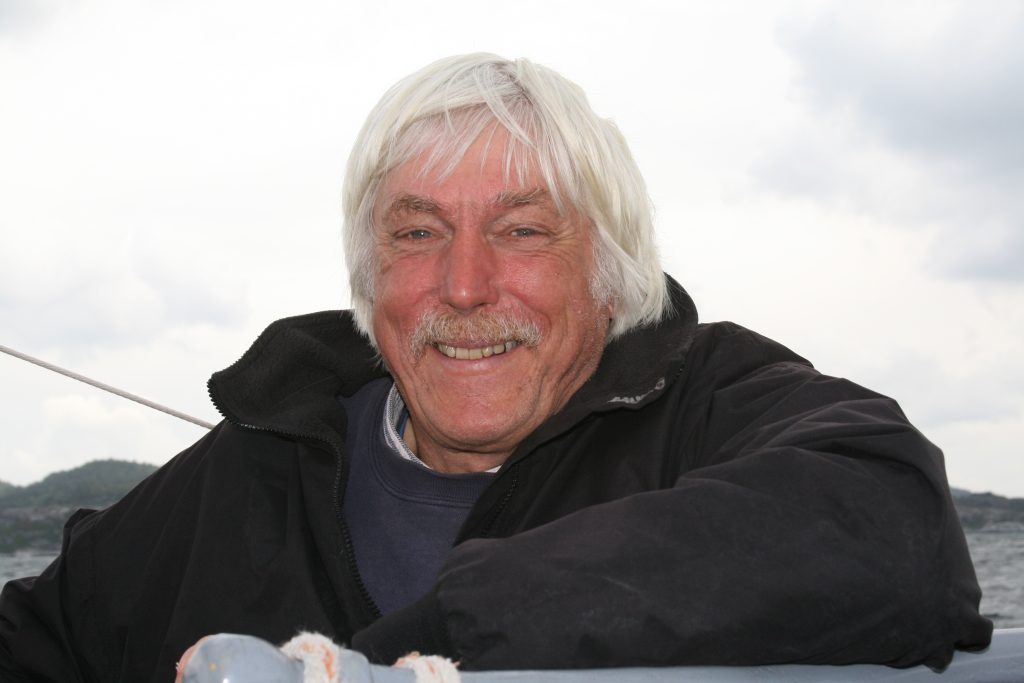
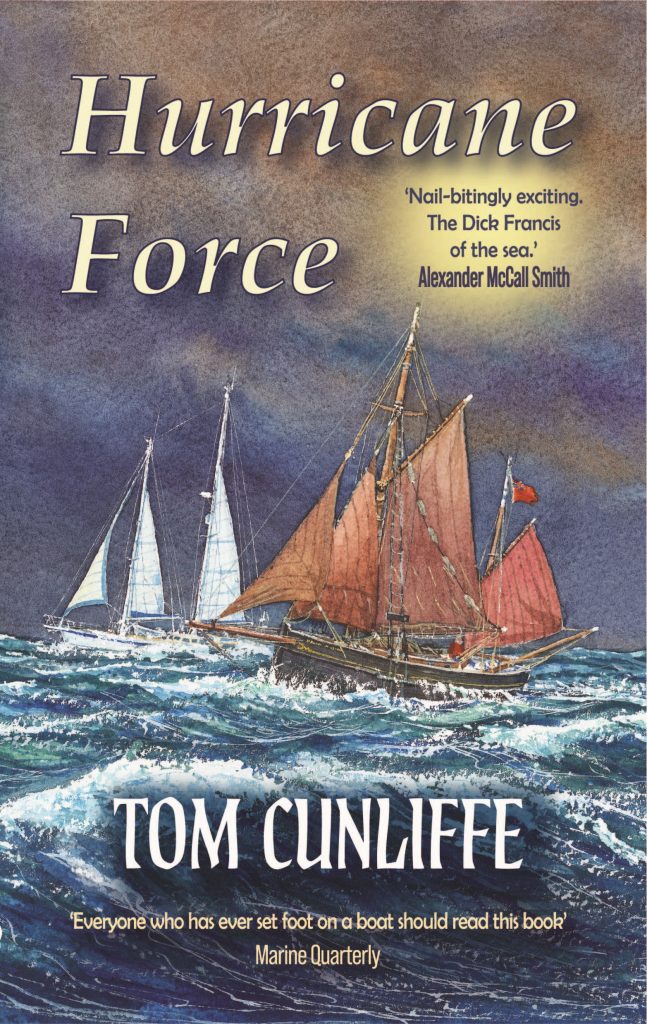
Editor’s note: Tom Cunliffe’s career as an award-winning author of over 25 technical books and the star of two BBC series on sailing is capped by his first novel, Hurricane Force, about the watery adventures of solo sailor Ian Hordle. Alexander McCall Smith (No. 1 Ladies Detective Agency) has written, “Tom Cunliffe is set to become the Dick Francis of the sea. This highly readable novel is nail-bitingly exciting as well as being very well-written. Exceptionally enjoyable.”
Caribbean Compass is proud to present the first chapter of Hurricane Force.
Looking back on the last night of April 1978, I can see that things were going far too smoothly.
I was alone, twenty-two days out from the Canary Islands. As usual I’d jammed myself into the chart table seat in the last of the daylight to check my dead reckoning position and set up the evening star sights that should confirm it. Martinique lay three days ahead, the trade wind held steady at east-northeast, the swells were regular and I was enjoying that deep feeling of security, described by a better man than me as “the peace of God which begins a thousand miles from land.” I felt relaxed about not keeping a formal lookout because ships were rare in that quadrant of the Atlantic. Earlier in the year, even back then, I could have found my way down to the West Indies by following the yachts, but I was too late for the Caribbean season. The plan was to stock up the food locker in the supermarkets of Fort-de-France, treat myself to a short rest, then clear out for Panama and the Pacific before the summer hurricanes set in.
As twilight replaced the golden sunset, I took my sextant and deck watch up into the cockpit to note time and altitude on the four stars I’d preplanned. Half an hour later I’d done my calculations. Satisfied with the position, I lurched across to the galley, fried the last of my onions in a deep pan, then dumped in a can of steak followed by a tablespoon of curry powder. I boiled the rice with half a saucepan of the North Atlantic’s finest to save fresh water, and dinner was served in the cockpit as the moon rose like a ghost out of the wind’s eye. Ahead, Venus was dipping toward the horizon over the bowsprit end, chasing the sun into the night as the wind-driven self-steering gear kept the boat steadily on course. Right on cue, the usual after-meal torpor began to crawl into my nerve endings. In those days sleep didn’t come easily and my brain is always willing to give up after a good feed, so I turned in. I knew I’d wake naturally in the night, one way or another, to check that all was well with the boat, and my alarm was set to shake me for morning stars. No trade wind squalls had disturbed the last few nights and the sky was clear, so I had high hopes of a decent watch below.
Down in the cabin there was too much heat left over from cooking to stretch out under my sleeping bag in the quarter berth between the cockpit footwell and the side of the boat. Once tucked into that tight space I was safe from being rolled out onto the floor. Instead, I crashed out on the saloon settee. I pulled an old sheet over me to ward off evil spirits, lay on my side with knees bent to maintain some stability against the constant rolling, and closed my eyes. The loneliness always bit more sharply during the night, but on this occasion dinner had done its job well.
Soon I was snoozing deeply with only a glimmer of consciousness left to maintain a listening watch as Dream of Olwen surged on through the darkness. The swishing hiss of her bow wave came in regular pulses through the open skylight as she ran buoyantly down the eight-foot face of each succeeding wave. With every roll, the creak of the gaff supporting the mainsail resonated through the mast. Some item of gear was tapping against the ship’s side in the focsle, also in time with the motion, while on the galley work-top the empty can of curry powder was rattling rhythmically to and fro. That was unnecessary and annoying, but not so infuriating that it was worth getting up to put a stop to its ramblings. Over everything sang the murmuring gurgle of the powder-blue tropic sea swirling by on the other side of Dream’s inch-and-a-quarter planking. The ship was doing what she liked best, and I slept fitfully into the middle watch and the small hours.
Suddenly, as though from a great distance, I felt rather than heard a shocking crash. Dream of Olwen pitched to a standstill and heeled hard over to starboard. I was thrown from the settee in confusion as a series of sickening bumps and splintering moved along the port side from the bow toward the stern. From forward there came a blood-chilling sound of in-rushing water. There were no rocks out here and the likelihood of being in collision with a ship was vanishingly small, yet we had run into something; that was certain. My ordered world was in collapse.
As I scrambled up from the cabin sole, I had a choice of investigating the extent of the damage from inside the boat or getting myself up on deck to find out what was going on. I opted for the deck. In the light of the moon a large, box-like object, almost awash, was lifting to the next sea that rolled up astern. It looked as big as the boat, and extremely heavy, but after watching it for a few seconds it seemed to be drifting clear, so I grabbed the powerful flashlight I always kept in the companionway and climbed down again. Below decks it was immediately clear that Dream of Olwen was seriously injured, probably mortally. Unlike modern yachts, a boat like her has a deep bilge capable of taking a lot of water. It was already full and the sea was now slopping over the cabin sole. If I’d had a radio, I could have started sending out distress calls to anyone who cared enough to listen, but Dream had no radio. She wasn’t that kind of yacht. Had she been kitted out with all the latest means of communication I’d probably still have been calling for help as she sank under me, but with zero possibility of outside assistance, saving her myself represented the only realistic hope of survival. Keeping her afloat lay entirely in the hands of her crew, which was me and me alone.
Dream of Olwen was a converted Cornish fishing lugger, forty-two feet long on deck, heavily built and austere, but she did have an auxiliary engine installed to which I’d fitted a large pump for just such an emergency. As always, the diesel started with a roar on the first touch of the button. I clutched in the pump then splashed forward to inspect the damage through the rising water that was slopping about violently as the boat rolled.
The state of affairs in the focsle would have discouraged even the most optimistic damage-control party. She must have run full tilt into the brutal, unforgiving corner of what could only have been a shipping container. Despite her stout frames and planking, Dream had been stove in comprehensively above and below the waterline. The ocean was gushing onto the wrong side of her skin with inexorable efficiency and it was immediately obvious that the mechanical pump wasn’t coping. For a moment I considered using the hand pump as well, but there didn’t seem much profit in cranking away at that until I dropped with exhaustion. What was required was a cure of the condition, not a postponing of the symptom, and it needed to be fast because Martinique was going to be a long row in my dinghy.
At that time in my life, emergency radio-beacons, life rafts and the like fell into the same grouping as radio telephones. They simply did not feature in my philosophy. Having spent the nineteen years of my working existence as a merchant seaman, much of it in tramp steamers, I had developed some old-fashioned principles about self-reliance. I have to chuckle nowadays at the growing navy of adventurers who will not slip a mooring before their boats are loaded down with an array of expensive equipment to encourage them to call for help if things don’t work out as they’d hoped. To me, the matter was simple. I had put myself out on the wide ocean voluntarily and was days away from assistance, so there seemed no reason to expect any mother’s son to come looking for me. I was on my own in more ways than one.
Faced with the grim reality of drowning like a gentleman, I soon set the luxury of thought aside. All the hull damage was to the port bow. Sailing as I now was with the breeze over the starboard quarter, the splintered planking was deeply submerged. Clearly, the first action must be to put the wind on the other side of the boat to raise the damage as far as possible out of the water.
Up on deck and powered by desperation, I disconnected the self-steering gear and leaned hard against the tiller, shoving it to leeward as far as it would go. Dream of Olwen swung round toward the wind and I rattled in the slack on the rope that controls the mainsail. As she swung her head through the breeze, I hardened up the lines controlling the jib and the staysail forward of the mast and let the sails come inside out, or aback, as she settled onto the new tack. She was now lying quietly hove-to, leaning away from the wind which blew on her injured port side. I lashed the tiller in place and, confident that she wasn’t going anywhere anytime soon, I went to take a fresh look at the waterfall in the focsle.
Although the water was at the level of the saloon settee on the ‘downhill’ side, the inrush up forward had been materially reduced. The engine ran on in neutral and, helped by me on the hand pump, began to gain on the bilge water. When equilibrium had been reached, I contrived a temporary bung for the hole with my redundant sleeping bag and an industrial-grade plastic sack. Jamming this unseamanlike parcel firmly into the breach, I noted a satisfactory improvement in the outlook. I could do no more until morning, so I tottered into the galley, brewed up, and returned to the cockpit to begin my solitary vigil.
The night seemed never-ending. Every so often I fell into a tortured catnap to wake with a start when the nightmares got the better of me. Out in the real world, the trade wind was still thrumming in the rigging, the familiar stars wheeled overhead and Dream was dipping and reeling to the even swell. Finally, the sun rose astern and I was congratulating myself on having won through to a new day when things started to go badly wrong.
I was sipping the first coffee of the morning when the regular throb of the engine took on a hollow note and the steady stream of cooling water from the exhaust turned into steam. The pump had sucked dry some time before so the motor was simply ticking over. The presence of steam spelled nothing but bad news. I leaped to shut it off, but by the time I had slithered down the accommodation ladder and groped for the knob, the engine had died with a spectacular clatter and clouds of acrid black smoke. For a moment I peered at it in disbelief, then tentatively withdrew the oil dipstick. With unjustifiable optimism I was still hoping for the best, but as a sickly cream emulsion appeared where there should have been good clean Rimula, it was evident that both the machine and myself were in bad trouble. Not even the pride of the Shell Oil Company had managed to cope with the seawater that must have found its way into the engine at the height of the flooding. The wonder was that it had run as long as it did.
Dream of Olwen was well-equipped to handle emergencies with a comprehensive tool kit and all the spares anyone could reasonably expect to need. With the long haul in mind our ‘bits boxes’ were stuffed with more than the standard issue of a spare injector and a cylinder-head gasket. We even had a replacement starter motor and an alternator. What we didn’t have was a set of conrods and, for all I knew, a crank shaft. Running the engine with no effective lubricating oil could well have done for at least some of these. It certainly had sounded that way. At best, the shell bearings in the big ends had been mashed. A major engine rebuild at sea couldn’t realistically be added to the foot of the already over-full agenda. The unit was dead, for now at least.
Life without the power bilge pump presented a dismal prospect. I put in some thought on the possibility of sailing to an alternative destination to maintain the wind on the damaged side and keep the hole more or less above the waterline. This could be done by steering to lay the strong trade wind on the port beam, blowing directly across the boat. The port side would then be well heeled, clear of the water, but it didn’t require a long session with the chart to conclude that this could only take me to some obscure spot in equatorial South America. It would be miles out of my way and, more to the point, would be unlikely to provide the sort of serious repair facilities I would be looking for if Dream managed to remain afloat long enough to arrive at all. The only workable option was to consolidate my sleeping bag repair and soldier on at reduced speed. Ian Hordle was going to have to pump his way to the Eastern Caribbean islands.
Forty-eight exhausting hours later, Dream of Olwen was in with a fighting chance of continuing her voyage. I’d spent most of the first day after the collision swimming round the bow, cleaning up the damage as the boat pitched mercilessly in the big swell while praying that any pelagic sharks in search of a free meal didn’t find me. The sharp bow with its wicked iron bobstay fitting and the taut chain that supported the bowsprit alternately reared out of reach then plunged down with homicidal force, threatening to brain me with every passing wave. This happened far too frequently, but despite the discouragement I managed to complete that part of the task before nightfall.
More than half of the following night was spent preparing the necessary items for making a patch. From the dark recesses of the focsle I dug out a roll of thin sheet copper. The forward compartment also yielded a can of strong copper nails I had picked up from a chandler in the hope that one day they’d be useful. Their moment of glory had arrived. The paint locker produced a jar of Stockholm tar, while an ancient sail, kept as a back-stop against losing my smart new ones in a storm, supplied a plentiful source of old-fashioned canvas.
Part-swimming, part hanging over the bow in a makeshift harness, on the second day I covered both the hole and my sleeping bag by nailing on a large tingle cut from the copper with my rusty tin snips. This outer skin was bedded down on a pad of the sailcloth well soaked with the Stockholm Tar to keep it watertight. Perhaps the tar acted as a shark repellent because not one showed up. The job looked like nothing on Earth, but I was past caring. Only people who have tried swinging a hammer at a moving target with a mouthful of nails when they are half drowned will appreciate the full implications of the effort involved, but by late afternoon the hole was plugged and covered. I put the dinghy in the water just in case; then, with the last of my moral fibre, I laid the ship onto the starboard tack, engaged the self-steering gear, and crept below to face the truth.
My head was light with exhaustion, and if the leak had been at full spate I might have had no choice but to give up and take to the dinghy, but it wasn’t. Dream was still making a lot of water, but rather than sinking, she was merely leaking badly. Only the watches to come would tell the truth about the repair, but the boat and I were in with a chance. There was everything to play for and the sea is always alive with the unexpected, the dramatic and occasionally the downright dangerous. It teaches those who follow its path to take one day at a time, which is just as well.
Cobbling up a boat in mid-ocean would turn out to be a walk in the park in light of what lay in store over the western horizon.
Hurricane Force is available through Amazon. (www.amazon.co.uk/Hurricane-Force-Tom-Cunliffe/dp/1917128177/ref=tmm_pap_swatch_0?_encoding=UTF8&dib_tag=se&dib=eyJ2IjoiMSJ9.lvU-VymhNEL_Lg5Ysecw5yACXTOtGNhBE7Wm6Hd_ZO7vsncun3diZlRYT2mbhiFd.DcdWW8Uqut5MMuPXGfEDs2VCfR1ONAE6k9HspOWIjKM&qid=1788207862&sr=8-1