




Dear Compass,
A little piece of my heart died this week. We returned to the British Virgin Islands with fond memories. This is where my love of sailing began. Where the dream began. To take the leap — sell everything on land and buy a boat to become full-time cruisers. If we hadn’t started in France with the purchase of our 89-foot wooden gulet and made this one of our last stops in the Caribbean, this is where the whole dream might have died in its infancy.
Sailing gives most of us a sense of freedom, a sense of independence. A way of life that is on our terms, not that of some corporate overlord. In our two-year- plus journey so far, that has been our experience. But in the BVI now, you’re back to bowing to the almighty dollar. Of conforming to the powers that be. Of being told where you can go, how long you can stay and how much it’s going to cost you. And the only difference between the rules and constraints you once felt working for someone else is that here, you pay them. They don’t pay you.

So what’s changed in the BVI? Why my disenchantment? Since the late 1990s, it’s always been a bit crowded. Always had pockets of expensive areas. Always been a place where credit card captains run amok. What’s changed are the people, the greed, the entire feel of the islands.
BVI was once considered a sailor’s paradise. Where you could drop the hook, dinghy or swim to a beach with an unassuming beach bar with laid-back vibes and cheap and potent Painkillers. Changing anchorages at a whim, exploring the joys of the islands leisurely and purposely slowly.
Today if you visit the BVI, be prepared to fight for a mooring ball. Set your alarm before 0700 if you want to change anchorage fast. The mooring balls in all of the major spots only allow you to stay for one day. That’s it. Get in, pay for an overpriced mooring ball, overpriced food and drink, pretend this is the spot you really wanted to be (in truth, it’s the only spot where you could find a mooring ball to reserve) and get the hell out.
In most places, if you want to anchor, you are relegated to the farthest distance from amenities in the least protected part of the harbor or bay. And that’s IF you can find room to anchor. Also be prepared to be anchored right next to a ferry or taxi route. You know the ones. The vessels that are in competition to see who can get there the fastest and throw out the most wake.
If you’re over 20 tons like us (we weigh in around 60 tons) the balls are not an option. And if you’re over 60 feet, (we’re 89) the balls are not an option either because the balls are so close together that if you’re 58 feet you can basically step off your stern onto your neighbor’s bow without having to take much more than a normal step.

But let’s say you’re okay with all of that. With the limitations on where you can go and how long you can stay there. With the crowded expensive mooring fields and the daily fight to find a ball at your next stop. You go to shore to absorb some of the island’s good vibes. To enjoy the food, the drinks and the company. Well, be prepared to pay dearly for the privilege and be disappointed in the “welcome.” We were hard pressed to find a hamburger for less than $20 (and that’s a plain burger — no cheese, no bacon, no mushrooms, no fries — that’s extra). Those Painkillers the islands are famous for? If you can find one for less than $12 you’re incredibly lucky. The people, aye, there’s the rub. The prices might even be swallowed, but the people are not what they were. Put aside the fact that most bars, restaurants and shops seem to be staffed by non-locals, it’s the consistent attitude that you are a burden — a job to them, not a guest.
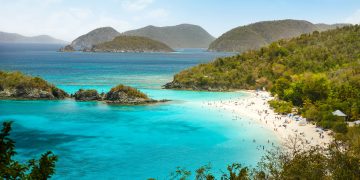
The islands are still physically there. They are still beautiful. The waters are still an unimaginable blue. The beaches still offer beautiful white sand. The waters still offer some of the best sailing on earth. But what made this place special, what made it a sailor’s paradise, has become something more akin to an overcrowded, overpriced amusement park meant to make money for companies. It’s not a place where cruisers are welcome. Not people who live and love a life of true sailing.
We won’t be back. And I’ll never recover that piece of my heart that held BVI with joy and excitement. The BVI I once knew is gone. In this sailor’s heart and mind, a piece of paradise has been lost.
Best,
Desiree Edgington

Desiree and her husband own and sail on an 89-foot ketch-rigged wooden 1983 Turkish gulet. They bought the boat in France and have sailed from Sète, France, to La Rapita, Spain, before going to Gibraltar, Portugal, The Canaries, Africa, Brazil, French Guiana, Trinidad and finally up the Windwards to arrive in the Leewards. Many miles have been sailed with only the two aboard. All manual except for hydraulic steering and “George” the autopilot when he feels like working. She is capable of running five sails but generally runs four. Captain Bob is a former helicopter pilot, woodworker, truck driver, tinker, tailor and candlestick maker with 54 years of sailing experience. Des is a converted sailor, having never stepped foot on a boat until meeting Bob. Most recently, they raced in the Antigua Classic Yacht Regatta and won their class.