

ADVERTISEMENT
Caribbean Compass
  • Home
  • Cruising
  • Destinations
    • Anguilla
    • Antigua & Barbuda
      • Barbuda
    • Bahamas
    • Barbados
    • British Virgin Islands
      • Anagada
      • Jost Van Dyke
      • Norman Island
      • Virgin Gorda
    • Colombia
      • Santa Marta
    • Dominica
    • Dominican Republic
    • Grenada
      • Carriacou
    • Puerto Rico
    • St. Barts
    • St. Lucia
    • Sint Maarten & St. Martin
    • St. Vincent & Grenadines
      • Bequia
      • Canouan
      • Mayreau
      • Union Island
    • Trinidad & Tobago
    • U.S. Virgin Islands
      • St. John
      • St. Thomas
      • St. Croix
    • All Other Islands
      • Guadeloupe
      • Martinique
      • Montserrat
      • Nevis
      • Panama
      • St. Kitts
  • Events Calendar
  • Regattas & Rallies
    Antigua Defends Nations Cup Title for Seventh Year as Caribbean Dinghy Championship Marks 30th Edition in Sint Maarten

    Antigua Defends Nations Cup Title for Seventh Year as Caribbean Dinghy Championship Marks 30th Edition in Sint Maarten

    Anegada:  Cow Bones, Shipwrecks & Lobster at Sunset

    The New CSA Majors Trophy – A Grand Finale

    Team TTO Competes in Sint Maarten at the 2026 Caribbean Dinghy Championships

    Team TTO Competes in Sint Maarten at the 2026 Caribbean Dinghy Championships

    Anegada:  Cow Bones, Shipwrecks & Lobster at Sunset

    Registration Opens for the West Indies Regatta Festival 2027

    2026 Caribbean Dinghy Championship Returns to Sint Maarten for 30th Edition

    2026 Caribbean Dinghy Championship Returns to Sint Maarten for 30th Edition

    St. Vincent and the Grenadines Sends Largest-Ever Team to Caribbean Dinghy Championships

    St. Vincent and the Grenadines Sends Largest-Ever Team to Caribbean Dinghy Championships

    Anegada:  Cow Bones, Shipwrecks & Lobster at Sunset

    Salty Dawg Departures Scheduled from Florida, Bermuda

    2026 ARC and ARC+ Fleets Gather in Gran Canaria for Atlantic Crossings to the Caribbean

    2026 ARC and ARC+ Fleets Gather in Gran Canaria for Atlantic Crossings to the Caribbean

    2026 St. Barth Cata Cup Draws 42 Teams for 18th Edition

    2026 St. Barth Cata Cup Draws 42 Teams for 18th Edition

  • JOIN NEWSLETTER!
No Result
View All Result
Caribbean Compass
No Result
View All Result
Home Eco News
An adult French angelfish, elegantly adorned with dark scales edged in bright yellow

An adult French angelfish, elegantly adorned with dark scales edged in bright yellow

More Than Skin Deep: Color and Pattern in Marine Fishes, Part Two 

Caribbean Compass by Caribbean Compass
July 31, 2025
in Eco News, Sea Life
Reading Time: 5 mins read
A A

Story and photos by Darelle Snyman 

In the previous article (Caribbean Compass November 2024, page 24; https://caribbeancompass.com/more-than-skin-deep-color-and-pattern-in-marine-fishes-part-one) we saw how color and pattern variations assist reef fishes to blend in to their surroundings, either to avoid predators or to increase their chances of snaring a tasty meal. Beyond the important function of camouflage, color patterns also serve as a sophisticated communication system that allows species to interact and reproduce.  

Many coral reef fishes view similarly colored or patterned fish as direct competition for food, territory, and reproductive opportunities. Color patterns can help fish establish territories and maintain social hierarchies within a group, thereby reducing direct competition for scarce resources and mates. This could explain why the juveniles of so many reef fishes look significantly different from the adults. In some species this shift in color pattern can be so dramatic that it is easy to regard these juveniles as a different species when first encountering them. It is believed that looking nothing like the adult members of their own kind is a way to help them avoid conflict with territorial adults, allowing them to access resources within the confines of the adults’ range.  

Juvenile French angelfish, with characteristic yellow-edged tail fin

This disparity in color and pattern between adults and juveniles is well established among the icons of reef fishes, the angelfishes and parrotfishes. For the juveniles of the commonly encountered French angelfish (Pomacanthus paru), looking strikingly different from their adult counterparts holds several benefits. Juvenile French angelfish are predominantly black, but catch the eye with their bright yellow vertical stripes. As they age, these stripes gradually disappear, transforming them into the elegant adults with dark scales edged in bright yellow that we so often encounter on the reef. For these adults, this color change signals their readiness to mate. Adult French angelfish mate for life and occupy a large range where they can be fiercely territorial. It thus benefits the young to not look like their aggressive kin to avoid conflict situations. It also helps that the young have a different diet from that of the adults.  

Juvenile French angelfish might not look like the adults of their own kind, but they do show a striking resemblance to the juveniles of the equally common Gray angelfish (Pomacanthus arcualus). The easiest way to tell them apart is to take a look at the tail fin, which is edged in yellow in the case of the juvenile French angelfish, while the edge of the tail fin of the Gray angelfish juvenile seems transparent. The juveniles of both species are in the cleaning business, so their similar look could be a way for them to be recognized by their clients as cleaners, making them less vulnerable to predation during the delicate juvenile stage. It never gets old watching these industrious juveniles hanging around their cleaning stations, giving you that wary sideways stare, often displaying their flank as they turn to give you a second stare, which is probably their way to say get out of here, you are chasing my meal tickets away. 

Bluehead Terminal Wrasse The bold color pattern of the terminal phase of the bluehead wrasse clearly reflects their social status.

Color patterns also play a pivotal role in the intricate dance of mate selection, and many Caribbean fish depend on this visual language to find their perfect mate. Some use it to identify mates of their own kind, crucially important to prevent hybridization with similar looking species. For others bright colors combined with intricate patterns may be an indicator of good health, genetic quality, and dominance, and a female may be more attracted to males that possess these desirable traits.  

A little Caribbean fish whose mating behavior has been well studied is the busy bluehead wrasse (Thallasoma bifasciatum), a species known for their multiple color phases. During the juvenile phase, the body typically has a dark mid-lateral stripe; interestingly, those that associate with reefs are yellow above this stripe while those that live offshore are white, and both are white colored below the stripe. As they age into young or initial phase males and females, the stripe becomes broken up into a series of blotches. The most notable color phase, however, is that of the super males or the terminal phase males. In this phase, they stand out with showy blue heads, yellow-green or blue-green bodies, and white collars flanked with black stripes. This bold color pattern that gives them their common name clearly reflects their social status and distinguishes them from the initial phase or subordinate males. Studies have shown that the terminal males exhibit rapid and frequent changes of body color from bright green to opalescent during courtship. The opalescent color is flashed while courting a female, while green is associated with aggressive chases of other fish getting in their way. During courtship the dominant male stakes out a prominent spawning site from where he courts the females by flashing his courtship colors while displaying a dashing motion. Studies have shown that female bluehead wrasse actively select males with larger and brighter white bands, a feature associated with more dominant males. A female receptive to the males advances will join him in a dash for the surface where they release their gametes. 

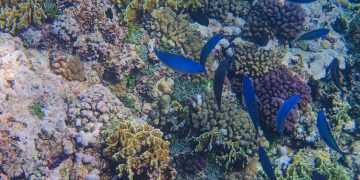
School of Caribbean Blue Tang- School The blue tang often attract attention as they move across the reef foraging together in large groups.

Another common Caribbean resident that relies on color to indicate their readiness to spawn is the beautiful blue tang (Acanthurus coeruleus). These fish often attract attention as they move across the reef foraging together in large groups. At first glance it is easy to confuse them with their close relative the doctorfish (Acanthurus chirurgus). As members of the Acanthuridae or surgeonfish family, both species bear the sharp, scalpel-like spines at the base of their tails. In the case of the Caribbean blue tang the spines are yellow, while those of the doctorfish are edged in blue.  

When ready to spawn, the Caribbean blue tang can gather in aggregations of over 100 fish. They usually choose sandy areas between reefs, and before mating the uniform deep blue color of the male changes to a pale blue on the front half of its body and a dark blue on the rear half to attract females. The female may reciprocate with her own color change by becoming lighter blue. During this mass spawning a number of males and females may break off from the group and release their gametes into the water, this is called a spawning rush. The two-toned color change is more noticeable among males actively courting females during the spawning rush. Studies have shown that color changes continue to play a role in maintaining the relationship once a pair bond has been formed. The fact that pairs often display synchronized color changes is suggestive of the role visual cues play to help strengthen the bond between mates. 

This article just gives a small glimpse into the wonderful use of color patterns by many reef fish to seamlessly blend into their surroundings, exhibit dazzling displays to attract mates, and intimidate rivals. By understanding the role of color in these fish’s social behaviors, we can gain a deeper appreciation for these fascinating reef residents. 
Previous Post

Climate Awareness in the Caribbean: A Growing Call to Action  

Next Post

How Hot is the Water in the Caribbean? 

Recommended For You

Caribbean Represented at Coral Reef Symposium

by Caribbean Compass
October 25, 2026
0
Caribbean Represented at Coral Reef Symposium

Twenty-three researchers and students from the University of the Virgin Islands Center for Marine and Environmental Studies delivered 26 presentations at the 16th International Coral Reef Symposium in...

Read moreDetails

A Record Year for Coral Restoration in Antigua & Barbuda

by Caribbean Compass
October 25, 2026
0
A Record Year for Coral Restoration in Antigua & Barbuda

AnuBlue has marked its most successful year of coral restoration since its establishment in 2021, planting more than 5,800 nursery-grown corals across reefs around Antigua. This represents approximately...

Read moreDetails

AnuBlue Marks Record Year for Coral Restoration in Antigua & Barbuda

by Caribbean Compass
September 27, 2026
0
AnuBlue Marks Record Year for Coral Restoration in Antigua & Barbuda

ANTIGUA & BARBUDA — AnuBlue has marked its most successful year of coral restoration since its establishment in 2021, planting more than 5,800 nursery-grown corals across reefs around...

Read moreDetails

Eco Focus: Two-and-a-half centuries of rainforest protection in Tobago

by Caribbean Compass
September 26, 2026
0
Eco Focus: Two-and-a-half centuries of rainforest protection in Tobago

By Janine Mendes-Franco Editor’s note: This story is part of Global Voices 2026 Spotlight series, “Global Crisis, Local Solutions,” which offers stories of resistance and successful climate action,...

Read moreDetails

Ripples to Waves Needs Whale Watchers

by Caribbean Compass
September 26, 2026
0
Environmental Reporting Gains Recognition

Ripples to Waves, a Vincentian nonprofit, is calling on whale- and dolphin-watchers to be a part of its research team. The organization is inviting all ocean users to...

Read moreDetails
Next Post
How Hot is the Water in the Caribbean? 

How Hot is the Water in the Caribbean? 

How to Advertise in Caribbean Compass

Compass Marketing Services

How To Submit an Article

About Us

Issue Archive

Newsletter Archive

Where to Find Compass in Print

Article Archive

Privacy Policy

Categories

  • Airlines
  • Beach Bars
  • Beaches
  • Book Reviews
  • Business
  • Carnivals
  • Cruising
  • Destinations
  • Diving
  • Eco News
  • Events
  • Geography
  • History
  • Hotels
  • Hurricanes
  • Island Spotlight
  • Magazine
  • Marinas & Boatyards
  • Navigation
  • News
  • On Shore
  • Reader's Forum
  • Recipes
  • Regattas & Rallies
  • Resorts
  • Restaurants
  • Rum
  • Sea Life
  • Tributes
  • Uncategorized
  • Weather
  • Wildlife
  • Yacht Charter
  • Yacht Services
Join Our Newsletter

Caribbean Marine Weather Resources

Caribbean Events Calendar

Reader's Forum

Center of Effort - Letter from the Editor

RECENT POSTS

  • Immigration And Maritime Services, Temporarily Relocated To Ferry Dock At Pjia During Simpson Bay Dock Refurbishment  November 1, 2026
  • Guadeloupe Announces Anchoring Restriction at Carénage November 1, 2026
  • Trapped Carriacou Boats Launched November 1, 2026
  • Caribbean Compass – November 2026 October 27, 2026
  • Antigua Defends Nations Cup Title for Seventh Year as Caribbean Dinghy Championship Marks 30th Edition in Sint Maarten October 26, 2026

© 2026 Caribbean Compass

No Result
View All Result
  • Home
  • Cruising
  • Destinations
    • Anguilla
    • Antigua & Barbuda
      • Barbuda
    • Bahamas
    • Barbados
    • British Virgin Islands
      • Anagada
      • Jost Van Dyke
      • Norman Island
      • Virgin Gorda
    • Colombia
      • Santa Marta
    • Dominica
    • Dominican Republic
    • Grenada
      • Carriacou
    • Puerto Rico
    • St. Barts
    • St. Lucia
    • Sint Maarten & St. Martin
    • St. Vincent & Grenadines
      • Bequia
      • Canouan
      • Mayreau
      • Union Island
    • Trinidad & Tobago
    • U.S. Virgin Islands
      • St. John
      • St. Thomas
      • St. Croix
    • All Other Islands
      • Guadeloupe
      • Martinique
      • Montserrat
      • Nevis
      • Panama
      • St. Kitts
  • Events Calendar
  • Regattas & Rallies
  • JOIN NEWSLETTER!

© 2026 Caribbean Compass