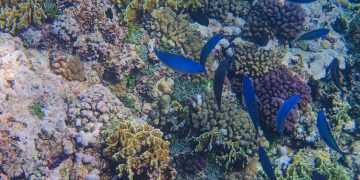





AnuBlue has marked its most successful year of coral restoration since its establishment in 2021, planting more than 5,800 nursery-grown corals across reefs around Antigua. This represents approximately 2.3 acres of restored reef — equivalent to nearly two American football fields.
With an 84 percent survival rate recorded among planted corals at restoration sites, the milestone reflects not only the growing scale of AnuBlue’s work, but the continued success of its approach to rebuilding coral populations.
As wild coral populations decline worldwide, active restoration has become an increasingly important strategy for preserving existing populations and rebuilding degraded reefs. By growing and planting thousands of corals, AnuBlue is helping give Antigua and Barbuda’s reefs a stronger future.
AnuBlue operates Antigua and Barbuda’s largest active coral restoration program, with four coral nurseries and five restoration sites across Cades Reef and the North East Marine Management Area (NEMMA), two important reef areas for marine life and coastal communities. The people behind the program are as varied as the reefs themselves, bringing together marine scientists, fishermen, divers and volunteers, all sharing a commitment to seeing Antigua’s coastline thrive.
But successful restoration is about more than the number of corals planted. AnuBlue’s restoration program is built around both resilience and diversity, selecting fragments from parent colonies that are already showing an ability to withstand pressures such as rising ocean temperatures and disease.
A combination of resilient genetics and a diversity of coral species makes it possible for AnuBlue to build healthier, stronger reefs better equipped for the future.
Visit www.anublue.org for more information; click the link for the group’s 2025-2026 report (bit.ly/3TfAN9E)