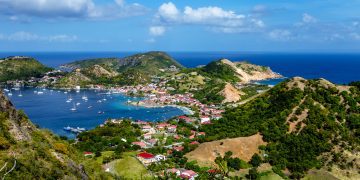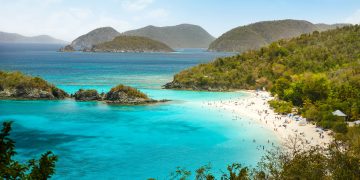





- By Simon Scott, photos courtesy Cruising Guide Publications
The United States Virgin Islands sit atop a curving arc of islands that stretch from the Florida Keys south to Trinidad off the north coast of South America, dividing the tropical waters of the Caribbean Sea from the Atlantic Ocean. Situated 40 miles east of Puerto Rico, they form the first link in a chain of islands known as the Leeward Islands that extend south to Dominica, where they meet the Windward Islands stretching from Martinique to Grenada. The island group comprises the main islands of St. Thomas, St. John and St. Croix along with numerous islets and keys that form, along with the British Virgin Islands to the east, the cruising area collectively referred to as the Virgin Islands.
Purchased by the United States from Denmark in 1917 toward the end of WW1 for the sum of $25 million to protect the strategic Panama Canal shipping routes, these islands have a rich history and have operated under both British, French, Spanish, Dutch and Danish administrations.


Discovered by Columbus on his second voyage in 1493 and claimed for the Spanish Crown, the islands languished for nearly one hundred years. During the seventeenth century, the islands became the home to both pirates and privateers like Blackbeard and Drake, where the quiet coves and hidden anchorages, now a haven for sailors from around the world, provided a unique location from which to lie in wait for Spanish galleons laden with gold mined in Santo Domingo (Hispaniola) and bound for Europe.
All three islands became a Danish Crown colony in 1755; St. Thomas was declared a free port shortly thereafter. As St. Thomas emerged as a major shipping center and distribution point for the entire West Indies, Charlotte Amalie flourished commercially, and a large portion of the West Indies trade was channeled through its harbor. The atmosphere on St. Thomas at the time was cosmopolitan, particularly in comparison to its sister island of St. Croix 40 miles to the south, where plantation life was thriving. Its typography supported over 375 plantations at its peak, perhaps the largest production of sugar cane in the Caribbean region.
Getting there and getting around
Direct air access is well represented by major airlines from the US mainland via many gateway cities. Travel from Europe, on the other hand, is a little more challenging and usually via Puerto Rico, St. Martin or the US mainland.
US citizens do not require a passport, but one is required for additional travel to the adjacent British Virgin Islands. Ferry service between St. Thomas and St. Croix is about 2-1/2 hours, between St. Thomas and St. John, 20 mins on a regular schedule between Red Hook, on the eastern end of St. Thomas, and Cruz Bay, St. John.


Visitors from Europe will need to apply for a visa in advance. Cruisers making their way up the island chain and planning to include the USVI in their itinerary may apply for an ESTA (Electronic System for Travel Authorization) that determines eligibility to travel to the US under the Visa Waiver Program (VWP); however, admissibility is ultimately determined by the receiving Customs and Border Protection officer upon arrival, which is required to be completed via commercial carrier (see link below for details).
The cruising area of the USVI is usually covered in a figure eight, starting in Charlotte Amalie harbor, then heading east along the south coast to St. John and the home of the VI National Park. There are numerous anchorages (mooring use only) within the park, which extends up the northwest coast and around the eastern end of the island to the south coast bays. This itinerary will then take you back to St. Thomas via the north coast and a visit to Magens Bay, a beautiful deep protected bay, before rounding the western tip of the island and making your way back to Charlotte Amalie.
From a cruiser’s perspective, perhaps one of the greatest assets of the area would be the associated anchorages of the VI National Park, which covers nearly two thirds of the island of St. John. These pristine bays are carefully managed to protect them from abuse; strict use guidelines are in force. There is no charge to enter the park; however, there are only two designated anchoring areas — all other destination anchorages within the park are by mooring only for approximately $26 a night. For those 65 and older, a permit is available from the parks center which reduces the fee by 50 percent. Within the park at Leinster Bay are the ruins of the Annaberg Plantation, open daily and offering a brief insight into the island’s history during the plantation era.
St. Croix lies in splendid isolation to the south, surrounded by the largest barrier reef system in the Caribbean. Rich in history and natural beauty, St. Croix remains far less crowded than the other US Virgins. Because of the distance between islands, St. Croix is not generally acknowledged as part of a charter itinerary, but cruisers with some time on their hands can enjoy the beautiful historic town of Christiansted, visit the Buck Island National Park, or enjoy some spectacular diving. Marine service facilities are available from St. Croix Marine in Christiansted and Green Cay Marina, just south of the Buck Island National Park, an ideal location providing a perfect sheltered spot to find dockage or storage.
In a cooperative effort between VIPCA (Virgin Island Professional Charter Association) and the USVI Department of Natural Resources, mooring balls have been installed at strategic locations throughout the territory to preserve the seabed and facilitate management of the marine environment. General marine services are well supported around St. Thomas with several marinas, haul-out facilities, chandleries, machine shops, rigging services, and sailmakers. Provisioning is readily available on all the larger islands, with charter yachts available from a number of companies operating from Charlotte Amalie, Compass Point Marina, or Red Hook at the eastern end of the island.
For more information on the Virgin Islands and the sailing areas of the Caribbean, pick up a copy of the latest 2025 edition of the Cruising Guide series or download the free Cruising Guide app on Apple or Google. www.cruisingguides.com
Useful links:
US Customs & Border Protection
Virgin Island Professional Charter Association
US Virgin Islands Entry and Exit Procedures from Noonsite
Ports of Entry:
There is one port of entry on each of the three main islands: Charlotte Amalie, St. Thomas; Cruz Bay, St. John; and Christiansted, St. Croix.
Advance Paperwork:
All nationalities, other than citizens of the US, Canada or Bermuda, arriving by private yacht need a valid US visa or visa waiver entry already in their passport. See Immigration Details on Noonsite for additional information.
Entry Process:
Easy clearance via the CBP ROAM App (Reporting Offsite Arrival Mobile), where users fill in vessel and crew information, declare arrival and answer clearance questions. CBP may request a video interview (via the App), an in-person report to a port of entry, or no further action will be required.
Exit Process:
CBP in Puerto Rico/Spanish Virgin Islands and the US do not request exit clearance papers from the USVI. A visit to the authorities is needed if your next port requires an exit zarpe.
Rates:
There are no entry or exit fees for vessels.
This information is provided by Noonsite.com, specialists in worldwide formalities for yachts, and was accurate at press time. Check Noonsite for more information and updates.