




Story and photos by Danii Mcletchie
Carnival is one of the Caribbean’s most important cultural traditions. Every year, hundreds of thousands of people participate in parades and celebrations wearing elaborate costumes made from feathers, beads, wire, and fabric. While these costumes are central to the Carnival experience, many are worn for only a single day before being put into storage or thrown away. This creates a significant but often overlooked waste challenge. Or … an opportunity?
While developing a business plan for a sustainability-focused venture with my co-founder, Luke Harris, I found my thoughts drifting to Carnival. I describe the idea as one I believes was placed on my heart by Jesus. As I reflected on my own years of participation, I wondered: Where did all of my costumes go?
The answer surprised me. Despite years of playing mas, I did not have a single costume left. That realization sparked a larger question. If I no longer had any of my costumes, what was happening to the thousands of others worn each year across the Caribbean? As I began exploring the issue, I saw an opportunity to address a growing waste challenge while creating value from materials that were often discarded after a single use.


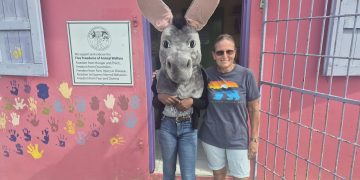
That moment — in a small house in Tobago, not in a corporate boardroom — became the foundation for what would eventually become Carnicycle.
Founded by myself and Harris, Carnicycle is a Caribbean social enterprise focused on making Carnival sustainable. The organization works to recover, reuse, and redistribute materials that might otherwise become waste.
What started as a small idea has since grown into a regional effort. Over the past several years, Carnicycle has recovered more than 10,000 pieces from Carnival costumes across Trinidad and Tobago, Jamaica, Bermuda, Grenada, Barbados, Miami, and other Carnival destinations.

The process begins after the music stops. Costumes that would normally be discarded are collected and sorted. Feathers, decorative pieces, and structural components are separated and assessed for reuse. Some materials are sold back into the Carnival industry, while others find their way into community projects, workshops, and creative reuse initiatives.
The work has challenged assumptions about what waste actually is.
Many people view a used Carnival costume as something that has reached the end of its life. Carnicycle sees it differently. A feather can be reused in another costume. Decorative elements can be incorporated into fashion pieces or art projects. Each individual costume component can often be given a second life when placed in the hands of the right creator.

Education has become a major part of that effort. Through workshops and community events, participants learn how to deconstruct costumes and identify materials that can be reused. The goal is not simply to keep items out of landfill, but to help people rethink how they view resources. A costume that appears to have no value may still contain materials with economic or creative potential.
Our organization has also worked with hotels, event organizers, mas bands, and cultural institutions to make costume recovery more accessible. Collection points placed at strategic locations help intercept costumes before they enter the waste stream, allowing more materials to remain in circulation.
As the organization evolved, it became clear that sustainability alone would not be enough. Any long-term solution would also need to make economic sense.
This led Carnicycle to explore additional circular business models, including a backpack rental program that lets visitors rent rather than purchase the elaborate feathered and beaded frameworks worn by carnival masqueraders. The program provides a lower cost option for travelers while extending the useful life of costumes that might otherwise be used only once.

Recovered materials are also sold through Carnicycle’s resale marketplace, creating an affordable source of supplies for designers and makers. In a region where many creative businesses face high material costs, keeping resources in circulation offers both environmental and economic benefits.
Today, Carnicycle’s work extends beyond material recovery. The organization advises businesses, event organizers, and cultural stakeholders on sustainable event practices, waste reduction, and circular economy strategies. It has become part of a broader conversation about how cultural industries can reduce waste without losing the creativity and identity that make them unique.
Looking ahead, Carnicycle hopes to expand its network of recovery partners across the Caribbean and throughout the Carnival diaspora. The long-term vision is not simply to collect more costumes. It is to help build a system where materials remain in use, waste is reduced, and sustainability becomes a natural part of the Carnival experience.
Carnival has always been built on creativity. Carnicycle is showing that the same creativity used to design a costume can also be used to rethink what happens after the celebration ends.
For more details visit the Carnicycle website at www.carnicycle.com