




Story and photos by Paul Weston
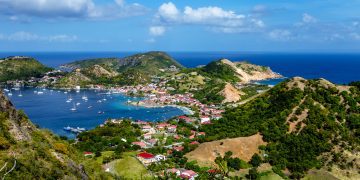
Anse à la Barque is a small bay on the western coast of Guadeloupe, about twelve miles north of the Island’s southern tip. From the sea it is almost invisible, and is not much frequented by cruising yachtsmen, who tend to crowd into the roadstead of Deshaies in the north of the island.
The few yachtsmen and women who do venture into Anse à la Barque are rewarded by the experience of a sheltered, though tight, anchorage, whose peace is only disturbed by traffic on the fringing main road.
The presence of a pair of lighthouses, however, hints at a more important past, as does the name of the northern headland, Pointe Batterie, but boat crews sipping their sundowners, or tourists who stop their rental cars at the viewpoint overlooking the Anse, probably have little inkling that the bay has been the scene of almost unimaginable violence, as it was on the December 17-18, 1809.

My interest in Anse à la Barque’s past started when we anchored our 40-foot sailboat, Kadash, there recently. Despite the absence of other cruisers, there were several moored local boats, and it took us three or four tries before we found a spot with reasonable depth and sufficient swinging room. We tied the dinghy to what seemed to be the remains of a substantial wharf at the head of the bay and walked to the lighthouse on Pointe Batterie. Near the lighthouse we saw a memorial, a poignant reminder that on November 17, 1972, a bus travelling between Point-a-Pitre and Basse Terre left the road at Pointe Batterie and plunged over the cliff, killing all nineteen people aboard.
Further seaward, we noticed the remains of a rampart on which rested the muzzles of cannons, clearly French. In the undergrowth nearby were several more guns, and to my astonishment, some of these were broken, the castings ruptured near the trunnions.

Broken cannons? I had never seen such a thing before, and I could only guess at what had happened. Perhaps an unseen weakness in the castings had disastrously revealed itself when the guns were fired in anger, or possibly they had been struck by enemy cannonballs. Though some of them were spiked, perhaps a victorious force had thought that this had insufficiently disabled them and had deliberately destroyed them by stopping their bores and firing them with a heavy charge.
It seemed to me that a battle had been fought in this unlikely place, but over what, and why?
The answer seemed to be that it was part of what was, until about 1914, known as the Great War, between France and Britain and her allies, for mastery of Europe, and that Anse à la Barque had been the location of a battle which decided the possession of Guadeloupe.
In 1809 the French island, under the governorship of Jean Augustin Ernouf, was in a desperate position. Years of brutal struggle between former slaves and the French had left it impoverished. Martinique had been taken by the British in the previous year, and Guadeloupe was surrounded by the Royal Navy. French ships bringing flour from France were cut off from “The Hayes,” as the British called Deshaies, or captured at sea. Supplies were running out, and French morale was low.
A squadron of four frigates was sent from France under Dominique Roquebert, two fully armed, and two armed en flûte — carrying cargo with reduced armament. On December 13, 1805, about 300 miles east of Guadeloupe, these ships were discovered by Junon, a British frigate, which later in the day was defeated by the coordinated efforts of the four French ships. The presence of the French ships was reported to Captain Volant Vashon Ballard of HMS Blonde who was watching Basse Terre, the main French base in the south of Guadeloupe, by Junon’s companion ship, a brig aptly named Observateur. The fully armed French frigates returned to Brest, leaving the two flûtes, Seine and Loire, to continue unescorted.
Blonde, with a squadron of ships including another frigate, Thetis, and smaller vessels Hazard, Cygnet, Scorpion and Ringdove, kept watch and on December 17 spotted Seine and Loire. Blocked from entering Basse Terre, and with the British in pursuit, the two flûtes entered Anse à la Barque at 10 a.m. I do not believe that the wharf was there in 1809. I suspect it was built subsequently to berth steamers, and the two flûteswere moored fore and aft with their broadsides facing the entrance to the Anse.

How Seine and Loire’s commanders, lieutenants de vaisseau Joseph Normand-Kergre and Bernard Vincent, managed to work their more than 150-foot-long ships, under sail in the often light and flukey winds of the lee side of Guadeloupe, into the narrow confines of Anse à la Barque is frankly a mystery to me. We found it difficult enough to anchor there in our 40-footer, equipped with a powerful iron topsail.
I can only imagine how the commanders felt. Let down by the departure of their escorting frigates and demoralized by the blockade of Basse Terre and their pursuit by the British squadron? Perhaps they were relieved to get into Anse à la Barque, and felt safely protected by the guns emplaced at its low headlands, and the knowledge that their flûteswere not defenseless— they had fought effectively in the action with Junon. Loire had closely engaged the British ship, running her bowsprit over the frigate’s quarter and clearing her decks with murderous small arms fire.
They had not long to wait, and could not have discharged much of their cargo before Vashon Ballard’s squadron arrived in the afternoon, bringing death and destruction to Anse à la Barque. HMS Ringdove, becalmed close inshore, was bombarded and damaged by the shore battery on the southern headland. At three o’clock her commander, Captain Dowers, responded in an unexpected fashion. He took a landing party ashore, which captured the battery, spiked its guns and destroyed the works. Without suffering any casualties, he was back aboard Ringdove by four.
In the evening, the schooner Elizabeth was sent into the Anse to sound for an anchorage, followed by Blonde, which provided cover, exchanging fire with the remaining battery. The British were joined by another frigate, Freija, and in the morning of December 18, 1809, by the 74-gun Sceptre, whose commander, Samuel Ballard, took command of the force.
In the afternoon Blonde, followed by Thetis, worked her way into the Anse, probably relying on the sea breeze which sometimes develops there in the afternoon. The intention was that these two ships would lay themselves alongside the flûtes, while Sceptre and Freija engaged the batteries and the smaller ships towed boats inshore ready for landing. The winds were light, however, and Blonde was becalmed at the entrance to the Anse, about 400 yards from the flûtes, and anchored “within half a pistol shot” of the battery, according to the account in Volume 5 of William James’s The Naval History of Great Britain. This seems hardly credible to me, as half a pistol shot — say between 25 and 50 yards — would put the ship firmly on the rocks, and probably unable to elevate her guns sufficiently to bear on the fort. At about 3:35 one flûtewas dismasted and surrendered, and at 4:20 the other French ship struck her colours. Blonde and Thetis left the Anse, escaping from the heavy fire of the fort. One flûte exploded — possibly as a result of having one of her own cannons fired through the bottom of the ship — and the other one, hit by burning debris, also caught fire and later exploded.

The northern battery, its evocative remains with broken guns visible today, was stormed by a party which was landed from the boats, and captured after fierce fighting.
In all, the British had lost nine men killed and 22 wounded. They had destroyed two flûtes laden with important supplies, further lowering French morale. Several other attempts to resupply the island failed, and when General George Beckwith landed with 7,000 men a few weeks later, the French garrison deserted en masse, and Governor Enouf surrendered Guadeloupe on January 6, 1810.
Was it worth it? The British gained Guadeloupe, but they did not seem to value their possession very highly. It was handed to the Swedish in 1813, and in 1814 the Island returned to French rule. It seems to me that fighting between the French and British in the West Indies was not really about the islands themselves, but was part of the larger struggle for Europe. the West Indies were really only a stage on which part of this war took place. Already British commanders were questioning the demands of planters to defend colonies whose economic benefits were declining, and over their protests, formed the West Indian regiments so that British troops could be spared for more important duties in healthier climates.
I set my novels in places I have visited by sea, and I used Anse à la Barque as a backdrop for some of the action in my upcoming book, Diamond Rock.

Paul Weston is the author of four books of naval historical fiction. Informed by his experience as a merchant seaman and yachtsman, Weston’s books are historically and geographically accurate, with fast moving, plausible plots. His fifth book, Diamond Rock, will be available in September 2025. www.paulwestonauthor.com