



Story and photos by Lexi Fisher & Chris Doyle
Montserrat is part of the Northern Leewards and sits between Antigua and Guadeloupe. It is also just west of both, making an easy downwind passage fromeither. Despite this, not many sailors visit, in part because the only main anchorage, Little Bay, is small and often rolly when strong north westerly tradewinds push swells around the corner. This can also make getting a shore impossible, but in calm conditions this island is one of the most unique in the region.

Montserrat’s first European settlers were Irish,who arrived from St. Kitts in 1630, having experienced problems with the Kittitian Protestants. A second wave of Irish settlers arrived in 1649, after Cromwell conquered Ireland. They beganas small farmers growing mixed crops, but the economy of the island slowly changed. Sugar became the main crop, enslaved people were introduced, andover the years the smaller farms became uneconomical. Many of the Irish returned to their homeland. They left behind smiling eyes, Irish names such as O’Brian, Dublin, and Ryan, and an Irish stew now called “goat water.” Today, Montserrat is known as the other Emerald Isle.
In 1995, the population was around 11,000 people who farmed, fished, and were employed in the tourist industry. Many Americans and Canadians bought homes here to escape the northern winters. Then, unexpectedly, the Soufrière Hills volcano erupted in 1995, and major eruptions in 1997 led to the evacuation and eventual destruction of the capital, Plymouth. Living and business conditions became very harsh, with volcanic dust polluting the air nearly every day. There followed an exodus of nearly two-thirds of the population, and those who did not have homes in the north had to resettle in the safe zone. The current population is around 5,000.

In the summer of 2003, the huge volcanic dome collapsed and the volcano showed every sign of going to sleep. This led to the reopening of many areas. The government removed the ash, some of it several feet thick, from many roads. People started repairing their damaged houses. You could go very close to Plymouth and up the hills behind it for dramatic views of the path of destructionand the ruined town. Then, early in 2006, there was another spurt of dome growth, lots of activity, and several major eruptions, including one of the biggest ever on February 11, 2010. The exclusion zone was moved back up from Bransby Point to Old Road Bluff. The Vue Point Hotel, having been completely renovated and booked solid for the season, was evacuated. It is not easy living with a volcano. The volcano is still smoking after all these years, but it has been quieter and you can now get very close for an excellent view of the buried city.
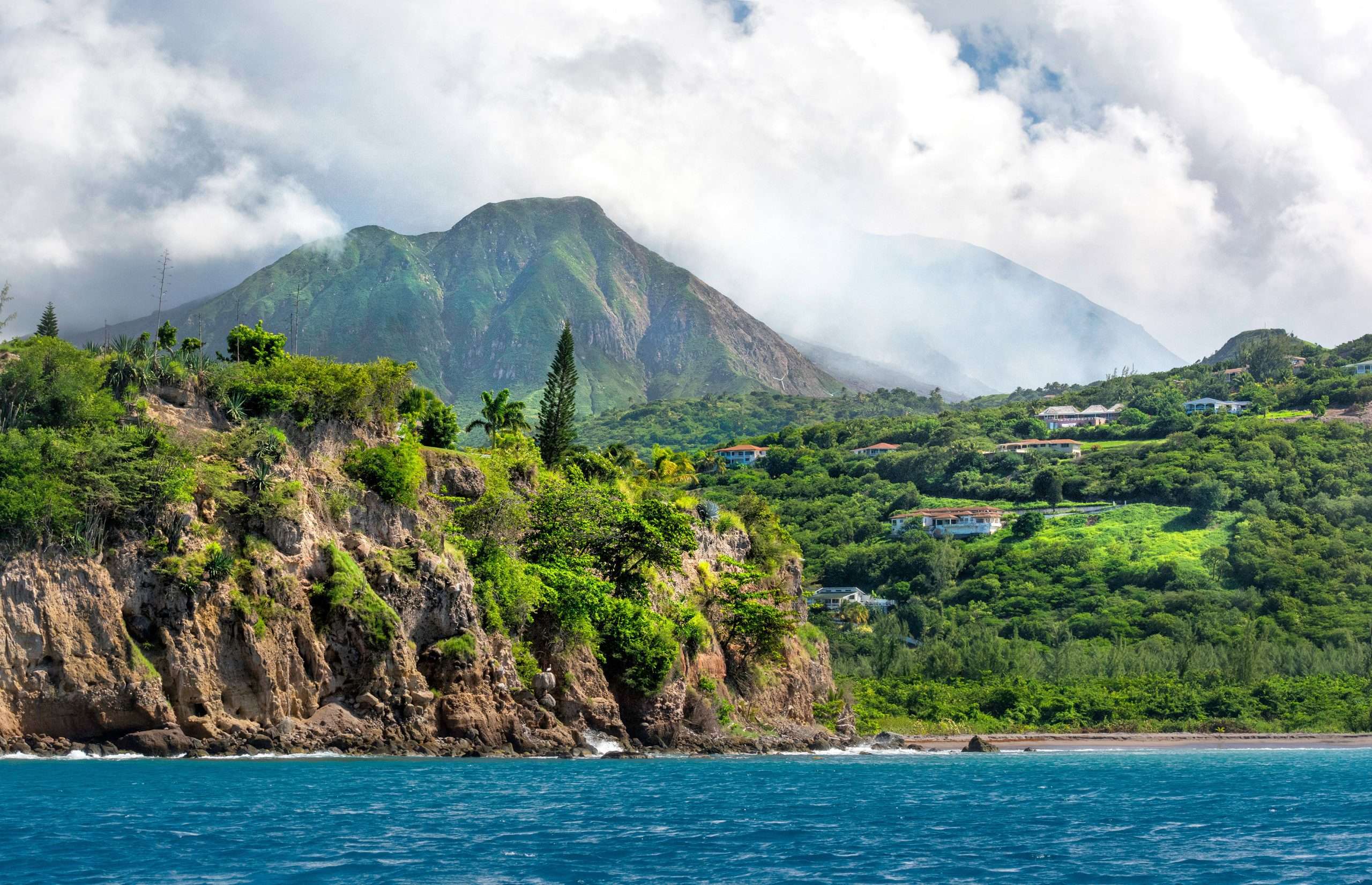
Today, as you sail past Montserrat, it is like two different lands. The southern half is starkly beautiful, a harsh terrain dominated by the awesome Soufrière Hills volcano, barren and smoking against the skyline. The remains of the ruined capital, Plymouth, are a humbling reminder of nature’s power over years of human endeavor. On the southeastern coast, you can see historic windmill towers and buildings buried to their roofs in volcanic ash and mud. Boulders the size of large houses spewed out by the volcano lie miles below the summit. By contrast, the island’s north is lush and green, with verdant mountains and handsome modern houses perched on the hills.
What you cannot gauge from the sea is the extent and beauty of the northern part of Montserrat. Most of the habitations follow the road that runs from Little Bay in the north, along the west coast to Salem in the south. This area is protected from the volcano by the Center Hills mountain range, and what you see is an island of almost picture-book perfection. On one side, lush dark green mountains are steep and convoluted. On the other, the land falls away to the coast, offering a perfect panorama of the Caribbean Sea, with views of the islands of Redonda and Nevis to the west. At nearly every turn, coconut palms or brightly colored flowers provide the perfect frame for a photograph. Houses are typically modern-day Caribbean, which means they can be small, brightly painted wooden houses, shaded by dark green bread fruit trees, whitewashed bungalows, or fancy modern mansions.

The tone of the island is quiet and rural. There are hills with cows and goats and few enough cars that you don’t feel threatened as you walk along the roads. The mood is generally upbeat and very friendly. Most Montserratians living on the island today are delighted to be there, not in some London tenement. The outlook is to the future: to bring in more tourists, to bring back Montserratians who fled, and to create more jobs.
Just as the volcano in the south testifies to the power of nature, the northern end testifies to humans’ ability to adapt and thrive in the face of adversity.
Navigation
Visit the Montserrat Volcano Observatory website at www.mvo.ms (or phone 664-491-5647). Both land and maritime exclusion zones remain in effect, thoughthey are now quite small. You can, at your own risk, sail through the maritime exclusion zone without stopping. I mark these approximately on the sketch chart. They are about one nautical mile off the south coast and two nautical miles off the east coast. If the volcano starts spewing dust your yacht may be subject to falling ash, which is messy.
Doyle Guides contain the Eastern Caribbean’s most comprehensive and reliable sailing information, available in hard copy and online through a free mobile app ,website, and Facebook group. (www.doyleguides.com)

Montserrat Entry and Exit Procedures
Ports of Entry:
There is one port of entry, which is Little Bay.https://www.noonsite.com/place/montserrat/little-bay/
Advance Paperwork:
All visiting yachts should pre-register with SailClear prior to arrival.http://www.sailclear.com/ For visitors from many countries ,a visa is not required.
Entry Process:
All yachts clear in with Customs, Immigration, and the Port Authority in Little Bay. All crew should go ashore for Immigration formalities.
Exit Process: Stays of up to 72 hours can check-in and out at the same time.
For longer stays, the skipper checks out with Customs and the Port Authority.
Rates:
Most cruising yachts can expect fees of EC$110. There is no charge for Customs and Immigration during normal weekday business hours. The Port Authority charges fees based on gross tonnage. Check Noonsite for more detailed information and updates. This information is provided by http://noonsite.com/, specialists in worldwide formalities for yachts, and was accurate at the time of going to press.