




Story and photos by Lexi Fisher & Chris Doyle
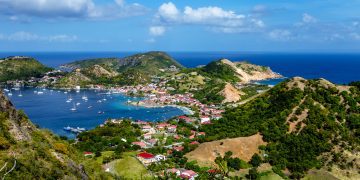
Dominica sits almost exactly in the middle of the Eastern Caribbean chain, between the French territories of Guadeloupe and Martinique. Known as the Nature Isle, its 300 square miles are differentiated from the rest of the island chain by its steep, mountainous terrain, abundance of waterfalls, active volcanic vents, and rocky coastline.
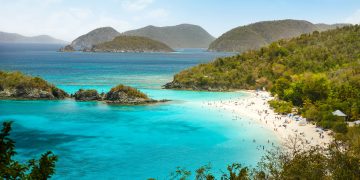
While it may not have the sweeping white-sand beaches typical of the Caribbean, it is the region’s most unspoiled country, its most exciting destination for spectacular natural beauty, and likely the only island Christopher Columbus might have recognized if he had come back to today. When he was before King Ferdinand and Queen Isabella of Spain, trying to describe the awe-inspiring mountains of Dominica, he had to resort to crumpling up a sheet of paper to illustrate the dramatic form of the land, with its valleys, gorges, and pinnacles.
That gives an idea of its topography but tells nothing of its amazingly lush vegetation. Greenery erupts everywhere, thrusting upwards, curling, stretching, climbing, and falling until the whole land is covered in a verdant tangle of trees, vines, shrubs, and ferns. Add to this a plethora of birds, butterflies, and brightly colored flowers, and you can begin to imagine its almost magical nature.
In addition, there are such unusual natural phenomena as a boiling lake and hot waterfalls, to say nothing of the more usual sulfur springs and crater lakes. The high mountains attract clouds, creating frequent showers interspersed with sunshine, and as a result, the island is known as the land of many rivers. It could equally be known as the land of many rainbows. You are sure to see some and, around the full moon, you might see a moonbow. Dominica has some lovely beaches, but not in the profusion of the islands to the north and south, so tourism is low-key.
Dominica has about 73,000 inhabitants who are naturally curious about outsiders and enjoy meeting visitors. Nature lovers and free spirits will likely rate this majestic land their favorite. Some of the island can be seen from the boat, but the best times are found walking inland. Light rain gear is advisable. We will outline some attractions under the nearest anchorages. If you only stop at one anchorage, you can reach most of them by road, but anchoring at both Portsmouth and Roseau will allow you to see more.


It should be noted that many of Dominica’s hikes, including the one to Trafalgar Falls, may be over slippery and muddy terrain and should only be undertaken by those who are reasonably agile and fit. It is best to take your camera in a waterproof bag. The Dominica Forestry Department has laid many hiking trails in the island’s national parks. They have done an amazing job; some sections include miles of log walkways. The Waitukubuli trail runs the full length of Dominica, and it has 14 segments, most of which take 6-7 hours to hike. You can hike any of them with a guide or on your own. We give a link for downloading maps and details on the Dominica page of www.doyleguides.com.
You can buy trail maps from the Forestry Department in the botanical gardens in Roseau. There are charges for visiting park sites and tickets can be bought by the visit ($5 US single site), or all sites by the week ($12 US). All the money goes toward park maintenance. The Waitukubuli trail has a separate charge, $12 US for a day, or $40 US for 15 days. In Portsmouth tickets may be purchased in the parks office at the mouth of the Indian River.
Just about all of Dominica is spectacular, and there are a number of lovely hikes on small roads and paths that are not part of the park. Dominica has seven potentially active volcanoes (most other Caribbean islands only have one). Eruptions are not expected anytime soon, but this history helps explain the dramatic scenery. An undersea fault to the north of Dominica occasionally shakes Dominica, the Saintes, and Marie Galante.
Navigation
The leeward coast of Dominica is generally steep to. A quarter of a mile offshore will keep you clear of all dangers, from the north down to Scotts Head. If you are closer in than that, watch out for shoals off Toucari, the Layou River, the coast below Morne Daniel, and Anse Bateau. Le Grand Maison is a shoal that extends between one and two hundred yards off the coast just to the north of Soufriere.
As you round Scotts Head, keep clear of The Pinnacle. This rocky peak rises to within a few feet of the surface, about 300 yards west of the northern part of Scotts Head. You can see it when the sun is high and visibility is good, and on calmer days fishermen often anchor there. Give it a wide berth at night or in heavy rain. Other rocks extend underwater from the Scotts Head side, so do not try to pass between Scotts Head and The Pinnacle.
Be prepared for shrieking gusts that seem to come from nowhere off some valleys, especially in the Scotts Head area. These are worst on days when there are no clouds hanging over the mountains. They often have a downward component and have capsized at least one catamaran.
Doyle Guides contain the Eastern Caribbean’s most comprehensive and reliable sailing information, available in hard copy and online through a free mobile app, website, and Facebook group. (www.doyleguides.com).

Dominica Entry and Exit Procedures from Noonsite
Ports of Entry:
The two ports of entry for Dominica are Portsmouth and Roseau.
Advance Paperwork:
All visiting yachts should pre-register with SailClear prior to arrival. For visitors from many countries, a visa is not required. Stays of up to three months are granted on arrival. Up to three days before arrival, crew can submit their landing card information online at https://edcard.dominica.gov.dm/.
Entry Process:
On arrival, the captain should proceed to the nearest customs and immigration offices with a SailClear notification ID number, crew passports, and boat paperwork. A cruising permit is needed to move between anchorages.
Exit Process:
Same as the entry process. For stays of less than two weeks, clearing in and out at the same time is possible.
Rates:
There are minimal clearance fees during working hours (approx. XCD$5 per person). Clearance outside normal working hours will incur overtime fees.
Check Noonsite for more detailed information and updates. This information is provided by Noonsite.com, specialists in worldwide formalities for yachts, and was accurate at press time.