




Story and photos by Darelle Snyman
Mangroves might seem an unlikely choice for a snorkeling outing, especially when compared to the vibrancy and color of coral reefs. But recent explorations of the mangrove edges that hug the coastline of Isla Colon, Bocas del Toro, Panama, have renewed my interest in discovering the life hidden within these often undervalued ecosystems. Below the green canopy, among the tangled web of roots, there is a complex and vital ecosystem teeming with life. These hardy trees, adapted to thrive in the salty coastal environment, form a vital link between land and sea, acting as a haven for both terrestrial and marine life. Mangrove forests, like seagrass beds, are the silent guardians of their coral reef neighbors, and their well-being is intricately linked to the health of coral reefs.
Caribbean mangrove communities are dominated by three key species and most will be familiar to you, especially the iconic red mangrove (Rhizophora mangle) with its very distinctive reddish prop roots. This hardy species tends to hug the water’s edge and is the species you are mostly likely to encounter while exploring fringe mangroves. Anyone that has watched fiddler crabs scuttle across the muddy substrate during low tide would have seen finger-like projections protruding from the mud. These are the aerial roots, called pneumatophores, of the black mangrove (Avicennia germinans). Black mangroves produce highly fragrant flowers and are a major source of mangrove honey, a honey with a unique taste. The white mangrove (Laguncularia racemosa), the third mangrove species, is found at higher elevations as it is more salt sensitive and lacks aerial roots.
Another species worth mentioning because it is commonly associated with mangrove forests is Buttonwood (Conocarpus erectus). These shrubby looking trees grow farther inland and are named after the distinctive, cone-like fruits they produce. Buttonwood also differs from the true mangrove species in having leaves that alternate and not occur opposite each other. Together these trees not only provide a home for a diversity of life but also form a vital barrier protecting coastlines against erosion and storm damage.
Surviving in this salty environment requires adaptation, and mangroves do not disappoint when it comes to the unique ways they deal with their salt problem. Red mangroves are the exclusionists; they rely on special filters in their roots to block out most of the salt, allowing them to take up the water they need. Black and white mangroves in contrast are excreters. They actively secrete excess salt out of their leaves via specialized glands called nectaries.
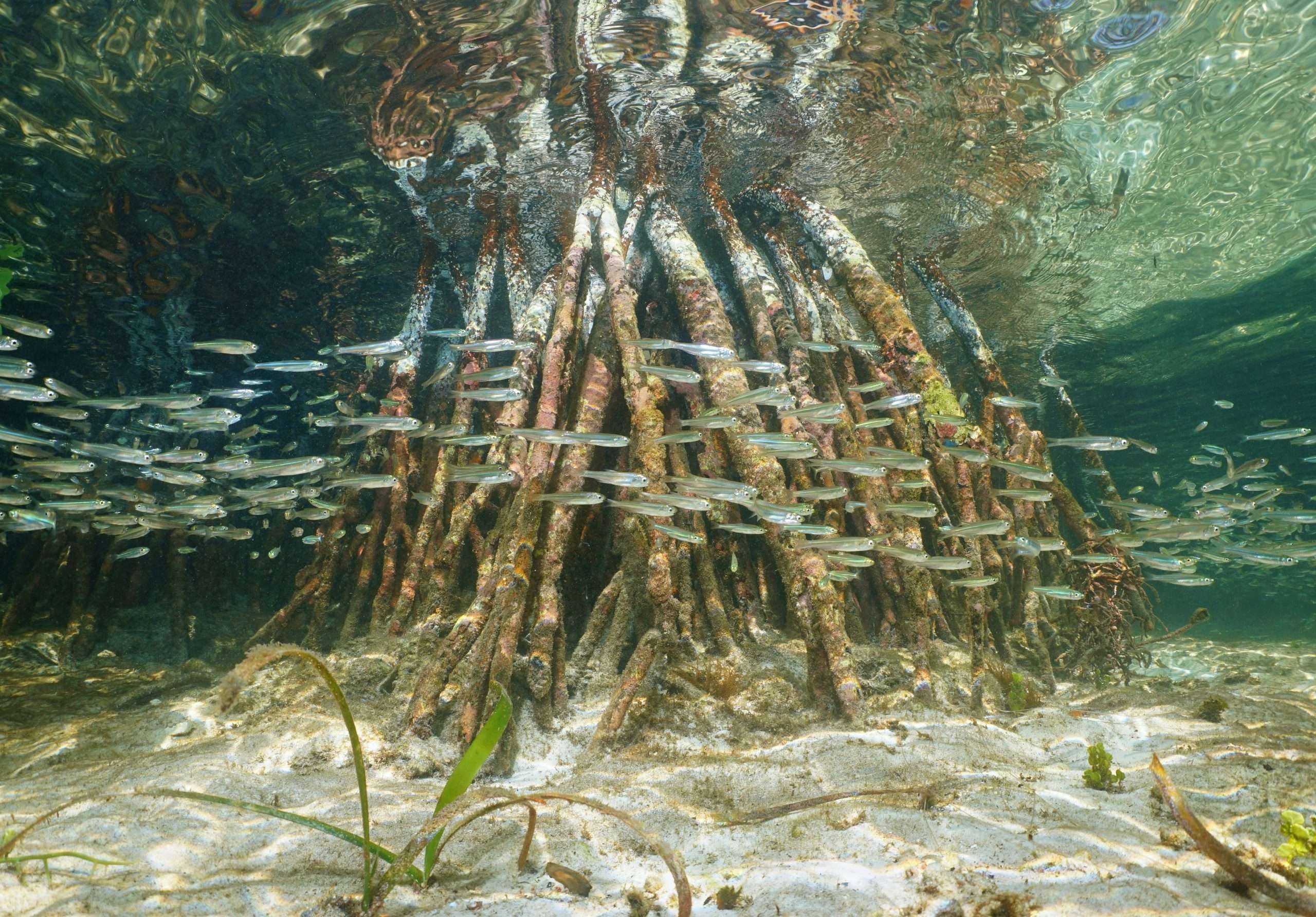
When it comes to exploring these shallow, sediment rich waters, a more gentle approach is required as it is very easy to cloud up the water with a too-swift fin stroke. Depending on the situation, it might even be best to ditch the fins. This is definitely an environment that requires a slow inspection, and as your eyes adjust to the shadows you will find more gems hidden in plain sight. The first thing you will notice as you float along is the multitude of schools of tiny fish that dart among the tangled mess of roots. These roots are the ocean’s nursery ground, an underwater playground providing food and protection to a large variety of juvenile creatures. Here juvenile fish can grow and mature in relative safety, feeding on a smorgasbord of algae and other microorganisms before they venture out to the reef or into the open water. So as you explore, you are likely to swim into schools of young mangrove snappers, French grunts, schoolmaster snappers, or to find yourself being eyed by a juvenile French angelfish as it tries to blend in among the roots.
Several studies have shown how important Caribbean mangroves are as nursery grounds and their influence on the community structure and abundance of fish on neighboring coral reefs. For some species, such as the beautiful rainbow parrotfish (Scarus guacamaia) and the critically endangered Goliath grouper (Epinephelus itajara), mangrove nurseries are essential to their survival. The decline in adult populations of these species on coral reefs can be linked directly to the loss of adjacent mangrove habitats. Goliath groupers are especially vulnerable, as their young may remain in their mangrove nursery habitats for five to six years, only leaving once they reach a length of one meter (39 inches). Factors like these further illustrate the importance of protecting mangrove habitats and the seagrass beds that provide connection to adjacent coral reefs.
Juvenile fish, shrimps and crabs are not the only creatures that thrive on the nutrients that a decomposing mangrove provides; it is a paradise for filter feeders as well. The presence of mussels, oysters, barnacles, and sponges will not go unnoticed as they thickly encrust the roots and submerged branches. Sponges add splashes of color and their constant filtering helps to maintain water quality and clarity. The diversity of species finding refuge among the roots is astounding, and sea anemones and echinoderms, such as sea stars and urchins, play their part in maintaining the ecological balance. As you can see from the photo, sun anemones (Stichodactyla helianthus) also seek shelter and light in the mangroves. I have been astounded by the sheer number of sun anemones that inhabit the seagrass beds and mangrove areas around the islands of Bocas del Toro.
Not all species display themselves like the sun anemones. For those that rely on camouflage for their survival these tangled roots provide the perfect hiding spot. One such charismatic creature — and my nemesis as it keeps on eluding me — is the seahorse, a magical creature we all seek out to observe and delight in. The Caribbean is home to three species of seahorse, and they are truly masters of camouflage. If you do find yourself swimming among the roots, I hope you have better luck than me encountering these tiny gems. The dense root systems not only provide safety to the vulnerable but also provide a home for the more majestic creatures. So as you slowly skirt the mangroves don’t be surprised if you encounter a juvenile nurse shark (Ginglymostoma cirratum) reclining on the sand, or if a sudden sand cloud erupts in front of you left behind by a southern stingray (Hypanus americanus) that went unnoticed because it was so well camouflaged, waiting to feast on the shrimps, crabs and worms that abound in the mangroves.
Mangroves are structurally diverse, so your snorkeling experience can also change as you leave the mangrove fringes and enter the more enclosed mangrove lagoons. Here, in the calmer, sheltered waters, you are likely to encounter a unique mangrove resident, the aptly named mangrove upside-down jellyfish (Cassiopea xamachana). Unlike their free floating cousins, these jellies spend most of their time with their bell nestled in the substrate and their frilly tentacles facing upwards. In this upside down state they can provide the symbiotic zooxanthellae they harbor in their tissues with maximum access to sunlight. This is important as these photosynthesizing symbionts are a source of free food for the jellyfish.
These tiny creatures are not upside-down jellyfish’s only source of energy, their tentacles, like all jellyfish, are armed with stinging cells or cnidocytes which they use to capture small prey. A fascinating aspect of their predation activity is their ability to sting and incapacitate their prey from a distance. This is something I experienced personally — the stinging part, not the incapacitated part. When disturbed or feeding they can secrete clouds of mucus into the surrounding water that are filled with tiny cell masses called cassiosomes, which are primarily composed of stinging cells. So if you find yourself innocently observing these critters from a distance and suddenly start feeling stinging sensations it means you have been bombarded by cassiosomes. Those of you who have experienced this will know that these stings are mild but still annoying enough to retreat.


Mangroves not only provide these odd creatures with a habitat to thrive in but also play an interesting role in their life cycle. During their development the fertilized eggs hatch into planula larvae that attach to suitable substrates to continue the next stage in their metamorphosis. The interesting aspect is that planula larvae are enticed to settle by a substance given off by decomposing red mangroves. Here we have an example of yet another species whose survival is intimately linked with these unique habitats, and if we have to delve deeper we can probably cite many more.
So next time you are seeking an underwater experience, give mangroves a try. That might not be your first choice, but the hidden treasures of biodiversity within a healthy mangrove ecosystem might just surprise you. It might even motivate you to spread the word and further help raise awareness of the importance of these unique ecosystems for terrestrial and marine life alike.


