




By Amanda Delaney
Listen to an audio summary of this article:
Ocean currents are found circulating around the world. These currents help regulate the Earth’s climate by distributing heat and moisture worldwide. If ocean currents did not exist, then temperatures would become more extreme with excessive heat in the tropics and cold air remaining over the polar regions. The main current that is found in the Caribbean Sea is known as the Caribbean Current. We’ll discuss its importance and how it contributes to the rest of the Atlantic Ocean circulation.
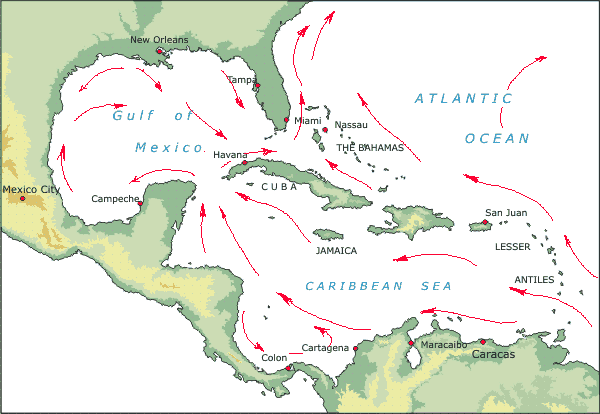
The Caribbean Current, a confluence of several currents from the Atlantic, flows in a general east-southeast to west-northwest fashion across the Caribbean, eventually extending into the Gulf of Mexico. This then feeds into the Loop Current in the Southern Gulf of Mexico, and then into the Gulf Stream south of Florida and off the U.S. East Coast.
The Caribbean Current originates from the tropical Atlantic Ocean. The strongest currents generally flow along northern Brazil and northeastern South America. These warm currents eventually flow through the southern Windward Islands and move northwest over the southern Caribbean Sea. At times large clockwise eddies will form to the north of the Guiana Current and move northwest toward the Lesser Antilles. These eddies will reach the northern Windward and Leeward Islands and will eventually absorb through passages between the islands into the Caribbean (Figure 1 displays the Caribbean Current during the winter).

Farther east and north, the North Equatorial Current that flows from east to west over the Atlantic Ocean will filter through some of the island passages over the northern Lesser Antilles. However, much of the current will lift to the north of the Greater Antilles (Puerto Rico, Hispañiola and Cuba), becoming the Antilles Current. This current will continue up through the Old Bahama Channel and will merge with the Gulf Stream.
Upon reaching the Western Caribbean, a portion of the Caribbean Current branches off and splits southward to form the Panama-Colombia Gyre, a broad “cyclonic” (counterclockwise in the Northern Hemisphere) current that covers much of the southwest Caribbean, flowing southward along the southeast coast of Nicaragua, eastward along the Caribbean coasts of Costa Rica and Panama, northeastward along the coast of Colombia, then westward to pass just south of the main Caribbean Current flow from which it branches off. This is a semi-permanent feature, showing little overall change in coverage, influenced otherwise by the continuous presence of smaller-scale eddies travelling within the Caribbean Current.
Temperature and Salinity Cycles
Sea surface temperatures in the Caribbean average about 80°F (27°C) and usually vary approximately three degrees throughout the year. As one might expect, the coolest sea surface temperatures occur in the winter and the warmest in the summer. Sea surface temperatures have increased one to two degrees above normal across the Caribbean Sea, and one to three degrees in the Atlantic Ocean and Gulf of Mexico starting last summer. This was one of the factors that led meteorologists to predict a higher than normal frequency of tropical cyclones in the Atlantic Ocean this year.
Salinity generally ebbs and flows in one cycle per year as well, reaching a minimum in early winter and a maximum in early summer. During mid to late summer and fall (August into December), the Caribbean Current diminishes following the arrival of freshwater discharge from the Amazon and Orinoco Rivers. a process which reverses itself as increased heating from the sun into spring yields increasing sea surface temperatures and evaporation at the surface, leaving minerals and salts behind. This forces the saltier water beneath the ocean surface, increasing currents, and eventually yielding the arrival of freshwater to repeat the cycle for another year.
Join tens of thousands of readers who never miss an update on Caribbean sailing, travel, and island living!
Just fill out the form below to get started. Want to take a look first? Browse past issues here.
Weather Influences
How do extreme weather events, such as tropical cyclones, impact the Caribbean Current? Tropical storms or hurricanes can mix deeper in the ocean waters. At times, larger hurricanes that move slowly can draw up cooler waters from deep beneath the surface, a phenomenon known as “upwelling.” The thermocline, or the boundary where warmer sea water and cooler sea waters meet, is located well beneath the surface.


Tropical storms and hurricanes can disrupt surface currents but overall will not impact deeper ocean currents in the Caribbean Sea, which generally move quickly east to west. A hurricane’s winds can, however, create a cyclonic current that will flow away from the center of the sea surface circulation. An example of this can be found in the two images below (figures 2 and 3) of the NOAA satellite image of Hurricane Maria in 2017 and the associated Real-Time Ocean Forecast System (RTOFS) currents located near the hurricane at the same time. Although tropical storms and hurricanes will damage marine environments, the deeper turbulence in the wake of these systems can stir up nutrients from deeper waters. This will draw marine life back into areas where the nutrients reach closer to the surface.
Drier weather can play a role across the Eastern Caribbean as well. There are times when strong easterly winds will blow large areas of dust from the Sahara Desert. These plumes of dust can remain intact across the tropical Atlantic Ocean and can reach the Caribbean. This dust and dry air will actually inhibit thunderstorm development and, when occurring during the tropical cyclone season, usually hinder any tropical cyclone activity in the region. This dust can carry nutrients and minerals that eventually fall to the ocean surface. These abundant nutrients, as well as less cloud cover, can help microscopic plants to develop and can lead to algae blooms over the Western Tropical Atlantic Ocean and Caribbean Sea.
The Caribbean Current assists in distributing Atlantic tropical waters and freshwater from major South American rivers back north toward the Gulf of Mexico and the Western Atlantic Ocean. The salinity, sea surface temperatures and nutrients impact marine life across the Caribbean Sea. Prevalent winds over the Caribbean waters can draw up moisture that will influence the weather across the region and, in some cases, tropical cyclone development. This current is just one of many that contribute to the entire North Atlantic current.
Amanda Delaney is a senior meteorologist at Weather Routing Inc. (WRI). WRI provides customized forecasts and online weather services to mariners worldwide.