ADVERTISEMENT
Caribbean Compass
  • Home
  • Cruising
  • Destinations
    • Anguilla
    • Antigua & Barbuda
      • Barbuda
    • Bahamas
    • Barbados
    • British Virgin Islands
      • Anagada
      • Jost Van Dyke
      • Norman Island
      • Virgin Gorda
    • Colombia
      • Santa Marta
    • Dominica
    • Dominican Republic
    • Grenada
      • Carriacou
    • Puerto Rico
    • St. Barts
    • St. Lucia
    • Sint Maarten & St. Martin
    • St. Vincent & Grenadines
      • Bequia
      • Canouan
      • Mayreau
      • Union Island
    • Trinidad & Tobago
    • U.S. Virgin Islands
      • St. John
      • St. Thomas
      • St. Croix
    • All Other Islands
      • Guadeloupe
      • Martinique
      • Montserrat
      • Nevis
      • Panama
      • St. Kitts
  • Events Calendar
  • Regattas & Rallies
    Antigua Defends Nations Cup Title for Seventh Year as Caribbean Dinghy Championship Marks 30th Edition in Sint Maarten

    Antigua Defends Nations Cup Title for Seventh Year as Caribbean Dinghy Championship Marks 30th Edition in Sint Maarten

    Anegada:  Cow Bones, Shipwrecks & Lobster at Sunset

    The New CSA Majors Trophy – A Grand Finale

    Team TTO Competes in Sint Maarten at the 2026 Caribbean Dinghy Championships

    Team TTO Competes in Sint Maarten at the 2026 Caribbean Dinghy Championships

    Anegada:  Cow Bones, Shipwrecks & Lobster at Sunset

    Registration Opens for the West Indies Regatta Festival 2027

    2026 Caribbean Dinghy Championship Returns to Sint Maarten for 30th Edition

    2026 Caribbean Dinghy Championship Returns to Sint Maarten for 30th Edition

    St. Vincent and the Grenadines Sends Largest-Ever Team to Caribbean Dinghy Championships

    St. Vincent and the Grenadines Sends Largest-Ever Team to Caribbean Dinghy Championships

    Anegada:  Cow Bones, Shipwrecks & Lobster at Sunset

    Salty Dawg Departures Scheduled from Florida, Bermuda

    2026 ARC and ARC+ Fleets Gather in Gran Canaria for Atlantic Crossings to the Caribbean

    2026 ARC and ARC+ Fleets Gather in Gran Canaria for Atlantic Crossings to the Caribbean

    2026 St. Barth Cata Cup Draws 42 Teams for 18th Edition

    2026 St. Barth Cata Cup Draws 42 Teams for 18th Edition

  • JOIN NEWSLETTER!
No Result
View All Result
Caribbean Compass
No Result
View All Result
Home Eco News
Hard to believe that the dainty, uniquely designed green mermaid’s wineglass arose from a single plant cell.

Hard to believe that the dainty, uniquely designed green mermaid’s wineglass arose from a single plant cell.

The Underappreciated Green Macroalgae- Part 1

Darelle Snyman by Darelle Snyman
March 16, 2023
in Eco News, Sea Life
Reading Time: 6 mins read
A A

 This month we take a look at another impressively diverse, often not so welcome, group of Caribbean residents, the macroalgae or seaweeds. On a coral reef the balance between these notorious competitors and coral is a delicate one, easily disrupted if there are not enough herbivores to keep their growth under control with their continuous grazing. However, while these organisms might not be as captivating as the colorful coral animals, they are equally important and interesting once you delve deeper into their lives.

 Macroalgae can be either calcified and/or fleshy in structure. They exhibit a vast array of growth forms. Highly adaptable, they colonize coral reefs, seagrass beds, mangrove forests, and the intertidal zone. Three broad groups of macroalgae can be recognized: red macroalgae (Rhodophyta), brown macroalgae (Phaeophyceae), and green macroalgae (Chlorophyta). This two-part article will focus on the ancestral relatives of vascular plants, the Chlorophyta or green seaweeds. 

A true treasure among the green macroalgae is the very unique and aptly named sea pearl (Valonia ventricosa). These squishy, mostly solitary, bubbles have fascinated me from the first time I stumbled across them nestled in depressions in the reef. The silvery sheen of the glitzy baubles catches your eye and draws you in for a closer look.
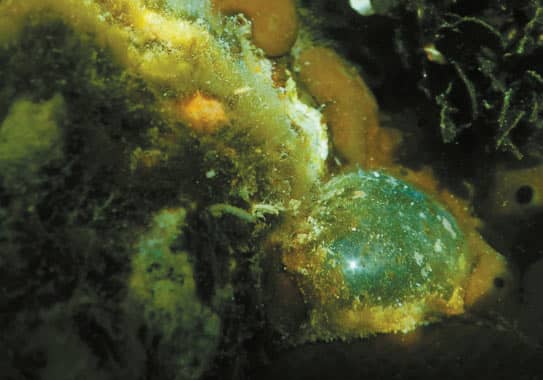
The silvery sheen of the sea pearl catches your eye and draws you in for a closer look.

Their tight, spherical cell wall makes them highly reflective under water, giving them that unique sheen that led to them to be also called sailor’s eyeballs. That beautiful sheen, however, can sometimes be obscured by a thin layer of lavender crust alga (Hydrolithon farinosum), a pesky encrusting red alga. 

Sea pearls are not picky where they set down roots, and can be found among coral rubble, mangrove roots or seagrass, and on sandy bottoms. They are attached to the substrate by minute, hair-like threads called rhizoids that provide a surprising strong hold. Their coloring, which depends on the amount of chloroplasts present, ranges from grass green to a dark, olive green. Algae bubbles can reach the respectable size of 2 inches or 5 cm, a fact that makes them one of the largest single celled organisms in the world. This is actually a big deal since unicellular organisms are normally microscopic, limited in growth by surface-area-to-volume-ratio restrictions. Sea pearls have overcome these limitations by having multiple nuclei and multiple chloroplasts. Squishing and bursting a sailor’s eyeball will result in more of them popping up as they only need to have one nucleus to grow into an entirely new ball. Their large cell size and unique function have made them the subject of many a scientific study, especially regarding the transfer of water and other fluids across biological membranes.  

A green algae that truly illustrates the structural beauty and diversity of macroalgae for me is the beautifully named green mermaid’s wineglass (Acetabularia caliculus). Hard to believe that these dainty, uniquely designed algae also arose from a single plant cell. Since its discovery in the 1800s the genus Acetabularia has been a source of fascination for many a scientist. In fact, Acetabularia was actually the genus used to first demonstrate that genetic information is contained in the nucleus of organisms whose cells have a nucleus, which essentially means all animals and plants. These delicate algae grow singly or in clusters, and each alga body, or thallus, represents a single cell with a single nucleus. The unusually large nucleus is situated at the base of the stalk or stipe, allowing it to regenerate if damaged. Calcium absorbed from the water provides it with the light calcium carbonate skeleton that gives it that fluid rigidity, allowing its stunning umbrella shaped cup to face the life giving rays of the sun. 

These hardy beauties can be found on a host of substrates, from pebbles, shells, pieces of rock to seagrass beds, mudflats, and mangrove roots. The cup of the green mermaid’s winegglass has rounded ridges that radiate from the center to form bulbous edges.

Reproduction mirrors fungi growing from spores. During sexual reproduction tiny cysts form in the cap that produce gametes. The cysts have tiny caps that open when the gametes are ready for release. Each individual produces only one type of gametes which unites with a different type to form a zygote. It takes approximately six months of the zygote to develop into the striking thallus that is fed upon by many fish and sea urchins. These tiny organisms are also unique in their ability to absorb mercury from the water and concentrate it in polypeptides in their tissues.  

 Another uniquely structured green alga that relies on a supportive calcium carbonate skeleton is the bristle ball brush (Penicillus dumetosus). This common Caribbean resident of sand flats and seagrass beds can be recognized by its rounded ball shape of tightly packed filaments that arise from a stout green stalk. It is also referred to as Neptune’s shaving brush because of its rounded shape. Their calcium carbonate framework allows bristle ball brushes to reach heights of 6 inches (15 cm). The carbonate component becomes part of the seafloor sediments when the alga dies and the soft parts decay away.

Another Penicillus family member to look out for is the flat-top bristle brush (Penicillus pyriformis), whose tightly packed bristles, as the name indicates, end in a flat top, forming an inverted cone.  
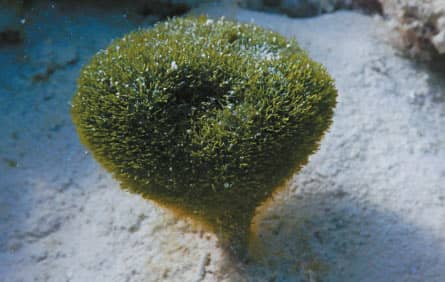
The bristle ball brush is also referred to as Neptune’s shaving brush because of its rounded shape.

Calcifying green algae, such as Penicillus, are major contributors of the carbonate that forms key reef habitats. In many tropical locales the beautiful white, sandy beaches we enjoy are mostly composed of the bleached and eroded calcium carbonate skeletons of one of the most common green algae on the reef, Halimeda. Studies have shown that, when considered globally, carbonate from Halimeda spp. accounts for an estimated eight percent of the total global production. 

A typical Halimeda alga consists of flattened, leaf-like segments reinforced with calcium carbonate and covered with algal protoplasm. The tiny, calcified segments are interconnected by a thin strand, giving the plant its flexibility. It has been shown that 60 to 80 percent of these segments are composed of aragonite, a crystal form of calcium carbonate — no wonder they can contribute so greatly to marine sediments when they die and decay. Their crunchy nature also makes them unpalatable to most herbivores, contributing to their success on a reef.   

Queen conch lying in a bed of Halimeda spp

Once you can recognize these segmented algae, you will spot them all over a reef nestled among coral, hanging down in a crevice or forming dense carpets across sandy bottoms. It is not the easiest task to identify individual species — for example, the watercress alga (Halimeda opuntia) grows crammed closely together in dense, spreading mats where it is often difficult to discern individual algal bodies or thalli. The large leaf hanging vine (Halimeda copiosa), as the name indicates, grow in bunches as long chains of beautiful green, rectangular segments joined down the middle by a single stalk, a species more easily recognized because of its distinctive growth form. Members of the genus can reproduce asexually and sexually, with sexual reproduction being completed within an amazing 36 hours. Members of this diverse genus are also known for the noxious metabolites they synthesize to further protect them from those pesky herbivores. It is these secondary metabolites that have become the focus of many scientific studies and their potential use as phytopharmaceuticals, especially for their hydrophilic antioxidant properties. Methanol and dimethylformamide extracts of the watercress alga (Halimeda opuntia) have shown positive antibacterial action against microorganisms such as Staphylococcus aureus, Escherichia coli and Bacillus subtilis. Ethanol extracts of the same species exhibited activity against hepatitis C virus, while extracts from other species have shown cytotoxicity towards cancer cells. Again it shows how much potential is locked up in nature in the most unlikely places. Imagine being saved from the hazards of cancer by what would normally be considered a lowly alga. 

Next month we will look at more of these unique organisms with beautiful names such as mermaid’s fan and mermaid’s teacup.  
Tags: Eco News
Previous Post

The Spanish Virgins to the US Virgins

Next Post

Grenada Sailing Week 2023 Returns with a Splash!

Recommended For You

Caribbean Represented at Coral Reef Symposium

by Darelle Snyman
October 25, 2026
0
Caribbean Represented at Coral Reef Symposium

Twenty-three researchers and students from the University of the Virgin Islands Center for Marine and Environmental Studies delivered 26 presentations at the 16th International Coral Reef Symposium in...

Read moreDetails

A Record Year for Coral Restoration in Antigua & Barbuda

by Darelle Snyman
October 25, 2026
0
A Record Year for Coral Restoration in Antigua & Barbuda

AnuBlue has marked its most successful year of coral restoration since its establishment in 2021, planting more than 5,800 nursery-grown corals across reefs around Antigua. This represents approximately...

Read moreDetails

AnuBlue Marks Record Year for Coral Restoration in Antigua & Barbuda

by Darelle Snyman
September 27, 2026
0
AnuBlue Marks Record Year for Coral Restoration in Antigua & Barbuda

ANTIGUA & BARBUDA — AnuBlue has marked its most successful year of coral restoration since its establishment in 2021, planting more than 5,800 nursery-grown corals across reefs around...

Read moreDetails

Eco Focus: Two-and-a-half centuries of rainforest protection in Tobago

by Darelle Snyman
September 26, 2026
0
Eco Focus: Two-and-a-half centuries of rainforest protection in Tobago

By Janine Mendes-Franco Editor’s note: This story is part of Global Voices 2026 Spotlight series, “Global Crisis, Local Solutions,” which offers stories of resistance and successful climate action,...

Read moreDetails

Ripples to Waves Needs Whale Watchers

by Darelle Snyman
September 26, 2026
0
Environmental Reporting Gains Recognition

Ripples to Waves, a Vincentian nonprofit, is calling on whale- and dolphin-watchers to be a part of its research team. The organization is inviting all ocean users to...

Read moreDetails
Next Post
Grenada Sailing Week 2023 Returns with a Splash!

Grenada Sailing Week 2023 Returns with a Splash!

Please login to join discussion
How to Advertise in Caribbean Compass

Compass Marketing Services

How To Submit an Article

About Us

Issue Archive

Newsletter Archive

Where to Find Compass in Print

Article Archive

Privacy Policy

Categories

  • Airlines
  • Beach Bars
  • Beaches
  • Book Reviews
  • Business
  • Carnivals
  • Cruising
  • Destinations
  • Diving
  • Eco News
  • Events
  • Geography
  • History
  • Hotels
  • Hurricanes
  • Island Spotlight
  • Magazine
  • Marinas & Boatyards
  • Navigation
  • News
  • On Shore
  • Reader's Forum
  • Recipes
  • Regattas & Rallies
  • Resorts
  • Restaurants
  • Rum
  • Sea Life
  • Tributes
  • Uncategorized
  • Weather
  • Wildlife
  • Yacht Charter
  • Yacht Services
Join Our Newsletter

Caribbean Marine Weather Resources

Caribbean Events Calendar

Reader's Forum

Center of Effort - Letter from the Editor

RECENT POSTS

  • Immigration And Maritime Services, Temporarily Relocated To Ferry Dock At Pjia During Simpson Bay Dock Refurbishment  November 1, 2026
  • Guadeloupe Announces Anchoring Restriction at Carénage November 1, 2026
  • Trapped Carriacou Boats Launched November 1, 2026
  • Caribbean Compass – November 2026 October 27, 2026
  • Antigua Defends Nations Cup Title for Seventh Year as Caribbean Dinghy Championship Marks 30th Edition in Sint Maarten October 26, 2026

© 2026 Caribbean Compass

No Result
View All Result
  • Home
  • Cruising
  • Destinations
    • Anguilla
    • Antigua & Barbuda
      • Barbuda
    • Bahamas
    • Barbados
    • British Virgin Islands
      • Anagada
      • Jost Van Dyke
      • Norman Island
      • Virgin Gorda
    • Colombia
      • Santa Marta
    • Dominica
    • Dominican Republic
    • Grenada
      • Carriacou
    • Puerto Rico
    • St. Barts
    • St. Lucia
    • Sint Maarten & St. Martin
    • St. Vincent & Grenadines
      • Bequia
      • Canouan
      • Mayreau
      • Union Island
    • Trinidad & Tobago
    • U.S. Virgin Islands
      • St. John
      • St. Thomas
      • St. Croix
    • All Other Islands
      • Guadeloupe
      • Martinique
      • Montserrat
      • Nevis
      • Panama
      • St. Kitts
  • Events Calendar
  • Regattas & Rallies
  • JOIN NEWSLETTER!

© 2026 Caribbean Compass