


ADVERTISEMENT
Caribbean Compass
  • Home
  • Cruising
  • Destinations
    • Anguilla
    • Antigua & Barbuda
      • Barbuda
    • Bahamas
    • Barbados
    • British Virgin Islands
      • Anagada
      • Jost Van Dyke
      • Norman Island
      • Virgin Gorda
    • Colombia
      • Santa Marta
    • Dominica
    • Dominican Republic
    • Grenada
      • Carriacou
    • Puerto Rico
    • St. Barts
    • St. Lucia
    • Sint Maarten & St. Martin
    • St. Vincent & Grenadines
      • Bequia
      • Canouan
      • Mayreau
      • Union Island
    • Trinidad & Tobago
    • U.S. Virgin Islands
      • St. John
      • St. Thomas
      • St. Croix
    • All Other Islands
      • Guadeloupe
      • Martinique
      • Montserrat
      • Nevis
      • Panama
      • St. Kitts
  • Events Calendar
  • Regattas & Rallies
    Antigua Defends Nations Cup Title for Seventh Year as Caribbean Dinghy Championship Marks 30th Edition in Sint Maarten

    Antigua Defends Nations Cup Title for Seventh Year as Caribbean Dinghy Championship Marks 30th Edition in Sint Maarten

    Anegada:  Cow Bones, Shipwrecks & Lobster at Sunset

    The New CSA Majors Trophy – A Grand Finale

    Team TTO Competes in Sint Maarten at the 2026 Caribbean Dinghy Championships

    Team TTO Competes in Sint Maarten at the 2026 Caribbean Dinghy Championships

    Anegada:  Cow Bones, Shipwrecks & Lobster at Sunset

    Registration Opens for the West Indies Regatta Festival 2027

    2026 Caribbean Dinghy Championship Returns to Sint Maarten for 30th Edition

    2026 Caribbean Dinghy Championship Returns to Sint Maarten for 30th Edition

    St. Vincent and the Grenadines Sends Largest-Ever Team to Caribbean Dinghy Championships

    St. Vincent and the Grenadines Sends Largest-Ever Team to Caribbean Dinghy Championships

    Anegada:  Cow Bones, Shipwrecks & Lobster at Sunset

    Salty Dawg Departures Scheduled from Florida, Bermuda

    2026 ARC and ARC+ Fleets Gather in Gran Canaria for Atlantic Crossings to the Caribbean

    2026 ARC and ARC+ Fleets Gather in Gran Canaria for Atlantic Crossings to the Caribbean

    2026 St. Barth Cata Cup Draws 42 Teams for 18th Edition

    2026 St. Barth Cata Cup Draws 42 Teams for 18th Edition

  • JOIN NEWSLETTER!
No Result
View All Result
Caribbean Compass
No Result
View All Result
Home Eco News
Prior to an experiment designed to verify the source of infections, a healthy sea urchin was swabbed to ensure it had never been exposed to the ciliate parasite. (PHOTO BY MYA BREITBART/COLLEGE OF MARINE SCIENCE)

Prior to an experiment designed to verify the source of infections, a healthy sea urchin was swabbed to ensure it had never been exposed to the ciliate parasite. (PHOTO BY MYA BREITBART/COLLEGE OF MARINE SCIENCE)

Massive Caribbean Sea Urchin Die-Off Caused by Parasite

Caribbean Compass by Caribbean Compass
May 24, 2023
in Eco News, Sea Life
Reading Time: 4 mins read
A A

Story by Krishna Ramanujan

Scientists have discovered that a parasite is behind a severe die-off of long-spined sea urchins across the Caribbean Sea, which has had devastating consequences for coral reefs and surrounding marine ecosystems.

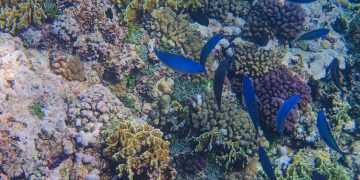
The long-spined sea urchins (Diadema antillarum) serve as vital herbivores that graze on algae, which if left unchecked will outcompete corals for resources and space. They will blanket them, block light and kill them. By feeding on algae, the sea urchins are essential to maintaining coral health and balance in the marine ecosystem.

Diadema mortalities were first reported in St. Thomas, U.S. Virgin Islands, in late January 2022. By late March, the condition was found across the Lesser Antilles, Jamaica and the Mexican Caribbean. And by June of last year, it had been detected in most of the Greater Antilles, Florida and Curacao.

Prior to an experiment designed to verify the source of infections, a healthy sea urchin was swabbed to ensure it had never been exposed to the ciliate parasite.

Scientists have been trying to identify the cause of the mysterious illness, which has led to declines of between 85 percent and 95 percent compared to pre-mortality numbers in affected areas. When sea urchins die, they lose their spines and detach from their anchors.

Now, an international team of 42 scientists has identified the culprit as Philaster apodigitiformis, a unicellular eukaryote that is part of a group of 8,000 species called ciliates. P. apodigitiformis is a known parasite in fish.

“Rarely are we afforded the opportunity to understand marine disease events in this detail, where we can actually work out a cause of it,” said marine ecologist Ian Hewson, professor of microbiology in the College of Agriculture and Life Sciences, and lead author of the study, “A Scuticociliate Causes Mass Mortality of Diadema antillarum in the Caribbean Sea,” which was published online April 19 in Science Advances.

Though scientists do not yet know how to treat P. apodigitiformis infections, discovering the parasite’s identity may help them design strategies for maintaining health in Diadema sea urchins that are being raised for restocking efforts across the region, Hewson said.

“Knowing the pathogen’s identity may also help mitigate risk to untouched Diadema through such things as boat traffic, dive gear, or other ways it may be moved around,” he added.

In the early 1980s, long-spined sea urchins were almost completely wiped out in the Caribbean by an unknown cause, leading to around 98 percent declines from previous numbers. Thirty years later, their populations rebounded, but only by an estimated 12 percent from their pre-epidemic numbers. That die-off led to rapid degradation of many coral reefs across the region that persist today, with some coral species becoming extremely rare. The cause of the early 1980s outbreak was never determined, though Hewson and colleagues may now investigate whether P. apodigitiformis can be detected in Diadema museum samples from that time and region.

In the current study, the research team collected three types of Diadema samples, which included: visually abnormal, infected individuals; healthy individuals from the same site; and completely healthy individuals from an unaffected area, which acted as a control for comparison.

Rapid sample collection from 23 sites was made possible by the Atlantic and Gulf Rapid Reef Assessment program, a network that helped Hewson collaborate with scientists from the Van Hall Larenstein University of Applied Sciences in the Caribbean Netherlands, and the University of the Virgin Islands, among others.

Collaborators prepared tissue samples and delivered them to Hewson’s lab at Cornell, a complicated process involving customs and border regulations. Hewson and colleagues then ran tests to identify viral or bacterial pathogens in the tissues using state-of-the-art molecular biological and veterinary pathological techniques, but results were inconclusive.

“They initially did not show any sort of unusual or candidate microorganisms at all,” Hewson said. “We were a bit at a dead end.”

It was then that Hewson decided to investigate genomic signals of eukaryotic microorganisms, such as fungi, ciliates and dinoflagellates. “Immediately when I did that, I had an enormous signal of this scuticociliate Philaster,” Hewson said.

He ran to the labs and pulled out fluid samples from Diadema that people in the field had collected, and put those under the microscope.

“I saw this ciliate was actually very, very abundant,” he said. “That was the big ‘aha’ moment.” The ciliates were not present in samples from the control sites, he said.

While P. apodigitiformis has been known to infect fish, this is the first time it has been associated with mass mortality in an invertebrate.

Hewson, a faculty fellow at the Cornell Atkinson Center for Sustainability, and co-authors Mya Breitbart, a biological oceanographer at the University of South Florida, and Christina Kellogg, a microbiologist at the U.S. Geological Survey St. Petersburg Coastal and Marine Science Center in Florida, designed an experiment to test Koch’s Postulates – the gold standard test for proving beyond doubt that a microorganism is associated with a condition.

Using fresh samples collected from infected Diadema from the Florida Keys and aquacultured Diadema (which had never been exposed to any pathogens) obtained from The Florida Aquarium’s Center for Conservation, the researchers infected the aquarium Diadema with ciliates isolated from the body fluid of infected Florida sea urchins.

“Animals that were treated with the ciliate became sick and died in 60 percent of the cases,” Hewson said. They were then able to isolate and identify the very same P. apodigitiformis ciliate from those newly diseased animals, proving it was responsible for the disease.

“Almost never are we able in a wildlife setting, at least in marine habitats, to prove that a microorganism is actually responsible for disease,” Hewson said.

This story was originally published in Cornell Chronicle, April 19 2023

Funders for the study include the National Science Foundation; the Cornell Atkinson Center for Sustainability; the National Oceanic and Atmospheric Administration; and the National Fish and Wildlife Foundation.
Previous Post

Spring Departures: Stopover in the Azores- a destination in its own right

Next Post

Small Island States Tally Climate Change Costs

Recommended For You

Caribbean Represented at Coral Reef Symposium

by Caribbean Compass
October 25, 2026
0
Caribbean Represented at Coral Reef Symposium

Twenty-three researchers and students from the University of the Virgin Islands Center for Marine and Environmental Studies delivered 26 presentations at the 16th International Coral Reef Symposium in...

Read moreDetails

A Record Year for Coral Restoration in Antigua & Barbuda

by Caribbean Compass
October 25, 2026
0
A Record Year for Coral Restoration in Antigua & Barbuda

AnuBlue has marked its most successful year of coral restoration since its establishment in 2021, planting more than 5,800 nursery-grown corals across reefs around Antigua. This represents approximately...

Read moreDetails

AnuBlue Marks Record Year for Coral Restoration in Antigua & Barbuda

by Caribbean Compass
September 27, 2026
0
AnuBlue Marks Record Year for Coral Restoration in Antigua & Barbuda

ANTIGUA & BARBUDA — AnuBlue has marked its most successful year of coral restoration since its establishment in 2021, planting more than 5,800 nursery-grown corals across reefs around...

Read moreDetails

Eco Focus: Two-and-a-half centuries of rainforest protection in Tobago

by Caribbean Compass
September 26, 2026
0
Eco Focus: Two-and-a-half centuries of rainforest protection in Tobago

By Janine Mendes-Franco Editor’s note: This story is part of Global Voices 2026 Spotlight series, “Global Crisis, Local Solutions,” which offers stories of resistance and successful climate action,...

Read moreDetails

Ripples to Waves Needs Whale Watchers

by Caribbean Compass
September 26, 2026
0
Environmental Reporting Gains Recognition

Ripples to Waves, a Vincentian nonprofit, is calling on whale- and dolphin-watchers to be a part of its research team. The organization is inviting all ocean users to...

Read moreDetails
Next Post
Small Island States Tally Climate Change Costs

Small Island States Tally Climate Change Costs

Please login to join discussion
How to Advertise in Caribbean Compass

Compass Marketing Services

How To Submit an Article

About Us

Issue Archive

Newsletter Archive

Where to Find Compass in Print

Article Archive

Privacy Policy

Categories

  • Airlines
  • Beach Bars
  • Beaches
  • Book Reviews
  • Business
  • Carnivals
  • Cruising
  • Destinations
  • Diving
  • Eco News
  • Events
  • Geography
  • History
  • Hotels
  • Hurricanes
  • Island Spotlight
  • Magazine
  • Marinas & Boatyards
  • Navigation
  • News
  • On Shore
  • Reader's Forum
  • Recipes
  • Regattas & Rallies
  • Resorts
  • Restaurants
  • Rum
  • Sea Life
  • Tributes
  • Uncategorized
  • Weather
  • Wildlife
  • Yacht Charter
  • Yacht Services
Join Our Newsletter

Caribbean Marine Weather Resources

Caribbean Events Calendar

Reader's Forum

Center of Effort - Letter from the Editor

RECENT POSTS

  • Immigration And Maritime Services, Temporarily Relocated To Ferry Dock At Pjia During Simpson Bay Dock Refurbishment  November 1, 2026
  • Guadeloupe Announces Anchoring Restriction at Carénage November 1, 2026
  • Trapped Carriacou Boats Launched November 1, 2026
  • Caribbean Compass – November 2026 October 27, 2026
  • Antigua Defends Nations Cup Title for Seventh Year as Caribbean Dinghy Championship Marks 30th Edition in Sint Maarten October 26, 2026

© 2026 Caribbean Compass

No Result
View All Result
  • Home
  • Cruising
  • Destinations
    • Anguilla
    • Antigua & Barbuda
      • Barbuda
    • Bahamas
    • Barbados
    • British Virgin Islands
      • Anagada
      • Jost Van Dyke
      • Norman Island
      • Virgin Gorda
    • Colombia
      • Santa Marta
    • Dominica
    • Dominican Republic
    • Grenada
      • Carriacou
    • Puerto Rico
    • St. Barts
    • St. Lucia
    • Sint Maarten & St. Martin
    • St. Vincent & Grenadines
      • Bequia
      • Canouan
      • Mayreau
      • Union Island
    • Trinidad & Tobago
    • U.S. Virgin Islands
      • St. John
      • St. Thomas
      • St. Croix
    • All Other Islands
      • Guadeloupe
      • Martinique
      • Montserrat
      • Nevis
      • Panama
      • St. Kitts
  • Events Calendar
  • Regattas & Rallies
  • JOIN NEWSLETTER!

© 2026 Caribbean Compass