



By Joan Conover, with Captain Michele Frost
Part One: The Night the Passage Changed
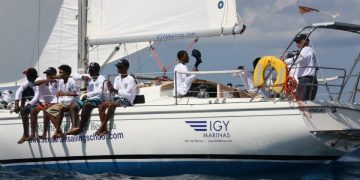
Every autumn, hundreds of cruising boats leave the U.S. East Coast and begin the annual migration to the Caribbean. The route is as familiar as it is demanding. Boats funnel through the Chesapeake, gather in Hampton, cross the Gulf Stream, and either continue offshore or pause in Bermuda before heading south through the island chain. Every skipper watches for the same thing: a weather window that offers just enough time to slip safely between cold fronts before settling into the trade winds.
It is a ritual shared by generations of cruisers. It is also a reminder that the North Atlantic always gets the final vote.
In November 2025, Wavelength, a 42-foot aluminum OVNI designed for offshore sailing, joined that migration.
The boat had been carefully prepared for the passage. She had been recently surveyed. Her rig had been inspected, electronics upgraded, communications tested, safety equipment reviewed. Bill and Captain Michele Frost had spent months preparing for what they expected would be another step toward their new cruising life in the Caribbean, where they planned to begin the Wavelength Ocean Project’s first beach cleanup as part of a personal mission to advocate for clean water shortly after arriving in Antigua.
Instead, they would become part of one of the more difficult offshore departures in recent memory.
Preparing to Leave Hampton
During the first week of November, Wavelength lay at Hampton Yacht Club amid one of the largest offshore fleets on the East Coast. Crews attended weather briefings, completed final provisioning, checked rigging one last time, and waited for the signal to depart.
Only two days before leaving, Bill and Michele also installed an experimental artificial intelligence configuration developed through the Seven Seas Cruising Association (SSCA). Known simply as HAL, it was never intended to navigate the boat or replace seamanship. Its purpose was much narrower: to organize information, verify sources, and help crews work through problems when fatigue and stress made clear thinking more difficult.
No one expected its first real-world test to come so soon.
Everything Changes
Not long after departure, the weather deteriorated.
A late-season frontal system intensified off Cape Hatteras, producing steep, confused seas that challenged boats throughout the fleet. Conditions built rapidly.
Bill later described the experience in a satellite message sent through Starlink.
“Hey Joan, it’s Bill and Michele on Wavelength. We had a hell of a night Wednesday night. Seas to 15–20 feet, manual steering for 18 hours into Thursday afternoon. We tried to keep the seas on the starboard quarter. We were swamped multiple times. One 20-foot three-wave group hit us as we climbed the first wave. It flooded the cockpit, spun the boat sideways, and left us nearly beam-on before we recovered, only to meet the next wave almost bow-first. By the third wave we finally recovered with the stern back to the seas.”
Captain Michele recorded the same experience very differently in her journal.
“It was a combination of the Tilt-A-Whirl and a runaway roller coaster. Except this ride didn’t end after two minutes. It went on for hours. For two people who had sold everything to pursue a dream of sailing, there were moments when I wasn’t sure we would ever see the next port.”
For 18 exhausting hours Bill hand-steered through breaking seas, trying to protect both the boat and themselves while every wave demanded another correction.
Eventually the sea state began to moderate. The steering system did not.
Critical Failure Offshore

As conditions slowly eased, something deep within the steering linkage failed.
The autopilot still functioned, but only because enough of the steering system remained intact to hold a course. The crew immediately understood they no longer had a routine equipment problem. They had suffered a potentially catastrophic steering failure hundreds of miles offshore. The original destination no longer mattered. Bermuda suddenly became the only practical refuge.
At the same time, reports from across the fleet painted a sobering picture. An estimated 40 percent of the rally boats either diverted to Bermuda or delayed their passages because of weather, equipment failures, or storm damage. SSCA Commodore Frank Smith, serving as a liaison with the U.S. Coast Guard, was coordinating reports from vessels throughout the region as numerous boats requested assistance or reported significant problems.
The event reminded many longtime sailors of previous difficult rally years, including 2013, when several boats were lost and others forced to abandon the passage.
Whether attributed to changing climate patterns or natural variability, these weather systems continue to intensify more rapidly than forecasts sometimes suggest, and offshore sailors continue to encounter them unprepared. A departure window that appears reasonable one day can become a survival exercise the next.
HAL Joins the Crew
Once the steering failure had been identified, the focus shifted entirely to keeping Wavelength moving safely toward Bermuda.

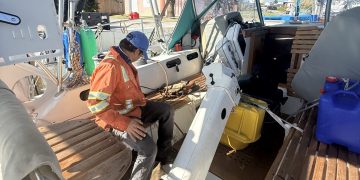
The rally organizers were notified. The boatyard in France was contacted. Photographs of the damaged steering components were transmitted. Possible repair options were discussed. Throughout those exchanges, HAL quietly became another member of the support team.
Rather than making decisions, it helped organize the information arriving from multiple sources. It reviewed photographs, summarized likely failure points, assembled emergency contact information for Bermuda, identified repair resources, and helped the crew think through inspection priorities once they reached port.
One assessment read:
“Rudder tiller-arm yoke fractured at the clamp, likely due to accumulated fatigue combined with shock loading. Inspect the rudder post, steering linkage, hydraulic ram, and seals. Temporary stabilization may be possible until permanent repairs can be completed.”
Bill’s response was immediate.
“We’ll need to haul out in Bermuda. We may also have a compromised rudder ram. At the very least, it all has to be inspected.”
The discussion quickly became practical. Could the autopilot continue to steer? Could additional shock loading be reduced? Had Bermuda’s repair facilities been contacted? What replacement parts might be available? How could the rudder be protected until haul-out?
While Bill reviewed engineering emails arriving from France, he simply remarked, “I’ll ask HAL as well.”
Joan’s answer reflected decades of seamanship. “Protect that poor rudder.”
A Different Kind of Crew Member

HAL never steered Wavelength. It never selected a route. It never issued a distress call. It never replaced the judgment of the skipper or the experience of those providing assistance ashore.
Instead, it served as another tool — one that helped organize information, verify sources, identify missing details, and allow an exhausted crew to work through an increasingly complex situation more methodically.
Every critical decision remained with the Frosts.
They protected the damaged steering system, monitored the weather, communicated with Bermuda, worked with the boat’s builder in France, and ultimately brought Wavelength safely into port.
Sometimes, that’s exactly what good seamanship looks like.
What is HAL?
HAL (Hybrid Applied Layer) is an AI-assisted cruising workflow developed through the Seven Seas Cruising Association. It is not an autopilot, weather router, electronic captain, or navigation system. Instead, HAL provides a structured framework that guides artificial intelligence to operate within defined maritime rules, trusted source priorities, safety boundaries, and operational workflows.
For cruisers, HAL helps organize equipment symptoms, weather information, photographs, maintenance procedures, emergency contacts, port resources, and crew observations into logical, verifiable steps. It is designed to support the skipper — not to replace seamanship, official forecasts, navigation, rescue authorities, or command responsibility.
Part Two, “Damage Control, Fatigue, and the Limits of AI Offshore,” will be published in an upcoming issue of Caribbean Compass.
The complete HAL Mariner workflow is available as an SSCA member benefit. A public version is also available through the SSCA Boating and Cruising Hub for anyone interested in exploring how this system works. It’s free for use, but users must have a guest or free ChatGPT account. Use this link to the workflow: chatgpt.com/g/g-6a112c2599f4819184a62dc8e11f50fe-ssca-boating-and-cruising-hub
This is a published Chatgpt GPT (workflow) usable by anyone with the link, created for users by Caribbean Compass. Ask it to do a port card for St. Martin, ask what HAL is, ask about general routes for planning. This workflow is not full HAL, but will give a sample of how HAL supports cruisers.