




Story and photos by David H. Lyman
It’s the end of another season in the Caribbean. It’s getting hot and humid. I have to tie a bandanna around my head to keep the sweat from running into my eyes. Frequent rain showers have put an end to the varnishing. I’ve got to make up my mind.

Haul the boat out for the summer’s hurricane season and fly home? See “Hauling Out“
Sail this boat north? Back through the Bermuda Triangle, over the Gulf Stream, into the cooler waters of New England. It’s a long voyage — 1,500 miles, twelve to fifteen days, with a stop in Bermuda to wait for favorable weather to cross the Stream.
Decisions have to be made: Where to go and how to get there, departure schedule, crew, provisions? Is the boat ready for another offshore voyage? I’ve got to give this some serious thought, before it’s too late. I’ll consult my yacht insurance policy, which will have the limits and policy for hurricane season.
Haul Out or Sail North
For five summers, I parked my Lord Nelson 41, Afaran, on a mooring in Great Cruz Bay on St. John in the USVI. That first September 1989, Hurricane Hugo blew through the islands. I flew down, moved the boat to Coral Bay, put down two anchors, and for 12 hours rode out 140-knot winds. We survived, but the 50 boats around me didn’t. September 1995, same thing. Hurricane Luis came through. I was there and rode out that hurricane in Maho Bay on St. John. Two weeks later, Hurricane Marilyn came through. I wasn’t there, but Afaran was. A week later, only parts of her hull, engine, and mast were recovered along the beach of Great Cruz Bay.
When I bought Searcher, my 57-foot Bowman ketch, that next year, I sailed her to the Caribbean and brought her home to Maine each spring.
And that was 30 years ago. Since then, hurricanes have only become more frequent and intense. I’d not leave a boat on a mooring, or at the dock unattended in the Caribbean these days. My pal Larry has been chartering his 54-foot private yacht, The Dove, in the Caribbean for over 30 years. He either hauls out in Trinidad for the summer or sails to Maine and the Canadian Maritimes.
Don Street has a suggestion or two for those living on their boats in the Caribbean over the summer. With today’s more accurate forecasts, it’s safe to predict the tracks of hurricanes a few days ahead of their arrival. Two days is all a capable yacht needs to get out of the way. Two days puts you 300 miles north or south of the track. Forget about hurricane holes. There are none left, he writes. Want to read more of Don’s sage advice? Try caribbeancompass.com/a-new-look-at-hurricanes-and-the-eastern-caribbean-sailing-season or street-iolaire.com.
Sailing North
You got the boat south, didn’t you? Just take the same way back. There are a dozen routes, some more amenable than others. First, where are you headed?
Destinations
I see no reason to head for Florida, or anywhere south of Cape Henry, Virginia — your insurance policy will specify an actual latitude. Maine is the only place to keep a boat in the summer. It offers the most interesting cruising on the East Coast, and it is out of the hurricane belt. By the time a tropical storm or hurricane gets that far north, it’s lost most of its punch. Most Maine anchorages are tucked up into inlets, coves and harbors in the lee of easterly winds. There are yards galore for a haulout if it’s needed.

A Bermuda Stop
If you’re heading to New England, or across the pond to the Med, Bermuda is right on the way — 800 to 900 miles, five to seven days from the islands. By the time you arrive, there’ll be something that needs fixing, and Bermuda has savvy folks to do the work. You’ll need to take on fuel, water, and provisions, as well as a round of Dark and Stormies at the White Horse Tavern. Then, wait for favorable weather to cross the Gulf Stream.
It’s 640 miles from Bermuda to Newport, five to six days. It’s another 36 hours to Penobscot Bay in Maine. You’ll be home by Memorial Day.
The Rallies
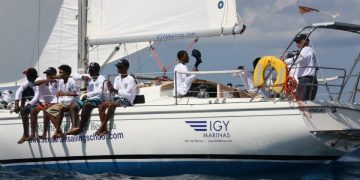
You don’t need to do this alone. Hundreds of other yachts will make the same escape from the West Indies to the United States or across the Pond to the European Union in May.
The ARC (Atlantic Rally for Cruisers) will depart St. Maarten on or about May 11, 2024, heading for the Azores and Europe, with a stop first in Bermuda. There, they will meet yachts from the US East Coast joining the Caribbean fleet for the hop across to the Azores (worldcruising.com).
The Salty Dawg Homeward Bound Rally plans to depart from Nanny Cay, BVI or Marsh Harbor, Bahamas on May 10 (weather permitting), then everyone heads for Hampton, Virginia, and various ports along the US East Coast. (SaltyDawg.org).
Both rallies charge a fee to join but provide myriad services: weather briefings, en route tracking and weather updates, social gatherings, and a radio net to chat with others. It’s a movable yacht club.
Offshore Crew
I’ve made the trip north and south dozens of times, solo, and with crew. If I take a crew, I want sailors who’ve made at least one extended offshore voyage before. I want a crew that can be counted on when conditions turn nasty. They should be able to stand a solo night watch and know what to look out for. They should be physically capable, agile, and fit, and not prone to seasickness. Anyone who doesn’t meet these criteria is a liability aboard. Should one or two get seasick, fall asleep on night watch, or be unable to cook or clean up, you may as well do the delivery alone.
How many people? I’m done with solo deliveries. And a two-handed crew is worse. After a few days, the lack of sleep leads to a breakdown in social cohesiveness. Three is doable, but four is ideal. Each crew stands one solo three-hour watch during the day, and one three-hour watch each night. Please, none of this rotating watch schedule. My body wants a fixed schedule. I’ll take whatever night watch anyone doesn’t want, just to have a fixed schedule.
If you are looking for an experienced crew, there are Facebook groups and websites. I use SailOPO.com. Hank Schmitt, a professional delivery skipper, is the founder of Offshore Passage Opportunities; his membership lists hundreds of experienced sailors looking to help owners deliver their boats. Listing a crew opening is free for skippers. The crew pay their way to and from the boat. Owners cover all onboard costs.
Make the Boat Ready
Since you got the boat to the Caribbean, it should be able to make it back, perhaps with a few necessary modifications and additions you discovered on the way down last fall.
When preparing for any extended offshore voyage, it’s useful to have a check list to ensure you don’t forget something. Airplane pilots, private and commercial, use check lists every time they prepare to depart the gate, take off, and land.
Offshore Prep List
I put together a list, then augmented it over 40 years of boat ownership and deliveries. It’s now four pages long. It covers the rig, sails, reefing systems, deck and cockpit safety, the engine, fuel tanks and fuel consumption, lee clothes for the bunks, communication and nav systems, spares and tools, fishing gear, crew and watch standing, and even an underway menu. Is there a bucket with a knotted lanyard to scoop up sea water to wash the decks?
There’s not room for the complete list here, so I’ve picked a few areas to get you thinking.
Is the boat already rigged for heavy weather?
Is there an inner stay for a storm jib, or staysail? Can the main be reefed down easily? Are the head sails all on roller fullers? There should be no reason to go forward of the mast once underway, and then only as far as the mast to reef the main.
Tankage

Is there sufficient tankage for fuel for five days (100 hours) of motoring? Each year, boats run out of fuel. One fall, a yacht ran out of fuel and hailed a passing cruise ship, which stopped. The captain sent over a launch with diesel, cake, and champagne (but don’t count on this!). How many jerrycans of fuel will you carry and where? Is the water tankage enough for the crew for a few weeks? Carry a spare jerrycan of drinking water in case the boat’s tanks get fouled.
Provisions
Carry enough food for double the anticipated days at sea. If you run out of fuel, the engine quits, and you are becalmed for a week, what’s for dinner? PBJs?
Prepare a menu for each day so you know what to shop for.
Top off the propane tanks.
Crew Safety
Jacklines along the decks for clipping into are fine, better are adequate hand holds along the cabin top, and strong points at the mast to clip into. A jackline that leads from the dodger directly to the mast will keep you from falling off the boat. Realize that jacklines along the deck can drag you alongside if you fall over.
Inspect the lifeline terminals.
Emergency Gear
Are the flare kit, the life raft, and the fire suppression system all up to date? Test all the running and deck lights. Have replacement bulbs on hand — especially the compass binnacle light.
Steering System
Every fall, a boat or two has a steering malfunction or the automatic pilot quits, and it gets towed back to port. Inspect the steering system below decks, chains, cables, turning blocks, and bolts in the quadrant. Do this yourself, don’t give it to the yard to do. If you know your steering system, you’re more likely to fix it and keep going.
Losing the autopilot is no reason for abandoning the voyage. We lost the auto helm at the beginning of a yearlong voyage and hand-steered Searcher, our 57-foot Bowman ketch, all the way to and through the Caribbean and all the way back to Maine. Keep going and fix it when you get to your destination.
Have you found the emergency tiller? Is there one? Have you checked to see how it fits and know how to operate it?
Engine
Can you change the fuel filters, bleed the fuel system, and restart the engine while underway? Long voyages in bumpy seas can stir up crud in the fuel tank and foul the fuel system. Have lots of fuel and oil filters onboard, and a change of oil, along with a few gallons of diesel fuel to prime the filters.
Communications
A fixed VHF radio with a masthead antenna, of course. But a few hand-helds are handy — one in the cockpit, and one when leaving the boat. An Iridum Go is almost required these days for weather and emergencies. A Garmin inReach GPS tracker is a good backup.
Is there an AIS screen in the cockpit?
Navigation

What navigation systems do you have? Besides a chart plotter, an iPad with GPS and Navionics is a good backup. I’ve navigated back and forth to the Caribbean with Navionics on just my iPhone. I bring a large paper chart (INT 493, 108), of the Southeast coast of North America. I use it for planning the voyage and plotting our track with lat/lon fixes every 6 hours. I then add notes and drawings of events so I have a visual record of each voyage. They make nice wall art.
Medical Concerns
With many older folks taking to sea on small boats on extended offshore voyages, a prudent skipper would have some means for accessing medical advice while underway. With a satphone, an Iridium Go, or even a texting device like the Garmin InReach, telemedicine is possible.
DANBoater.org and GlobalRescue.com are two options for calling up an experienced EMT or doctor while far at sea. They can walk you through the process of accessing and stabilizing an injured or sick crewmate. At $60, it’s an affordable option.
Now, get out the iPad or a notebook and begin preparing your own departure list. You’ll add to it daily as more things pop into your head. Then you’ll add to it as you go. By the time you get the boat home you’ll know what you should have known before you left.
Good luck.
David Lyman has for more than 60 years of sailing in his wake. He’s a regular contributor to CaribbeanCompass and Cruising World magazines. He spends summers in Maine and most winters in the Caribbean. Find his stories, photographs and videos at DHLyman.com.