



By Lexi Fisher & Chris Doyle
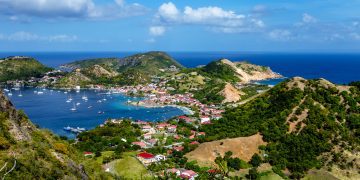
Martinique is the northernmost of the Windward Islands and lies between St. Lucia to the south and Dominica, the first of the Leeward Islands, to the north. It is also the largest of the Windwards and has been French since it was colonized apart from a few short spells under the British. It is part of the European Union as an outpost of France and feels it, with excellent roads and a thriving economy. Nearly every bay has a wonderful government-built dock, ideal for leaving your dinghy. Fort de France is a busy city, bustling with shoppers and cars. The smaller towns are quieter and some look so clean they could have just been scrubbed. You will notice the smells of wonderful coffee and delicious cooking.

You can get almost anything done in Martinique, from galvanizing your boat to having stainless steel tanks made. The sailmakers are first-rate, the chandleries magnificently stocked, and restaurants and boutiques abound. When you have had enough deserted beaches and raw nature, Martinique is the place for a breath of civilization. The island has enough excellent and varied anchorages for a week or two of exploring. Choose bays with fashionable resorts, sleepy waterfront villages, or visit deserted bays with excellent snorkeling. Well-marked trails make hiking a delight.
Napoleon’s Empress Josephine grew up in Martinique on a 200-acre estate run by 150 enslaved people near Trois Îlets. A strange quirk of fate links Josephine and Martinique to the Battle of Trafalgar. In 1804, Napoleon was master of Europe, but the British still had naval supremacy and largely controlled Caribbean waters. However, ships were scarce and some bright spark noticed that Diamond Rock on the south coast of Martinique was just about where the British would station another vessel if they had one, so they commissioned the rock as a ship. It was quite a feat to climb this steep, barren, snake-infested pinnacle and to equip it with cannons and enough supplies and water for a full crew of men. But they succeeded and for some 18 months H.M.S. Diamond Rock was a highly unpleasant surprise for unsuspecting ships sailing into Martinique.

Napoleon was incensed; this was, after all, the birthplace of his beloved Josephine. Brilliant as he was on land, Napoleon never really understood his navy or its problems and considered his men to be shirkers. Consequently, he ordered them to sea under Admiral Villeneuve, to free the rock and destroy the British admiral Horatio Nelson while they were about it. Villeneuve slipped out under the British blockade of France and headed straight for Martinique. Lord Nelson smelled blood and bounty and hurtled off from England in hot pursuit. Poor information sent him on a wild goose chase to Trinidad, so Villeneuve was able to liberate the rock and return to France, prudently keeping well clear of Nelson.
Napoleon was none too pleased with Villeneuve because the British fleet was still in control of the high seas, so he was ordered to report in disgrace. Villeneuve preferred death to dishonor, so he put his ill-prepared fleet to sea to fight Nelson at the Battle of Trafalgar. Ironically, Villeneuve, who wished to die, survived the battle, and Nelson died.
Today Martinique is very civilized, and while it helps to speak French, it is not absolutely necessary. More locals speak English than in years past. There is an annual boat show held at Z’Abricots Marina near Fort de France, but the main yachting hub is Marin, which, together with neighboring St. Anne, often has up to 2,500 yachts at any one time. Marin is a pleasant small town that is one of the Caribbean’s largest yacht centers, with the huge Marin Marina, a big haul-out facility, and a large array of yacht services and technicians. This is also the main base for the Martinique charter industry: R&M Croisieres, Star Voyage, Autremer Concept, Fram, ACM, Dream Yacht Caribbean, Punch Croisieres, Azur Spirit, VPM Dufour, and Corail Caraibes all have bases here.

For quieter anchorages, head west to Grande Anse d’Arlet, Les Anses d’Arlet, and the surrounding bays, where white sand beaches, waterfront dining, and snorkeling are the main attractions. The adventurous should continue north to St. Pierre, where Mont Pelée and the Centre de Découverte des Sciences de la Terre captivate hikers and historians alike. When your stores are full of fine French wine and ripe wheels of brie, it’s a short hop south to hike it all off in St. Lucia.
Doyle Guides contains the Eastern Caribbean’s most comprehensive and reliable sailing guide content, available in hard copy and online through a free mobile app, website, and Facebook group. (www.doyleguides.com).
Martinique Entry and Exit Procedures
Ports of Entry:
Fort de France, Les Anses D’Arlet, Le Marin, St. Pierre, La Trinite and Trois Ilets
Advance Paperwork:
It’s now possible to get clearance approved online, prior to arrival.
Entry Process:
Clearance on arrival is still possible at one of the Customs computers located in establishments island wide. Long queues in high season and business hours apply.
Exit Process:
The same options as entry, but if using the online system be sure to get your departure approval officially stamped. Departments of France (St. Martin, St. Barts, Guadeloupe and Martinique) all require you to clear out of one before sailing to another.
Rates:
3 Euros for use of Customs computer, 5 Euros for online clearance.
This information is provided by Noonsite.com, specialists in worldwide formalities for yachts, and was accurate at press time. Check https://www.noonsite.com/place/martinique/view/clearance for details and updates.