




By Denise Simpson
If you’re heading south or north in winter/spring, or any other time of the year for that matter, why not choose the “thornless” route to the Dominican Republic made famous many years ago by Bruce van Sant in his classic The Gentleman’s Guide to Passages South: The Thornless Path to Windward? Van Sant, now a longtime resident of Puerto Plata, laid out a plan for the thorny difficulties of harsh weather and rough seas, and has extolled the DR as hugely varied, affordable, and friendly. There’s so much to see and do.

From December through April every year, many boats start moving down from Bahamas and Turks & Caicos. I’ve talked to many travelers over the years I have been based here, and have heard how the first sights they notice from afar are the beautiful massive mountain ranges. Once closer in, they experience the smell of the rich soil that anything can grow in, which explains why one can find very well priced local fruits and vegetables here year-round.
Check-in is easy and affordable. For example. at one of the DR’s coastal service providers, Ocean World Marina, it costs approximately US$50 (RD$ 3,000) for three months entry for the vessel, and approximately USD8 (RD$ 500)/ per individual for a 30-day tourist visa (you pay a sliding-scale overstay fee on check-out via sea or air when you decide to leave). If you want to stay here, as many do, and keep on sailing the coastlines after 90 days, then speak to your marina to find out about the navigation permit extension for six or 12 months, and about getting a zarpe (a clearance document authorizing you to island hop, using the DR as a home base).
US vessels/crew sailing direct from US or a US territory (say Puerto Rico), you can enter the Dominican Republic without a zarpe/checkout and the armada/navy will welcome you, but if you are a non-US vessel entering from US, Puerto Rico etc., then you will need to check out there to provide paperwork on entry to check in here.
US and foreign vessels sailing direct from a non-US country must provide checkout papers from their last port of call, as is done anywhere else in the world.
As a backup to your chart plotting system, feel free to download the free Chart Locker Charts (thechartlocker.com) that include a toggle for satellite imagery kindly created by Bruce Balan. The charts are proprietary to any cruisers, but they can be run on Open Chart Plotter Navigation (www.opencpn.org), a free, open-source electronic chart display and information system for maritime navigation.
Puerto Plata Carnival
During the weekends of February (usually Sundays) the vibrant carnival is celebrated in the main streets of most DR cities and towns, with each community adding its own twist, but all of them featuring flashy elaborate costumes and traditional masks.
Carnivals were first held in the Americas in the early 1500s. The Spanish conquistadors who settled here brought the carnival culture from Europe, though the Roman Catholic authorities of the time considered this to be a Pagan celebration, and therefore mixed Christian traditions into it and began to celebrate the event as well.

The celebration became a way to escape from the rigid religious traditions brought from the old world. By the late 1700s, the carnival had become a major celebration in the colony. Then on February 27, 1844, when the Dominican Republic won its independence from Haiti, the celebration grew even greater in popularity, as the country’s Independence Day celebrations were combined into the pre-existing carnival celebrations. February 27 is still the most festive carnival night.
The carnival held in the city of La Vega is one of the largest and oldest in the country, going back to when the early residents of the island dressed themselves as Moors and Christians. It is thought that this colony, along with the one in Santo Domingo, was the first place in the Americas to have a pre-Lenten costume celebration. Now it includes the national parade and a large military display with the Dominican air force, navy, and army.
Puerto Plata carnival events are held outdoors during the daytime and in the open-air stadium at night. Carnival masks are elaborate, and the costumes used on the parades include satires of the Devil called Diablos Cojuelos. They dance and run to the rhythm of merengue music mixed with other Latin and Caribbean rhythms. Revelers flee from the Diablos Cojuelos, who try to hit them with vejigas. Other Dominican carnival traditions include Roba la Gallina and Califé.
Diablo Cojuelo (Limping Devil) is the main character of the carnival, by tradition a devil banished to earth because of his childish pranks. When he hit the earth he hurt his leg, causing him to limp. While most of the communities across the island represent this character in different ways, several common practices are the use of a mask, a satanic suit, sleigh bells and a whip or Vejiga (a bladder filled with air) to hit people in the streets (other Diablos). A Dominican tale claims that the mask represents the Spaniards who came to the island and enslaved and whipped the natives.
Roba la Gallina (Steal the Chicken): This festivity satirizes the fact that some people used to steal chickens from farms. This often consists of a man dressing up as a woman who just stole a chicken. This comical character often carries a large purse with candy inside for the crowd.
La Ciguapa: This female character comes out at night. She is naked with very long black hair, and her feet are backwards. She enchants the men she comes across.
Los Indios (The Indians): are a group of men and women dressed in the typical native Taino Indian attire. They travel together representing Dominican origins.
For those who want to experience the carnival day and night in the mountainous and lush Puerto Plata on the Amber Coast, options include Ocean World Marina in Playa Cofresi, close to Puerto Plata. The marina welcomes members of SSCA, Salty Dawg Sailing, Ocean Cruising Club (OCC), and the Cruising Association, and offers a range of convenient services for sailors and their boats. Many other restaurants and cafes are a short walk away. Puerto Plata also has many repair facilities, plus transport companies that bring parts in quickly by air, as well as shipping ports.
Samaná Whales, a Sailing Regatta
After experiencing carnival and tourist fun in Puerto Plata, many sail or motor to Samana, on the northeast coast, to see one of the world’s most famous attractions, whale watching (the season is active January-March). Samaná Bay is the perfect place to watch the North Atlantic humpback whales who overwinter in this warm marine sanctuary before they begin their long migration to their summer grounds — as far away as Greenland and Iceland!

Whales are often sighted upon entry to the bay (the males seem to hang out around the outer edges of the bay, whereas the females and young stay in the middle, so try to avoid transiting the middle of the bay at all costs.) Some boats over the years have also reported that you can hear their beautiful whale mating songs down below on calm passages. Not all humpback whales travel in the same group, but at any one time during the whale-watching season there are at least 300 whales in Samaná Bay! With all those whales, it’s more a matter of patience than luck, and you’ll have ample chance to watch all sorts of behavior on display such as flipping, tail lobbing and breaching by the most active species of whale in the Atlantic.
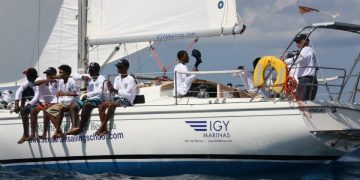
Many vessels head on over to Marina Puerto Bahia, which can also arrange whale tours. Note that the marine sanctuary whale nursery in the center of the bay is heavily protected, so only licensed whale-watching boats are allowed to enter this area, and even these are heavily restricted. This tourism is what keeps the little town of Samaná alive as the town people only have a few months in the year to benefit from this. The marina welcomes associated partners including members of the SSCA, Salty Dawg Sailing, OCC, and the Panama Posse. It offers a range of amenities and services, including the only fuel dock on the northeast coast. The marina also hosts a sailing and dinghy regatta in March for those who plan to stay toward the end of whale season.
After spending time in Samaná, you may want to head out, carefully passing whales in the bay, to the beautiful Los Haitisies national park/hurricane hole.
Remember that for a thornless passage, you can’t do better than to follow the trusted advice in Bruce van Sant’s book, augmented by Chris Parker’s Marine Weather Center services.
Sailors who use Facebook can join the Dominican Republic Cruisers & Boaters info group, which shares loads of up to date official entry info, navigational warnings, country-wide contacts/services and more, plus why Puerto Plata on the north coast has an excellent track record for many years of being safe from hurricanes due to the huge mountain ranges in DR, so the north coast only experiences tropical storms (I also cannot find any records of a direct hurricane hit).
Wherever you choose, I’m sure you will enjoy the DR. Here’s wishing you a safe passage to and from this affordable, friendly, scenic, historically rich and increasingly popular tourist spot, home to many expats and boasting one of the Caribbean’s fastest growing economies.
Denise and her daughter, Natasha Simpson, plus ship’s cat Fritz, live aboard S/V Fair Lady, a 1984 Morgan out-island ketch. Denise is an SSCA host, Ocean Cruising Club port officer and the Cruising Association honorary life host member.