




Story and photo by Ruth Parsons
Pitch black dark and hard rain almost obscure our visibility on a 75-mile night trek from Trinidad to Grenada, usually a 12-hour sail. The early spring winds are still from the northeast and we are sailing slightly off the wind, into five to six feet seas, not particularly comfortable but doable conditions. My sister, Lou, and husband, Ken, have joined us a few days ago in Trinidad to experience carnival and to sail with us. After spending the day watching the “Pretty Mas” parade down the streets of Port o’ Spain and Woodbrook, Trinidad, we have pulled away from the Cruise Inn dock and headed out north for an overnighter to Grenada.
Unlike our usual light menu under sail — cheese, boiled eggs, sliced apple — because we have guests aboard, we have picked up some greasy lasagna from Joe’s Pizza for our dinner underway. This is their first night passage. Easing Makaru out of the Boca inlet on the north shore of Trinidad, we confidently set our northeasterly course, as we have taken this 10-12 hour passage several times.
Underway for an hour or so, it seems that we seem to be going nowhere. The speed reader says six knots, but the over the ground speed meter says only three knots! How can that be? Current check reports a three-knot current. No wonder! And since you can always count on a weather surprise, the wind has built from a somewhat comfortable 15 knots to 20-25 knots. Pouring rain creates terrible visibility. The wind and current seem to be blowing us backwards.
We cannot see more than three feet in front of the boat. There is no distinction between the sea and the air, a disaster for my inner ear, which tends to go wacky in those conditions. I can hardly balance on my feet, making it difficult for me to take watch. I have to sit still and stare into one spot on the boat or else my vertigo will lead me to vomit. I have become comatose and a useless crew member.
It is always darkest just before it is pitch black. Then the lasagna begins to join forces with the rough conditions. Lou feels sick and goes to the main saloon, and lies on the sofa, trying to stay balanced. My vertigo gets worse, so I go inside and scoot my sister over. We share the main saloon berth, both of us unable to move. Soon Ken joins the march and vomits in the cockpit. Too sick to clean up, he apologizes to Captain George, who, handling the boat by himself, also becomes the vomit clean-up crew. Ken is flat on his back in the cockpit.
Captain George solo sails in incredible bad conditions of high wind, a head current and six-foot waves. Crawling into the wind, George weighs the options. We can return to Trinidad but will reach there in the dark and have to negotiate the tricky Boca inlet in the dark. Not a good option. We keep with our goal. The hours turn into more hours and the captain holds on. Finally, the rain begins to let up so he can see and hear better. The better light begins to distinguish between sea and air, and my inner ear starts to adjust and I will soon be able to help.
As daylight approaches, we notice that we only have one anchor on the bow, where there should be two. Captain George harnesses himself onto the boat and goes forward to the bow. One anchor has fallen into the water with 30 feet of line out! We have launched and dragged a 40-pound anchor for who knows how many hours! We slow the boat speed to retrieve the anchor. With my disabling vertigo, I hold the boat into the wind, carefully. George winches the anchor back onto the bow.
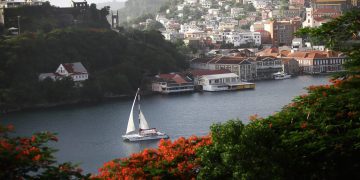
What can’t be ended must be endured. At this point, while conditions begin to calm, we have come not much more than halfway. We continue slugging. Captain George is exhausted and hungry and none of us can come to his rescue. He manages with crackers and caffeine. With daylight, my inner ear begins to cooperate and I can do small assists. At last, 20 hours later, for what should have been a 12-hour crossing at the most, we steer the boat into Prickly Bay, Grenada and anchor safely.
Captain George gathers his boat papers and passports, lowers the dinghy off the davits into the water and heads into the customs office. Exhausted, standing in line for customs, he experiences the effects of the last 24 hours, and tells the customs officers that he feels faint and needs to lie down. After a rest on the sofa, he feels more stable. After he tells the customs officers the passage story, the officer in charge suggests that maybe George needs to stay with them for a while longer until he gains some strength.
As he rests, they tell him they have seen this before — immediately after carnival, boaters leave Trinidad, not yet recovered from the carnival ruckus, and don’t fare well on the trip. We haven’t fared well. However, George manages to check the boat in, clears the crew with immigration and returns to Makaru. With some food, he collapses for many hours. The rest of the crew slowly recoups.
When planning a passage, you try and gather data on the wind, weather, sea conditions, etc. But sometimes none of those sources prepare you for the actual conditions on the sea. And perhaps, one should not bring an inexperienced crew on an “into the wind” 75-mile night passage, tired from carnival, and stuffed with greasy lasagna! And, on a rough passage with current and wind against you, double secure the anchors! I was right. I don’t like nighttime sailing.
I looked forward to our next bright sunshine sail. And it came along with catching a large delicious mahi mahi.
Ruth and George Parsons sailed their catamaran, Makaru, for 20 winter seasons, from the west coast of Florida to Trinidad and Tobago, where they stored their boat during the summers, and learned to play steel drums with local Carnival bands. Ruth was a Fulbright Scholar at the University of the West Indies in St. Augustine, Trinidad. Her memoir, A Long Way from Rough Creek, captures many of their adventures up and down the island chain, as well as other events.