




Adapted from Lin Pardey’s Cost Conscious Cruiser
This is the third of a four-part Caribbean Compass series by Lin Pardey, adapting and updating material from her book, Cost Conscious Cruiser. Additional installemnts can be found below.
Cost Control While You Cruise, Part 2
Cost Control While You Cruise, Part 3
New Year’s, a time when our wide-flung fleet of cruising friends – even those who hate writing – send us emails and yes, some even send letters letting us know where they are, and how they have fared. Because the majority of these newsletters and notes come from people who have broken free to explore under sail, we gain considerable insight into how cruising styles, cruising locations, and personal choices affect cruising costs. And year after year, the same patterns seem to emerge. Although boat size will always affect cruising costs, comparing the experiences of two of our most budget-minded friends over the past year highlights other major factors that keep some people cruising within their financial means while others “break the bank.”
The crew on one 40-year-old, 35-foot (10.7m) sloop, both in their early 30’s, stuck to their $1,000-a-month budget, even though they were exploring in Norway, possibly the most expensive country in the world (one glass of beer, US$25 at a grocery store, US$50 in a cafe). The other couple, on a brand-new, classic-design 28-footer (6.7m) built of GRP, were cruising in Mexico, a country known for its relatively low cost of living (one beer, 50 cents). This couple is returning home a year earlier than planned, having overrun their $1,200-a-month budget by almost double. What are the major differences? The crew on the first boat, along with most of our friends who stay on target year-in, year out:
1. made their boat unstoppable;
2. kept sailing in light breezes;
3. were willing to postpone repairs of nonessential gear until a more appropriate time;
4. were comfortable being at anchor instead of in marinas;
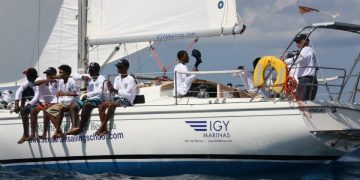
5. did not enter races/rallies and limited the time they spent sailing in company;
6. slowed down and spent a lot of their time with local people.
As we discuss in detail these and some of the other less obvious ways you can cut your cash expenditures, you will notice that many offer other benefits. These range from saving time during the ideal sailing season to adding emotional pleasure to your cruise.
Make your boat unstoppable

Achieving this requires that you accept that your boat is first and foremost a sailing machine, the engine an auxiliary and convenience. If you outfit it from this premise, then practice sailing to gain confidence in your skills before you set off, you will be en route to unstoppability. The next step is to make sure that all of the essentials – from sailhandling to steering to food storage and preparation to navigation – can be done with gear that can be repaired by you and/or is not dependent on the engine or the boat’s electrical system. In many instances, this can be achieved by carrying self-contained backup gear powered by solar cells, or dry-cell batteries. A back-up handheld GPS, a sextant, printed charts, separate solar powered cabin and navigation lights, hand pumps for water systems, a backup single-burner camping stove – all these mean you can sail onward even if the electrical system or the engine fails or you run out of fuel.
When we were at anchor at St. Helena Island, one of the most isolated communities in the world, the owner and crew on a 40-foot (12.2m) ketch arrived, their crew frightened and disillusioned because their engine had seized and nothing on board worked – no lights, refrigeration, navigation gear, or anchor winch, nor water pumps. They had no way to get fresh water out of their bilge tanks (the tanks had no visible inspection plates large enough to scoop out some water). The next scheduled supply ship wasn’t due for ten weeks. At that time there was no airport on the island (an airport was finally built in 2016 but didn’t have scheduled flights for a few years after that).
The owner contacted the Royal Cape Yacht Club and arranged for another yacht to bring parts and a yacht delivery team. Six weeks of lying in the swell-tossed roadstead gave him time to realize that he wasn’t comfortable having his life controlled by machinery. So, he reconsidered his dream. When parts arrived and repairs were finished, he and his crew returned to South Africa, where the boat was sold. An extreme case? No. We’ve seen variations on this story all over the world. The cost of trying to get any but the simplest of gear fixed “right now” in Tonga could be twice the cost of waiting until you sail to New Zealand, where parts and repairs are not only available but also dependable.
Even with non-interdependent gear, some people cannot bear the idea of knowing that something on board isn’t working correctly. They want it fixed “right now.” We were in Bora Bora, French Polynesia, when a sailor I’ll call Dave decided he was going to solve the problem of batteries that didn’t seem to stay topped up. The boat was a fine sailing machine and Dave and his wife were both good sailors. In fact, we were all at dinner together when his wife suggested they live with the problem and sail on to American Samoa, where they knew good repair people were available and it would be relatively inexpensive to buy new batteries if required. But Dave persisted. The repair turned into a three-week saga of living with a disassembled boat and a frustrated family. Over cocktails one evening, his wife said, “It’s not the money that hurts, it’s that we are here in the middle of paradise spending day after day being too upset to enjoy it all.” Dave finally had to fly to Papeete and carry back new batteries. When he installed the batteries, he was heartbroken to find the whole problem had been the fault of a bad connection between the ground strap and the engine block.
On the other hand, consider Laura and Randy Hacker-Durbin. They had been cruising the Pacific for two years on their self-built 40-foot (12.2m) cat-ketch Pollen Path. Laura sent us a letter outlining their concerns when the approaching cyclone season made it important that they set sail from Lautoka, Fiji, to the safe haven of New Zealand, even though their engine had packed up. After ten days of sometimes sailing, they reached the entrance to New Zealand’s Bay of Islands, where a new adventure began. The breeze died down to a whisper and as Laura wrote, “Andy began digging the dinghy and outboard out of the forepeak to lash it alongside and motor us in. But for me it became a challenge to see if we could sail the whole way from Fiji. We began ghosting up the channel on the incoming tide. The satisfaction was immense when we dropped the anchor. The passage became a real accomplishment for both of us – we had sailed the whole way.” They definitely illustrate the advantage of creating an unstoppable boat.
This is the first of a four-part Caribbean Compass series by Lin Pardey, adapting and updating material from her 1998 book, Cost Conscious Cruiser, available from Amazon (amzn.to/3o7CuGn), or ask for it at your local bookstore. She’ll continue with tips two through six in coming issues. And check out her blog at pardeytime.blogspot.com.