




By Olivia Hackshaw
Photos courtesy Olivia Hackshaw, color restoration on vintage photos by Peter Jones
By no means am I a landlubber. I was born and raised on the island of St. Lucia in the Lesser Antilles. In the absence of air transport, visiting family and friends in our island neighborhood was a maritime affair. At the age of five months, my parents nonchalantly but carefully lashed my cot to the deck of a beautiful inter-island schooner and away we sailed to neighboring Martinique for Bastille Day celebrations. The animal and vegetable cargo were stowed below deck.
The Columbia, most likely Grenadines-built, was representative of the transportation system that moved goods and persons. As diesel augmented sail, those vessels became sooty, grimy, not so clean, but that aspect was overshadowed by the graceful beauty of wind-filled sails. They plied these waters well into the 1970s.
Passenger services began to be provided by entrepreneurs via a plethora of “converted” craft. Among others these included a minesweeper, a Norwegian fishing boat and yes, the presidential yacht Potomac, once the hangout of Theodore Roosevelt. My sister and I used it one year on our school holiday trip to neighboring St. Vincent.
My dad was a shipping agent and we often went down to the wharf with him. I knew every boat in Castries harbor and visited lots of them. Recreational activities with the cousins were on board another conversion, a World War II patrol boat, and later, a succession of speedboats — Bertram, Cigarette, etc. From time to time a cabin cruiser would come in and leave quietly without fuss. They were privately owned; guests from some movieland or other were hosted by the owner. Sir Winston Churchill passed through one afternoon on the famous Christina, owned by shipping magnate Aristotle Onassis.
Private sailing yachts, though, were still a rarity and the domain of intrepid adventurers from far-off lands. They went at their own pace, stopping to explore, rest or repair as needed. Cruising is as old as mankind, but the concept of chartering was not fully appreciated back then.
Our neighborhood
There were relatively few kids in our neighborhood. In the late 1950s a Canadian family rented the house next door. Captain Walter Boudreau was about to plant the seeds of a charter industry that would later take root.

They had five kids of various ages, about ten years to six months. The two older boys, Lou and Peter, mixed well, and we often wandered through each other’s yards and verandahs. They spoke excitedly of Dad’s three beautiful boats and on rare occasion would point them out in the harbor just below our houses. They soon left to begin their new life in Marigot Bay.
I chose a career in nursing and undertook training and studies in Britain for six years. I completed my specialty in psychiatric nursing at a prestigious, world-renowned hospital in London. Landing a job at our local hospital, I got a shock, and did not quite see it as a location for professional growth. My nearest and dearest thought I’d soon be settling down, but I was looking for my next adventure.
An advert in the mid-week edition of the local newspaper caught my eye. “Crew needed for a large charter yacht.” The female answering asked if I had any sailing experience. “No,” I said but I had “other assets.” She asked me to repeat it, so I did. I didn’t clarify further, but they gave me an interview date and time.
Captain Boudreau, my old neighbor and the owner/skipper of the 110-foot schooner Janeen, was interviewing. Recognizing me at once, he smiled and inquired about my tertiary education. He told me that the job was that of stewardess, one of two. His description of the duties was evidently aimed at trying to make the job look tough. I assured him that British nurse training prepared one for the toughest of jobs. He seemed convinced. I was hired.
At Sea
There were eight guests and 12 crew — a generous ratio. The latter represented Canada, US, Grenada, St. Vincent, and St. Lucia. Skipper ran a tight ship, yet the atmosphere was relaxed with undercurrents of fun and an unspoken camaraderie. The guests were expectedly well-heeled, both old and new money, but not demanding and easy to look after. Boundaries always observed, we enjoyed our guests, but we may well have looked after the boat more than them!
Out of sheer love, I think, we had paint sparkling, brass and walnut paneling shining. No modern appliances, everything manual and, as customary for an old boat built back in the day, nothing synthetic to ease the strain of some tasks.
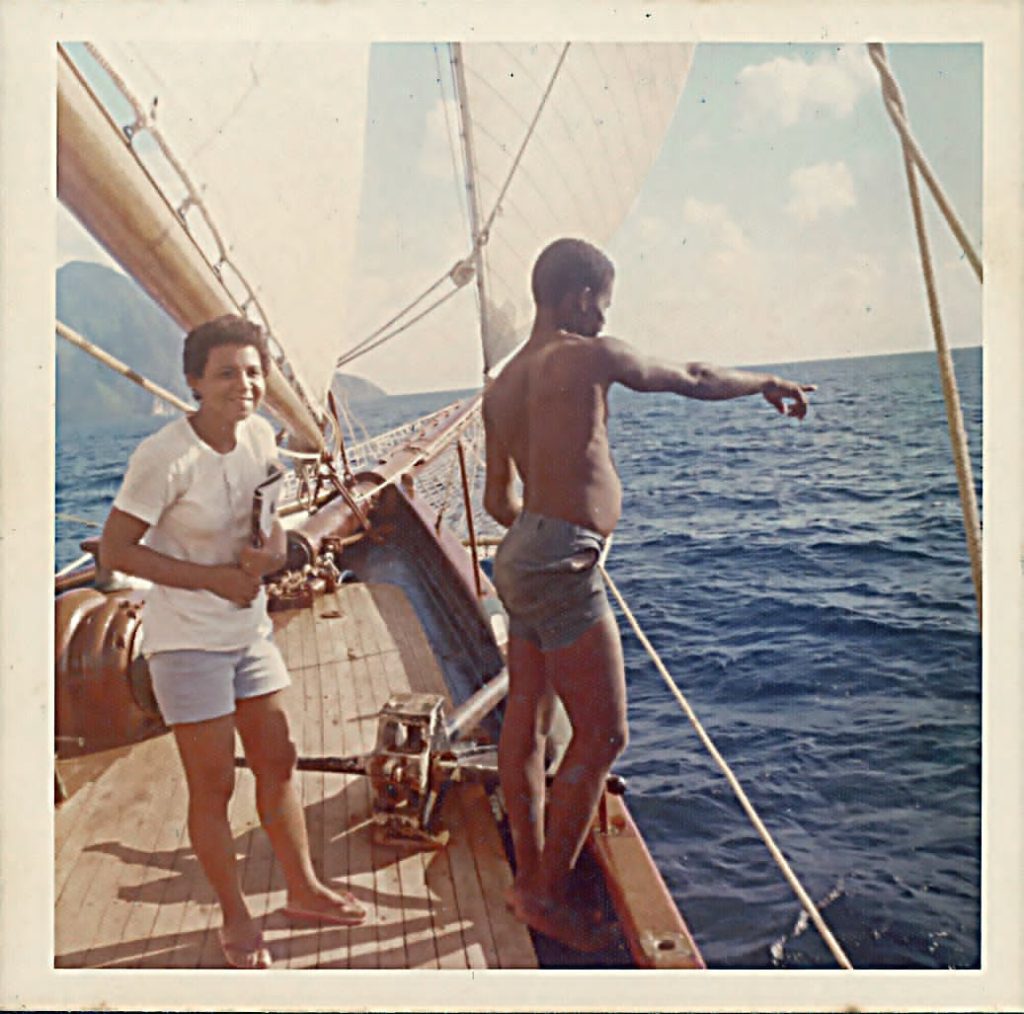
As previously indicated, I did not know a sheet from a cleat, but my duties did not require me to learn how to sail. The Boudreau boys were no longer playmates but shipmates, now experienced mariners. They taught me all sorts of things about this new world. There were far fewer boats than now, giving us a chance to get more than a glimpse of the few others in our class. Soon words like “Alden” and “Herreshoff” design became familiar, and I learned that alongside of chartering, there was the growing activity of bare boating. The magic of mechanical roller-reefing was pointed out to me — a stark comparison to the traditional performance on our boat. The Boudreau family could give a history of just about everything afloat.
There are two very nice hulls that stick out in my memory. We seemed to see them everywhere so that to my mind, they even had personalities of their own. The sleek, black hulled Marie Pierre spoke of sophistication and self- assuredness. Fandango was broader beamed, white hulled, and it exuded an open friendliness. I imagined that we looked content and confident — that was the atmosphere on board, anyway. (I spoke of them some 35 years later as I drove along in a Bequia taxi. The driver looked thoughtful and even distant. Finally, he admitted he’d known them when he was a young lad. “Those nice ones don’t come here anymore,” he wistfully declared.)
On Christmas Eve morning in 1973, I hopped up on deck to survey Port Elizabeth, Bequia. Those two were in port — we had company. Three of the most beautiful schooners in the Caribbean were in port together. What a sight! It was the Universe’s gift to me.
The bad news came after breakfast. Our good-natured guests suggested we leave for St. Lucia so the crew could get some home time with family. Surrounded by those beauties, a teak deck beneath my feet, I was already home! For those two seasons I viewed my neighboring Caribbean isles from the best vantage point —the deck of a sailboat. We covered the Virgin Islands, the French territories, the Lesser Antilles as far south as Grenada.
Charter Life
On a regular basis, every charter boat operator will have to face some untoward incidents. We had our share. They can’t be swept below deck (metaphorically) or the whole operation could sink (literally).
An after-midnight fire in the lazarette was hastily extinguished. At anchor in a remote bay in the Virgin Islands we all felt a bump in the dead of night. It was a sportfisher party of three who’d evidently lost their way. Informed that they were nowhere near St Thomas, one of them asked “How the hell did we miss St. Thomas?!”
An unauthorized absence of some crew meant we leave for Martinique without them. It was all hands on deck, with me actually pulling a couple of ropes! And finally my clinical skills were put to use in executing some primitive surgery on a painful face abscess of a young St. Lucian crewman. It worked very well.
Half a century has flown by. It is now 2025, and a not so new millennium. There are so many more boats afloat on these waters, but it still does not feel overcrowded. They come in all sizes and all designs but one no longer tries to keep up with who might be on board. Perhaps the celebs like it so. Maybe 40 or so miles from my front porch in southern St. Lucia lies Bequia, that little gem. It makes a nice getaway. In Port Elizabeth the Friendship Rose sways gently at anchor. Fifty years ago she too was a pretty sight as she daily carried passengers and supplies between Bequia and St. Vincent. The nine-mile journey can sometimes be one of the roughest passages in the Caribbean, but faithfully, dutifully, she’d churn her way through, delivering the goods. She is the last survivor of her class, a gaff-rig, Bequia-built beauty, never retired. She ferries day trippers to the Tobago Cays.

In 2023 I did just that. It was my 76th birthday gift to myself. The roles were reversed now: Its crew waited on me and even produced a scrumptious chocolate cake! That birthday week the ultra-modern Bayesian seemed to follow me around the southern Grenadines. I am happy I did not follow her to the Mediterranean, where in just a few minutes a freak storm took her to a watery grave.
Now I am neither boat owner, cruiser or charterer. In the autumn of my years the adventures take place down Memory Lane. I am really grateful to Captain Walter Boudreau for giving me that opportunity to have been part of the evolution (if not genesis) of Caribbean chartering.
In 2022, the Charter Yacht Brokers Association posthumously honored the skipper. The plaque described him as “Pioneer in Charter Yachting- Schoonerman.” Like him, though possibly for different reasons, I simply adore those old schooners. It is comforting to know that Antigua continues to provide a niche where annually, originals and replicas strut their stuff. Every December, St. Lucia welcomes the ARC voyagers. They too come in all designs and sizes as well as all ages (boats and crew).
I personally want to welcome every mariner who ends up in my Caribbean for I know that in the hearts of every one of you is a burning desire for adventure. Whether cruising or chartering, may you find it here!
Olivia Hackshaw is a retired nurse living in St. Lucia.