




by Chris Doyle
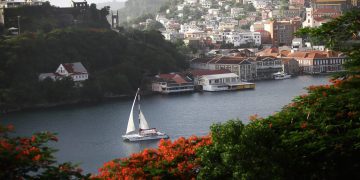
In the early 1970s Grenada was quiet and tranquil. About a dozen grand old charter yachts from 50-70 feet long were in the lagoon, along with a few individually owned bareboats. One, Rustler of Arne, was mine. There were maybe 40 cruising boats owned by cruisers and locals on the island, generally in the 30-40-foot range, and six knots was considered fast.
Most yachts were on the docks of Grenada Yacht Services (GYS), a much smaller marina than Port Louis, which now takes its place. GYS had a screw lift to haul the larger yachts, and Prickly Bay on the south coast had a railway and a small dock. Grenada Yacht Club, across the water from GYS, was the other popular yachting facility. Nowadays, if you look at the yacht club, it is sandwiched tight into St. George’s port and has a fuel dock and a good many docks for local boats. Back then, the port was smaller and did not even touch the lagoon. Grenada Yacht Club stood on a piece of land called the Spout, with a clear view across the entry passage and out to sea. We would sit on the deck with drinks in hand and watch as boats passed through the narrow channel. Occasionally, my friend Ron Smith would give me a call and offer me a blow-by-blow account of Rustler when charters ran aground.

In those days the yacht club had a dock extending to sea, where a boat could come alongside, and parallel to this was a simple railway with a wooden cradle and a hand-crank winch. Those with enough energy could haul boats of 30-35 feet. Hauling was laborious, launching was trickier. The slope was insufficient to allow the boat to roll gracefully into the water. The way to launch was to let out plenty of cable so the trailer was free to roll. To get it started, you needed a few people to push hard downhill till the cradle got up enough speed to launch the boat with a giant splash.
Grenada Yacht Club was a popular meeting spot for members and cruisers, with a basic bar and restaurant. Regattas were arranged from here, as was an annual fishing tournament. Don Street was often around. He had a house on the ridge above Benje Bay and lived in Grenada much of the time. He refitted his boat Iolaire several times on the yacht club dock. I remember the first time I met him. My friend John Hazlehurst, owner of Paisano, one of the grand old charter fleet, took me to meet him by car. We rattled down this rutted road and came to a small well-worn wooden house. Beside it stood a large iron-framework rusty windmill, stationary despite the breeze. Out came a figure slim of build, wearing a large straw hat, with strands of hair showing below. He had a long scraggly full beard, ginger in color, which hid many of the buttons on his shirt but did not make it down to his jeans. He welcomed us in the high-pitched voice that earned him the nickname “Squeaky.” I thought for a moment I was somehow in Appalachia, but the palm trees said Grenada.
Don at this time was just starting to write his first cruising guide, taking his first steps to becoming a legend. Back then he was one of many people you might meet, Like Ray Smith, the commodore of the yacht club, his brother Ron, head of public works, plus some colorful characters anchored below including Rabbit Man and Banana Bill. There was always someone to talk to.

When I walked into the yacht club and saw Freedom’s Child on the club jetty, it was love at first sight. She cast bright yellow reflections on the calm water and was the most outrageous looking machine I had ever seen. The main hull was 37 feet long with a beam of maybe three feet at water level, flaring to five at the deck. Some twelve feet to port she was accompanied by her outrigger, 20 feet long by two feet wide. They were joined by two crossarms which curved gracefully over the water between. The arms were lashed to the hull by miles of nylon cord. She was an open boat, save about 10 feet of decked bow and stern. She had a short Bermudan ketch rig adjusted by deadeyes, with a small jib.
Her designer and builder, Russel Hawn, a young American, was about to leave for Trinidad to take part in the annual Trinidad-Grenada race. His goal was to build a boat in the local sailing fishing-boat style inexpensively and with locally available materials and labor, but to try and jazz up the design to produce a faster and more stable craft. He hoped his design might help the local fishermen get to the fishing grounds faster and be a more stable platform for fishing. People had become somewhat skeptical of his design, since in his first race he had been forced to retire with numerous problems, his crew telling tales of uncontrollable speed and disastrous gear failure. Russel planned a comeback.
It did not go well. Her mast step had collapsed, and she was towed. The local yacht club regulars now treated her as a joke. Russel fixed the mast step. It was then that I had my first sail in her. It was a pleasant afternoon, blowing about Force 4 with waves of 2-4 feet. I remember great speed, water everywhere, gushing up through the centerboard housing, and flying over the bow; the crew pumping continuously, and being fascinated by the outrigger which flew high on the port tack and buried itself in a mountain of spray on starboard. Unlike many proas, she didn’t end for end.
Russel left for a long time after that, and when he came back, he was on his way to the States. No one was interested in buying Freedom’s Child. Russel declared he was going to remove all his fittings and the sails, then sink the hulls. I traded him a lovely little sailing dinghy and a little cash for the hulls, mast, and rigging.
I needed help so I found two partners: Peter and Tony. Peter, a cruising dentist, worked for the government. Gregarious, fun and a regular at the yacht club bar, Peter was living ashore and missed sailing. Tony was a bearded introvert who was living on an ancient gaff-rigged smack, recognizable by the pile of spare spars and other paraphernalia which adorned her decks. He was generally barefoot and would wear strong pants and shirts until they wore out. His shyness could make him seem crabby, but when you got to know him, he was kind and a genius at fixing anything electronic or mechanical. People considered us an unlikely team to go proa sailing.

In a couple of months we had her ready. Cruisers gave us cast-off sails and we recut them in a defunct hotel. We ransacked our boats for pulleys and lines.
We sailed by anarchy. No skipper, but each did his own thing as he felt inclined. Although against nautical traditions, it worked well enough, and I only once remembered the helm being left for any period of time when no one wanted to take it. We put a 2-foot-wide net alongside the rear crossarm, so one of us could crawl out and sit on the outrigger, a suggestion that was met with derisive laughter from those who had experienced her wild ways.
With practice it wasn’t hard and riding the outrigger became our favorite job. Out there, and away from the helmsman’s mutterings, and the continuous straining of the sheetman, whose job was to ease and tighten the main according to how high the outrigger lifted, one could sit in quiet contentment, holding on for dear life, alternately flying and submarining as if riding a giant porpoise. The trade winds blew hard that year, we took her out, never reefing. She was the wettest boat imaginable, cutting remorselessly through every sea. Bailing with a bucket was continuous, but the feeling was wonderful.

Our first big weekend was Whitsun for St. Vincent’s ‘Round Bequia Regatta. The yacht club pundits maintained we surely wouldn’t make it, and did we have life insurance?
St Vincent is 80 miles on starboard tack from St George’s, with a string of islands between. We decided to spend the night halfway at Union. By mid-afternoon we were going well, clear to the north of Grenada, in a force 3-4 accompanied by a gentle sea. As we progressed it became apparent that the outrigger, which tended to submarine a little on the starboard tack, looked about ready to deep-six itself for good. I opened my mouth first and found I’d automatically volunteered for the job of crawling out there for a look, while the others tacked the boat to lift it a little.
The outrigger had filled up and bailing was impossible at sea as waves were continuously washing over it. We ran back to Grenada on port tack and found a little cove to anchor in. Our first problem was to get the outrigger high enough so that we could bail without the swell washing over and filling it again. So we swung the boom out opposite the outrigger and while Peter and Tony sat on the boom having a smoke, I bailed. By the time it was fixed we would be sailing in the dark — not a pleasant prospect as the breeze had freshened and we had to pass the notoriously rough Kick ‘em Jenny Rock to get to Union.
It turned out to be a magnificent sail. Freedom’s Child flew through the night almost leaping from wave to wave, blazing a trail of phosphorescence. When the strong gusts hit, she would pause a little; then everything took up in a frightening chorus of creaks and groans, and she would leap forward with an acceleration that could lay the unwary flat on their back.
The next day we reached St. Vincent in a confident mood. At the race meeting we looked at our handicap and noted with pleasure we were not the scratch boat. However, the rest of the Grenada contingent, scarcely believing we had actually arrived, formed a pressure group, and our handicap was uplifted to top of the list. If we were not popular among the yachtsmen, the kids loved us. “You in de two piece?,” they would call, “I bet a dollar you win.”
Look for Part Two of “Caribbean Reminiscences” in an upcoming issue of Caribbean Compass.