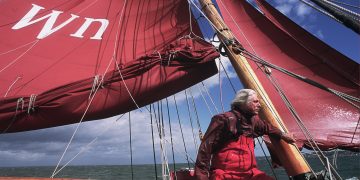




The Last Schoonerman, The Remarkable Life of Captain Lou Kenedy, by Joe Russell, The Nautical Publishing Company, paperback, 284 pages, with photos and illustrations.

The recent passing of 99-year-old Captain Niels Thomsen, whose memoirs (Voyage of the Forest Dream) were reviewed in these pages, reminds us that the stories of the men who lived and worked on cargo schooners in the 1920s and ’30s and who served their country in the Second World War are becoming increasingly rare. The Last Schoonerman is one such gem. It documents the life of Captain Lou Kenedy (1910-1991), a seafaring John Wayne with a penchant for hard work, and, if necessary, quick fists. A generous family man, Lou was also:
…a tightwad, so tight, he squeaked.…
As a perfect example of his frugality, he would choose the names of ports in which to register his vessels based on the fewest number of stencils he had to buy to paint the city’s name on the stern.
In the Northeast, he used RYE (New York) several times. ‘MIAMI’ was a favorite because it only took three stencils. If he was forced to register in a port with too many stencils, he simply would not bother painting the name on the stern. Lou’s ships often plied the “milk run,” hauling salted cod or lumber to Barbados, returning with Bajan rum and molasses, and then filling the hold with salt from Turks Island. After a scrape with the law in the US, Lou moved briefly to Barbados and established an annual round-the island schooner race in 1936, which was won by his 115-foot Sea Fox (built in Sweden in 1888).
For four years the race featured 15 to 18 entrants, but Sea Fox won every time and was even immortalized by a calypso, “The Sea Fox beat up the Mona Marie.”
It was also in Barbados that Lou met and married his wife, Pat, the beautiful socialite daughter of a Scottish doctor. The wedding was frowned upon by both sets of parents; Lou’s mother didn’t attend the wedding, thinking Pat was black, and Pat’s parents were not thrilled at the thought of a rough-and-tumble sea captain for their daughter, not realizing that Lou’s family was also socially prominent in Stamford, Connecticut. It was a match that endured tough times as well as good times, as Pat was salty enough to work as a cook on several of Lou’s ships until the couple bought a home in Nova Scotia so that their fast expanding family could settle down. Lou started his sailing career in a rowboat with main and jib, at age 11 graduating to a small keeled sloop (he called it Tilky — This Is Lou Kenedy’s Yacht) and at 14, a 25-foot Maine fishing boat. In the summers, Lou and his crew sailed around Block Island, Martha’s Vineyard, as far north as Gloucester, occasionally stealing food from a farmer’s field or liberating lobsters to upgrade their larder, which was described as “pretty awful.”
At 18 years, the strapping 200-pounder dropped out of Georgetown University to work on a Chesapeake schooner for 18 dollars a month. He moved on and hauled lumber from the northeast US to Nova Scotia and worked as a rigger at a New York yacht club before signing on to his first commercial, square-rigged ship, the 1,800-ton Tusitala, in 1930, bound for Hawaii. On returning, Lou studied for three months and earned his Master’s ticket on the day after he turned 21. He then set off with a buddy in a Stutz Black Hawk for Lunenburg to purchase his first three-masted schooner, Abundance.
On her second voyage Abundance was destroyed on a Jamaican reef and Lou’s second ship, the 500- ton Adams, sank when her seams opened with a hold full of salt, but Lou was never without command of a vessel for very long. Author Joe Russell sensibly separates Lou’s ten vessels (he owned 115-foot Sea Fox twice) into 11 chapters in chronological order.
Sailing romantics may be dismayed to find that Lou turned towards power boats in the ’60s, hauling freight from Miami to the Bahamas, but he ended up by retiring on a 62-foot motorsailer (renamed Sea Fox, after his beloved schooner), which he and Pat cruised up and down the east coast from the Bahamas to Nova Scotia, visiting family and friends, until he was 75.
For all the years in between, author Russell combines compassion, wit, and thorough research into his telling of Lou’s countless adventures of a lifetime at sea, including close encounters with hurricanes, the law, union toughs, and local hoods. Many photographs accompany the text to make this a compelling read.
Wawaloam, Lou’s fourth schooner, was sunk by a German U-boat. The captain allowed Lou to come on board the surfaced sub while his crew stayed afloat in two dories; Lou had the presence of mind to ask for a tow closer to port!
One young officer grabbed his crotch and said, “Er hat Messingtestikel,” and they all laughed.
“What did he say?” Lou asked.
“Your balls are made of brass!”
The captain politely refused the tow, but he radioed the missing ship’s position to increase their chance of rescue. He also gave Lou some flares, which saved them on their sixth night at sea. All hands were rescued as well as Butch, Lou’s pet German shepherd, by an Irish freighter. On the first try, the crewman hauling Butch over the ship’s rail cried, “Oh my Lord Jesus, ’tis a great beast,” and dropped him back into the sea. Lou shouted up, “You dumb sonofabitch, haul this dog aboard or I’ll personally come up there and beat the living crap out of you. This dog’s a survivor, for Christ’s sake.” They hauled Butch back on board, no worse for wear. After the war, Lou tried to contact the German skipper but was told that the Allies sank his U-boat. “I would have liked, after the war, to get together with him over a couple of beers and compare notes of our adventures,” Lou reflected, years later.
Reading Lou Kenedy’s life story, one truly appreciates what captains and able seamen went through in the days of commercial sailing, and how the survivors had to adapt. Lou was the ultimate survivor. He was no saint, but I would have loved to have raised a pint or two with him.