




Introduction by Bill Woodroffe
I just finished reading a wonderful book, Harry and Me: Adventures at Sea by Melinda Schell. It is much more than wonderful, and a few words can’t describe a lifetime adventure.
Maureen and I were very fortunate to meet Melinda and Harry Schell in 2012 in Florida. Without Harry’s help, we would never have sailed to the Bahamas. By the time we both got to Georgetown, Harry had introduced me to SSB radio, particularly Cruiseheimers, while Melinda had taught us Farkle and Mexican Train dominoes and so much more! We knew we had friends for life. We returned north and headed back to New York while they continued south on amazing adventures in the east and west Caribbean. I always wondered what our lives would have been like if we had made the decision to follow them.
This book might be an answer to that question.
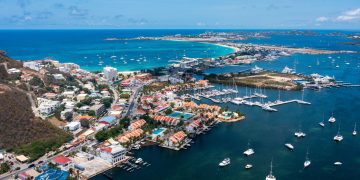
On a passage to St. Martin at about 3 AM, I was on watch while Harry was sleeping. I looked up and there it was: the Southern Cross. It was a perfect cross and so bright. Then I turned around and there was the North Star. I was so excited. I called on the radio to tell everyone and then I woke Harry up because it was a sight we might only see once in a lifetime. Crosby, Stills, and Nash would have loved it.
Their song, “Southern Cross,” says, “When you see the Southern Cross for the first time, you understand now why you came this way.”
After St. Martin, we went to St. Lucia. St. Lucia is a great place for visitors because there is so much to do. We spent a long time there before making our way to the south end of the island under the Piton mountains. We made our way down the Leeward Islands and then the Windward Islands to Grenada and Trinidad. It took us close to a year, but it was filled with the most exciting and fun adventures. We stopped at all the islands, getting to know the local people and their customs, eating food we had never heard of, and, of course, meeting many more sailors.
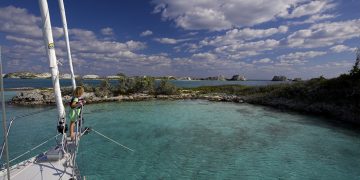
We had never socialized so much in our lives until we started living aboard. Every night we had “sundowners” either on our boat or someone else’s. What an experience. We would anchor out in the middle of nowhere and other boats would come in and anchor nearby. Then someone would get on the radio and say, “Come to our boat for sundowners!”
Total strangers became close friends in one evening. The established protocol was to bring your own drinks and something small to pass. I found I had to keep certain provisions on my boat at all times so I always had something to share. This became the norm for all our years of sailing. It was not too great for our waistlines, though; thank heavens we did a tremendous amount of walking on the islands, exploring, finding grocery stores, and doing laundry. It was amazing how easy it was to make new friends. I guess it was because we had so much in common. We also learned a ton of information about navigating waters, charts, and how to fix our boat. Everyone had something different to offer and, boy, did we soak it up.
All our sailing disasters happen at night for some reason. It was 3 AM, and I was at the helm. Harry was sleeping like a baby, which I could never do when we were on passages. All of a sudden, the mainsail went flying out into the open water. It is held down by a traveler. The end of the traveler came off, so the attachment to the boom went flying and, of course, the sail went with it. Not only did it scare me to death, but it made such a noise that “sleeping beauty” woke up and came running into the cockpit. It took the rest of the night to figure out how to get that sail back in, reattach it, and seal the end of the traveler. Needless to say, no sleep happened that night.
In Trinidad, we learned about cruising down the Orinoco River in Venezuela. So two other boats and Sea Schell crossed the Gulf of Paria to the delta of the Orinoco River. The Orinoco eventually connects to the Amazon. We sailed down about 30 or 40 miles before we turned around, so we never actually found the Amazon. We met the Warao Indians, which was one of our most interesting adventures. They live on the riverbanks on platforms with no walls. They bathe in the river and perform basic needs there as well. We did not speak Warao and they did not speak Spanish, so we did a lot of hand maneuvering. The children have dugout canoes and paddled up and down the river. We were told they would come to our boat and beg, so we were asked to bring things they would need but not to give them away unless they came bearing gifts of some kind. They brought beads and baskets that they had made, all very pretty, so then we could offer things to them. We were only to give them basics like flour, sugar, and rice. Also, the women loved brightly colored materials to make clothes. We had gone into Chaguanas in Trinidad to buy material, thread, fishing line, shampoo, and toothpaste for them. They loved it.

They invited us to their homes and loved to show us what they had. No furniture, no walls. Their clothes were in stacks and they slept on man-made cushions on the floor. They had a generator which kept an empty freezer running. They had no idea what a freezer was, so there was nothing in it. There was a washing machine not hooked up and one TV (run on the generator) which only broadcasted a government channel in Spanish. They didn’t speak Spanish, so they had no idea what to do with this. We found out Chavez gave them these appliances only if they voted for him. There was a makeshift schoolroom with chairs and a blackboard. A teacher came once a month for a day to teach Spanish and dental hygiene. Their teeth were in bad shape because they suck on sugarcane all day. I am not sure I have painted an accurate picture of this colony of people, but it was an eye-opening experience. They were very gracious people with big smiles and warm hearts. The children had beautiful smiles.
Buy Harry and Me: Adventures at Sea at www.amazon.com/Harry-Me-adventures-sea-Sailboat/dp/B0HF21CKRC