




Story and photos by Lexi Fisher
Though I’ve spent significant time in Trinidad working on boat projects over the years, our Trinidad & Tobago guide content hadn’t been updated since 2012. In the years that followed, the local yachting industry dipped, mostly because of security concerns linked to unrest in nearby Venezuela. Between 2015 and 2019, there were a handful of piracy incidents between Grenada and Trinidad. The Trinidad government took it seriously, increasing coast guard patrols and creating a floatplan program with North Post Radio. It’s been effective, with no incidents since 2019 (see Caribbean Safety and Security Network, thecssn.org, for details).
As boats began returning, many were surprised by the welcome they received. One cruiser told me, “Everywhere else we’ve hauled out, it felt like they were doing us a favor. Here, it’s been the opposite.” Service providers know cruisers remain wary and have built a reputation for going above and beyond.
While news reports about Trinidad’s crime rate can also be alarming, the reality for visiting sailors is different. Most of it is gang-related and concentrated in the capital, Port of Spain. Chaguaramas, the island’s yachting center, is considered safe from violent crime, and for a while, Trinidad seemed like a bit of an industry secret. Then, in early 2024, Hurricane Beryl pushed yachts south from Grenada in search of safety. While some yachts only stuck around long enough to wait out the storm, others stayed to explore. Most left with a positive impression. With hurricane unpredictability on everyone’s mind, it seemed like the right time to finally update the guide.
It was May 2025, and I had just finished updating our Windward Islands content. I was looking forward to spending some time at my desk, but if I wanted to get the Trinidad and Tobago updates out before the end of hurricane season, then now was the time to do the research. And so, my father Jeff and I set off from Grenada on Ti Kanot, a 40-foot catamaran, back to where she was built in the yachting center of Trinidad — Chaguaramas.


The last time we’d checked in pre-Covid, boats were required to tie up at the customs dock immediately upon arrival and then go to the customs and immigration offices to fill out endless triplicate forms. This time, the officer asked for our “Port Health Clearance” (AKA Maritime Declaration of Health Form). Confused, we learned it was a Covid-era form that had stuck around, and that since then, the major marinas had been processing the health form for their customers in advance of arrival and compiling it with all the other required paperwork, for them to take to the customs and immigration offices. It’s more work for the yard offices, but it simplifies the process for cruisers.
I pulled out the trusty old folding bike and lugged it ashore to start my rounds. After a few days of pounding the pavement visiting businesses and taking photos and notes, I decided to get up early to explore the nearby 135-square-mile Chaguaramas National Park. One of my goals for the guide was to not just update the many general and technical yacht services in the area, but also to encourage yachtspeople to explore beyond the yards and experience some of the wonderful and unique ecological and cultural attractions Trinidad has to offer — one of which is right in the middle of Chaguaramas: Bamboo Cathedral and the howler monkeys that often gather there in the early mornings. Trinidad’s ecology is more similar to that of Venezuela and South America than the rest of the Caribbean, and it is the only Caribbean island where howler monkeys are found. With their calls able to travel up to three miles away, they are the world’s loudest land mammals, and recordings of them were used as part of Jurassic Park’s sound effects for T-Rex.
When I got to Bamboo Cathedral a handful of monkeys were there, swaying in the arches of criss-crossed bamboo, totally unbothered by the walkers and cyclists passing below. At first, they were silent, but then one of them started, and a cacophony followed. Stretching the deep Os of their mouths like megaphones, they projected deep, throaty howls, reminiscent of diesel engines in desperate need of servicing. I could almost feel them reverberating through my body. It was spectacular, this mind-boggling noise coming from such average-looking monkeys sitting in the treetops.
I was also looking forward to visiting the main local market where hundreds of vendors sell local fruits, vegetables, bottles of hot sauces, local spices, cuts of fresh local meat, and dozens of types of fresh fish. There are also massive grocery stores, shopping malls, and a Costco-like wholesale store, all a short bus ride away, but the market is the place to go for a truly local experience. Jesse James’s taxi service organizes multiple weekly shopping trips that pick up and drop off from the boatyards so you don’t have to lug all your bags back on the public bus; other groups have the same service. I took the shopping bus, and met a family that was planning to do the Caroni Swamp tour the next day. I had done the tour years ago but was eager to join them and do it again.
The term “swamp” doesn’t do it much justice. It’s a 6,000-hectare Wetland of International Importance under the Ramsar Convention with mangrove forests, brackish channels, and intertidal mudflats. After getting us seated in the large pirogue, our tour guide started the outboard and putted us down the muddy channel. Mangroves encroached on either side, their prop roots reaching down from high above and more than once forcing us to bob and weave our heads out of their way. It wasn’t long before the guide pulled us alongside the channel to point out a couple of owls hiding among the branches, and then a tree boa curled tightly in the branches above the boat. Herons and egrets stalked the treeline for unlucky crabs, and kingfishers trilled as they swooped among the branches. We pulled over again to look at a silky anteater, the world’s smallest species, that looked like nothing more than a ball of light brown fuzz barely larger than a fist.
And then it was time for the show we had all come for. We motored to the other side of the lagoon, tied to a post, killed the engine, and waited quietly. It was late afternoon, and the sun hung low in the sky behind us. Minutes ticked by, and I started to get nervous. What if they didn’t show? And then, from the distance to our left, a handful of bright red scarlet ibis emerged from over the treetops and swooped down onto the mangrove island in front of us. And then another, and another, until dozens of them were circling and settling into their roost. The golden light of the setting sun emblazoned their already fiery-red feathers and long, pointy beaks, and they almost seemed to glow. “Oooh”s and “Ahhh”s rolled over the group as we sat entranced.
We also spent some time exploring the nearby offshore islands of Gaspare Grande, Chacachacare, and Monos. Monos and Gaspare Grande are populated with holiday homes, but Chacachacare is a former leper colony where most of the buildings are abandoned. Exploring ashore is an interesting, if not eerie, experience.
And then it was time to head to Tobago. I lugged the bike back to the boat and my dad went to deal with Customs and Immigration. Even though Trinidad and Tobago are the same country, you are required to get your papers endorsed before transiting between the two.
We wanted to make the 100-nautical-mile passage to the anchorage at the Tobago village of Charlotteville in as much daylight as possible, so we set off around 5 a.m., motor-sailing through the Bocas and northeast along the coast of Trinidad. The wind was light and we stuck close to shore where the water was calmest. It was leatherback turtle nesting season, and Trinidad’s north coast bays are known for their nesting habitats. In the previous edition of the guide, founding author Chris Doyle noted once seeing more than 40 on this passage. My sightings weren’t that prolific, but I did see a few shiny, bulbous head-like things pop up out of the water in the distance.
Our first real wildlife sighting didn’t come until the afternoon, when we were about halfway across the channel between Trinidad and Tobago. I was lounging in my favorite spot, watching the wake of the boat, when something made a graceful arc out of the water. Something big. It looked like a dolphin, but was dark gray, almost black, and a little larger than a bottlenose. Pilot whales, we guessed, and we watched a handful of them jump and play off our stern for the next few minutes.


The real delight came as we were approaching Tobago and the setting sun turned the sky into one of those breathtaking Caribbean sunsets that sets the clouds on fire. My dad spotted them first. “Dolphins!” he exclaimed, “on the bow!” It was a pod of a couple dozen bottlenose dolphins, and we hurried forward to watch them glide through the water just inches from our hull, racing ahead and jumping in tandem, rolling alongside to show us their white bellies. They were more generous with their time than the pilot whales, and delighted us with their displays for what must have only been 10 minutes, though it was so spectacular the memory of it feels longer.
We inevitably arrived in Charlotteville after dark, which was less than ideal. The anchorage is deep, and space is limited since much of it is a fishing priority area. I knew moorings had been installed in the northeast corner of the bay in recent years, so we headed that way. We could see some boats gathered, but the mooring balls were difficult to spot. We finally saw one next to the headland. It seemed awfully close to the rocks. Was it a mooring, or a bleach jug marking a fish pot? Our motoring about while loudly debating mooring options got the attention of the handful of other boats in the area, and it wasn’t long before one kindly dinghied over to help us tie up to what was indeed a mooring. In the morning, we brought them a copy of the Windwards guide, and they gave us directions to the Customs and Immigration offices.
The customs officer was kind and enthusiastic, though there was a moment of panic when we realized that, due to a miscommunication, my dad had only gotten our papers stamped by immigration before leaving Trinidad, and not by customs. After apologizing and declaring our honest intention to follow the regulations, the officer made some calls and faxes and got our paperwork in order.
I spent the rest of the day exploring and updating the Charlotteville content. It’s a quiet town with just over 1,000 inhabitants, and while most of the buildings have been modernized with concrete, a few wooden clapboard houses, trimmed in delicate lace fascia, remain. One thing that hasn’t changed is the traditional fishing industry. As we walked down the long sandy beach, we came upon a group of fishermen pulling a seine net ashore as the frigatebirds and seagulls swooped, trying to secure a cut from the boiling mass of writhing silver jacks.
The non-profit Environmental Research Institute Charlotteville (ERIC) was a new addition to town. They installed and continue to maintain the 15 moorings in the bay, which help manage the relationship between visiting yachts and fishermen. They also do underwater research and monitoring, and have a PADI dive center and teach courses.
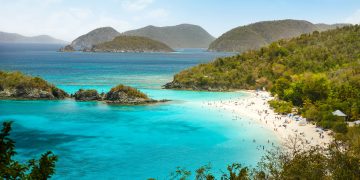
We rented a car from a local bar owner for the going rate of $300 TTD (about $50 US) per day, and to my surprise and delight, it was a hybrid. We drove up and over the center of the island and through the Tobago Main Ridge Forest Reserve, a birdwatching haven and the oldest legally protected forest reserve in the world. We spent the following days exploring the serene bays and sandy beaches of the north coast, the restaurants and more lively holiday areas around Store Bay and Pigeon Point, and chatted with other cruisers about their experiences in the islands.
Too soon, it was time to return home to Grenada. For cruisers debating the passage south, Trinidad & Tobago offers far more than safe storage and skilled boatyards. From the warmth of the people to the wildness of the landscapes, it’s a place that rewards those who make the extra effort to get there.
The updated Trinidad & Tobago sailing guide content is available digitally on the Doyle Guides mobile app.