




by Chris Doyle and Lexi Fisher
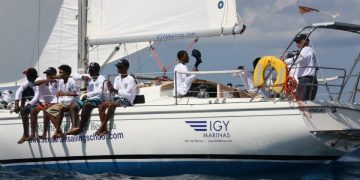
Antigua has some great historical destinations, a plethora of yacht services, and some world-renowned sailing events. The annual Antigua Sailing Week regularly sees over 100 participating yachts, from 24-foot monohulls to spectacular 100+-foot Maxis. Hundreds, if not thousands, of people gather to watch participants hoist their sails for a week of racing and fun.
From a yachting point of view, Antigua is inextricably linked with beautiful and historic English Harbour, perhaps the most famous yachting center in the Eastern Caribbean. Come the winter season, English Harbour, and the next-door Falmouth Harbour, attract a dazzling selection of the largest and fanciest sailing and power superyachts in the world. That leaves plenty of room for cruising yachts, and Antigua offers more beautiful, protected, and varied anchorages than most other islands. When you are in English, Falmouth or Jolly Harbours or anywhere with a hotel, there are plenty of restaurants. Other anchorages offer seclusion away from the bustle. Come summer, most yachts leave and the island reverts to a quiet and peaceful place.
The Antigua coast guard broadcasts weather forecasts from St. John’s on VHF channel 14 at 0100, 0900, and 1800. You should be able to receive broadcasts in most places on the west coast and maybe on passage to Barbuda.
Amid Antigua’s highest hills are areas of mixed forest, mainly dry forest. Fig Tree Drive winds through this area and offers several attractions. Wallings Reservoir is along this road and many trails start here. If you hike up Signal Hill, you will find an open area of small ponds and great views or you can hike to Rendezvous Bay. Also in these southern hills is the Antigua Rainforest Canopy Tour. This is not a conventional canopy tour, but it is exciting, good exercise, and something to remember. Much of it has been built by Bernard Nichols and it includes walking on well-designed trails and steps, and ziplining back and forth across a gorge strapped to a harness on a series of wires. The longest of these rides is 300 feet over a drop of 350 feet. This takes you downhill and you walk back up some amazing steps to a bar with a great view of the forest.
English & Falmouth Harbours
In the old days, it was hard to find secure ports that were easily defensible, with immediate access to the trade winds, yet protected enough to careen a ship and be safe in a hurricane. Falmouth Harbour and English Harbour sit side by side, almost touching at the closest point, and they meet all these requirements. Their potential was recognized as early as 1745, when work was begun on the English Harbour Dockyard. It was completed much as it stands today in around 1789 and was Britain’s main naval station in the Lesser Antilles. Lord Horatio Nelson was stationed here in 1784 under Sir Richard Hughes, who had recently blinded himself in one eye while chasing a cockroach with a fork. Later, Nelson took over as naval commander. He did not enjoy Antigua and did not get on well with Governor General William Shirley (after whom Shirley Heights is named) or the plantocracy, who resented the boring way in which Nelson insisted on enforcing the Navigation Act. This meant he kept the port closed to trade for all but British ships. Nonetheless, the dockyard is now generally known as Nelson’s Dockyard in deference to Britain’s favorite hero.

When former commander Vernon Nicholson sailed into English Harbour in 1947, the dockyard was in ruins. The arrival of Nicholson’s Charter Company in 1949 and the restoration of the ruins into a beautiful yet functional monument gave momentum to the development of the yachting industry here. Today, these harbors are managed by Nelson’s Dockyard National Park, part of the National Parks Authority. This is not only the yachting capital of Antigua, it is a major Caribbean yachting center and a UNESCO World Heritage site.
As the winter home of many gold-plated charter yachts of sail and power, both harbors have become the Caribbean’s main base for sailing superyachts, and these make a grand spectacle on the docks. English Harbour is prettier; Falmouth Harbour is more convenient for most yacht services. Many businesses are set up to sell duty-free goods to those on yachts and yacht owners can order duty-free parts. A wide range of marine services and a convivial social scene are found here, complete with happy hours and jump up nights.
In the summer this area has a quiet village atmosphere and many businesses and restaurants close. Antigua is a good base for the hurricane season as it is uncrowded and has many secure hurricane holes. The haulout facilities all take special measures to ensure that boats do not fall over.


The whole of Nelson’s Dockyard has been beautifully reconstructed to house hotels, restaurants, and businesses. The UNESCO World Heritage Site boundaries run to the ruins in the east of the area. It is an outstanding historical monument, all the better for being used. Falmouth Harbour is considerably larger and surrounded by hills.
Because the harbors are close together, most services, restaurants, and shops work for both. Most service providers are members of the Antigua and Barbuda Marine Association. You can view a copy of their cruisers directory on the website of the Antigua & Barbuda Yachting & Marine Association (ABYMA.ag).

Doyle Guides contains the Eastern Caribbean’s most comprehensive and reliable sailing guide content, available in hard copy and online through a free mobile app, website, and Facebook group.

Antigua & Barbuda Entry and Exit Procedures from Noonsite
Ports of Entry:
The two ports of entry in Antigua are English/Falmouth Harbour and Jolly Harbour. Codrington is the single port of entry in Barbuda and is possible with advanced approval.
Advance Paperwork:
All visiting yachts should pre-register with eSeaClear or SailClear before arrival. For visitors from many countries, a visa is not required. Stays of up to 90 days are granted on arrival.
Entry Process:
All vessels must clear in with Antigua Customs and Immigration upon arrival with their eSeaClear or SailClear notification ID number, crew passports and boat paperwork. A cruising permit is granted on check-in.
Exit Process:
Same as the entry process. Outstanding anchorage/park fees will be collected along with a departure fee and fees for any passengers.
Rates:
Jolly Harbour is the cheapest option for entering and exiting the country at 85EC for check-in and 20EC for check-out (credit cards not accepted). Children are deemed passengers and incur an additional charge of 75EC when clearing out.
This information is provided by Noonsite.com, specialists in worldwide formalities for yachts, and was accurate at press time. Check Noonsite clearance for more details and updates.