


ADVERTISEMENT
Caribbean Compass
  • Home
  • Cruising
  • Destinations
    • Anguilla
    • Antigua & Barbuda
      • Barbuda
    • Bahamas
    • Barbados
    • British Virgin Islands
      • Anagada
      • Jost Van Dyke
      • Norman Island
      • Virgin Gorda
    • Colombia
      • Santa Marta
    • Dominica
    • Dominican Republic
    • Grenada
      • Carriacou
    • Puerto Rico
    • St. Barts
    • St. Lucia
    • Sint Maarten & St. Martin
    • St. Vincent & Grenadines
      • Bequia
      • Canouan
      • Mayreau
      • Union Island
    • Trinidad & Tobago
    • U.S. Virgin Islands
      • St. John
      • St. Thomas
      • St. Croix
    • All Other Islands
      • Guadeloupe
      • Martinique
      • Montserrat
      • Nevis
      • Panama
      • St. Kitts
  • Events Calendar
  • Regattas & Rallies
    Antigua Defends Nations Cup Title for Seventh Year as Caribbean Dinghy Championship Marks 30th Edition in Sint Maarten

    Antigua Defends Nations Cup Title for Seventh Year as Caribbean Dinghy Championship Marks 30th Edition in Sint Maarten

    Anegada:  Cow Bones, Shipwrecks & Lobster at Sunset

    The New CSA Majors Trophy – A Grand Finale

    Team TTO Competes in Sint Maarten at the 2026 Caribbean Dinghy Championships

    Team TTO Competes in Sint Maarten at the 2026 Caribbean Dinghy Championships

    Anegada:  Cow Bones, Shipwrecks & Lobster at Sunset

    Registration Opens for the West Indies Regatta Festival 2027

    2026 Caribbean Dinghy Championship Returns to Sint Maarten for 30th Edition

    2026 Caribbean Dinghy Championship Returns to Sint Maarten for 30th Edition

    St. Vincent and the Grenadines Sends Largest-Ever Team to Caribbean Dinghy Championships

    St. Vincent and the Grenadines Sends Largest-Ever Team to Caribbean Dinghy Championships

    Anegada:  Cow Bones, Shipwrecks & Lobster at Sunset

    Salty Dawg Departures Scheduled from Florida, Bermuda

    2026 ARC and ARC+ Fleets Gather in Gran Canaria for Atlantic Crossings to the Caribbean

    2026 ARC and ARC+ Fleets Gather in Gran Canaria for Atlantic Crossings to the Caribbean

    2026 St. Barth Cata Cup Draws 42 Teams for 18th Edition

    2026 St. Barth Cata Cup Draws 42 Teams for 18th Edition

  • JOIN NEWSLETTER!
No Result
View All Result
Caribbean Compass
No Result
View All Result
Home Sea Life
Midnight parrotfish

Midnight parrotfish

Heroes of Herbivory – Fabulous Parrotfishes

Caribbean Compass by Caribbean Compass
August 7, 2023
in Sea Life
Reading Time: 5 mins read
A A

Story and Photos by Darelle Snyman

In a previous article I introduced you to some of these fabulous fishes that grace the waters of the greater Caribbean with their beauty, such as the iconic spotlight parrotfish (Sparisoma viride). Since then I have been lucky enough to encounter more members of the Scaridae clan. As a group, parrotfish need little introduction to divers and snorkelers. Their vivid colors and patterns, and their unmistakable bird-like beaks, make them easy to spot, but a potential nightmare to identify. No wonder the number of species, based on chameleon-like appearance, were once estimated to be over 300, but in reality there are only some 90 parrotfish species swimming around in coral reefs across the world.

Most parrotfish start out life as female, a stage referred to as the initial phase. As they mature, the largest individuals undergo a sex change to become male when circumstances require; this stage is referred to as the terminal phase. The process is accompanied by dramatic changes in coloration, creating male and female individuals so unlike each other that it is easy to imagine them separate species. As often happens in nature, it is the male parrotfish that are endowed with the most vivid colors and intricate patterns, while the poor females seem somewhat drab in comparison.

Rainbow parrotfish

One such show-stopper is the male queen parrotfish (Scarus vetula), a true beauty cloaked in hues of pale blue-green with distinctive bright blue to green markings around the mouth and eyes. The female, by contrast, dresses in dark gray with a pale head and a distinctive broad white stripe low on each flank. You will typically encounter the attractive male queen parrotfish with a harem of four to five females. Queen parrotfish breed year-round. During courtship, a male will constantly circle a female. If receptive, she will join him in this circling maneuver, resulting in the simultaneous release of their spawn into the surrounding water.
These procreation activities usually occur early morning; for most of the day queen parrotfish, like all their family members, actively scour the reef, scraping plants and algae from the reef surface with their renowned set of fused front teeth. This constant cleaning keeps macroalgae growth in check, allowing corals to grow and thrive, and reefs to support more fish and other marine life. It is this feeding habit that makes parrotfish irreplaceable within the reef system. Several studies have now shown that the presence of these heroes of herbivory is essential to the overall health of a reef ecosystem.
Parrotfish are not only renowned for their attractive colors and unique beak; many species, such as the queen parrotfish, are known for the mucus sleeping bag they create to sleep in at night. Unusually heavy sleepers, they are capable of ten hours of uninterrupted sleep, a long time to be vulnerable to night-time predators such as moray eels and sharks. They can create this mucus cocoon within an hour and it is believed to mask their scent and act as an early warning system, waking the fish if something brushes past it or tries to nibble at it, such as annoying parasitic isopods.

Another male stunner I swam into, while exploring the beautiful reefs of Belize, was the redband parrotfish (Sparisoma aurofrenatum)—such a gorgeous fish with its distinctive red iris and red stripe under the eye! Its blue-green body clearly shows the large, robust scales parrotfish are known for, and it bears a distinctive yellow and black spot above the pectoral base. Female redband parrotfish have been adorned with more color than some other females; their body color varies from green to a solid olive, rimmed with reddish fins. The juveniles, who do not resemble the adults at all, apart from bearing the red iris and beginnings of the parrotfish beak, prefer to keep to the safety of seagrass beds. Redband parrotfish are, like their kin, primarily herbivores, but are known extend their food repertoire beyond algae and coral polyps to sponges, crabs, brittle stars and sea urchins. When it comes to chomping down on crusty food, such as coral polyps, to extricate the soft delights hidden inside, parrotfishes have been well endowed with the right equipment. Their teeth are not only composed out of one of the hardest biominerals in the world, fluorapatite, but they also have a set of inner pharyngeal teeth that crush the food to liberate the soft morsels hidden inside. Next time you bump into a group of feeding parrotfish, listen carefully—you might hear them grinding away at the corals.

What goes in, however, needs to come out, and in the case of parrotfishes the pulverized coral skeleton gets pooped out as fine sand. It is not unusual to suddenly see a plume of fine, sand-laden poop appearing behind a feeding parrotfish. There is debate about the amount of coral sand each parrotfish produces, but estimates put it around 90 kg or nearly 200 pounds a year. Regardless of the number, it is clearly a lot, considering most of the sandy beaches we enjoy have parrotfish poop as their primary component.


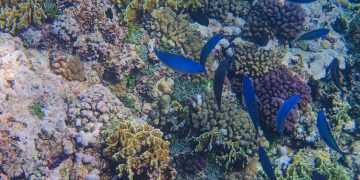
As always there are exceptions to the rule, thus there are parrotfish that defy the whole color-changing rule as they progress through their life stages. One such rebel is the midnight parrotfish (Scarus coelestinus). They retain the same coloring as they progress from juvenile through to adulthood. They might not be as attractive as some of their family members but one is unlikely to confuse them with any other parrotfish species. Their dark blue coloring, with splotches of light blue on the body and head, makes them easy to identify. I encountered them for the first time under a dock, of all places, in Isla Mujeres, Mexico. But now the conundrum is reversed—since they all look the same, it is difficult to distinguish between the sexes. But this not a problem if you don’t care and are just happy to know that you are looking at another gorgeous parrotfish.

Redband parrotfish

When it comes to feeding, midnight parrotfishes are primarily herbivorous, but evidence has shown that they also love to treat themselves to the eggs of sergeant major damselfish (Abudefduf saxatilis). They seem to love it so much that they even school with up to 30 other individuals to overwhelm the typically heavily guarded damselfish nests. Bite scars indicate that this is not an uncommon behavior. The fact that such large fish have to band together to overwhelm a tiny damselfish is to me testament of the feistiness of those arrogant little fish.

My most recent parrotfish observation has been the rainbow parrotfish (Scarus guacamaia) in the Florida Keys, moving in a small group, hugging the mangroves. They are very distinctive in coloration, but not as colorful as you would expect considering their common name. That, however, does not detract from their beauty; their front part is dressed in hues of brown-orange and the rear portion in green ending in a reddish to bronze tail with long tips (like the midnight parrotfish, both sexes have the same coloration). This beauty is among the largest of its family members, reaching respectable lengths of 1.2 m or 4 feet and can weigh in at 20 kg or 44 pounds.
These sociable fish can sometimes be seen patrolling the reef in male-dominated aggregations of up to 40. They depend on both mangrove and coral reef habitats to complete their life cycle. Their juveniles rely on mangroves for food and safety before venturing out to adjacent coral reefs. The continued loss of mangrove habitats, combined with overfishing, has placed this species in a vulnerable situation, resulting in them being listed as near threatened on the IUCN red list of threatened species. Many Caribbean countries have already made positive steps in not only protecting this species, but all parrotfish species, considering their key role in promoting coral health.


It is clear that parrotfish are not only beautiful but unique, with intriguing habits. So next time you encounter one of these stunning fish, you will appreciate that there is more going on than good looks, as they scour the reef with their routine comings and goings.
Previous Post

Test Cases: Using Satellite Data to Navigate

Next Post

August-September 2023 Caribbean Compass Now Available

Recommended For You

Caribbean Represented at Coral Reef Symposium

by Caribbean Compass
October 25, 2026
0
Caribbean Represented at Coral Reef Symposium

Twenty-three researchers and students from the University of the Virgin Islands Center for Marine and Environmental Studies delivered 26 presentations at the 16th International Coral Reef Symposium in...

Read moreDetails

A Record Year for Coral Restoration in Antigua & Barbuda

by Caribbean Compass
October 25, 2026
0
A Record Year for Coral Restoration in Antigua & Barbuda

AnuBlue has marked its most successful year of coral restoration since its establishment in 2021, planting more than 5,800 nursery-grown corals across reefs around Antigua. This represents approximately...

Read moreDetails

Ripples to Waves Needs Whale Watchers

by Caribbean Compass
September 26, 2026
0
Environmental Reporting Gains Recognition

Ripples to Waves, a Vincentian nonprofit, is calling on whale- and dolphin-watchers to be a part of its research team. The organization is inviting all ocean users to...

Read moreDetails

Alarms Sounded over Water Quality in Bonaire’s Coastal Waters

by Caribbean Compass
July 30, 2026
0
Alarms Sounded over Water Quality in Bonaire’s Coastal Waters

A new assessment of water quality in the Caribbean Netherlands identifies significant concerns related to nutrient pollution and chemical contaminants in Bonaire’s coastal waters. The Bonaire Nature Platform...

Read moreDetails

The Intricate Relationships of Caribbean Tube Worms

by Caribbean Compass
June 29, 2026
0
The Intricate Relationships of Caribbean Tube Worms

 Story and photos by Darelle Snyman  Life on a reef is built on relationships, and tube worms are no exception. These highly specialized segmented marine worms (polychaetes) have...

Read moreDetails
Next Post
Celebrating Fifty Years: The Bitter End Yacht Club Is Back!

August-September 2023 Caribbean Compass Now Available

Please login to join discussion
How to Advertise in Caribbean Compass

Compass Marketing Services

How To Submit an Article

About Us

Issue Archive

Newsletter Archive

Where to Find Compass in Print

Article Archive

Privacy Policy

Categories

  • Airlines
  • Beach Bars
  • Beaches
  • Book Reviews
  • Business
  • Carnivals
  • Cruising
  • Destinations
  • Diving
  • Eco News
  • Events
  • Geography
  • History
  • Hotels
  • Hurricanes
  • Island Spotlight
  • Magazine
  • Marinas & Boatyards
  • Navigation
  • News
  • On Shore
  • Reader's Forum
  • Recipes
  • Regattas & Rallies
  • Resorts
  • Restaurants
  • Rum
  • Sea Life
  • Tributes
  • Uncategorized
  • Weather
  • Wildlife
  • Yacht Charter
  • Yacht Services
Join Our Newsletter

Caribbean Marine Weather Resources

Caribbean Events Calendar

Reader's Forum

Center of Effort - Letter from the Editor

RECENT POSTS

  • Immigration And Maritime Services, Temporarily Relocated To Ferry Dock At Pjia During Simpson Bay Dock Refurbishment  November 1, 2026
  • Guadeloupe Announces Anchoring Restriction at Carénage November 1, 2026
  • Trapped Carriacou Boats Launched November 1, 2026
  • Caribbean Compass – November 2026 October 27, 2026
  • Antigua Defends Nations Cup Title for Seventh Year as Caribbean Dinghy Championship Marks 30th Edition in Sint Maarten October 26, 2026

© 2026 Caribbean Compass

No Result
View All Result
  • Home
  • Cruising
  • Destinations
    • Anguilla
    • Antigua & Barbuda
      • Barbuda
    • Bahamas
    • Barbados
    • British Virgin Islands
      • Anagada
      • Jost Van Dyke
      • Norman Island
      • Virgin Gorda
    • Colombia
      • Santa Marta
    • Dominica
    • Dominican Republic
    • Grenada
      • Carriacou
    • Puerto Rico
    • St. Barts
    • St. Lucia
    • Sint Maarten & St. Martin
    • St. Vincent & Grenadines
      • Bequia
      • Canouan
      • Mayreau
      • Union Island
    • Trinidad & Tobago
    • U.S. Virgin Islands
      • St. John
      • St. Thomas
      • St. Croix
    • All Other Islands
      • Guadeloupe
      • Martinique
      • Montserrat
      • Nevis
      • Panama
      • St. Kitts
  • Events Calendar
  • Regattas & Rallies
  • JOIN NEWSLETTER!

© 2026 Caribbean Compass