



By Zoë Carlton
While much of Antigua hums with election fever, English Harbour has been listening to something else entirely. No speeches, no slogans — just the crack of halyards, the creak of rigging, and the low, steady rhythm of crews intent on sailing well.
The Antigua Classic Yacht Regatta has always had its own tempo. But in 2026, it feels more assured than ever — not louder, not flashier, just fuller. At a time when fleets elsewhere in the Caribbean are thinning, the Classics have quietly expanded, with 48 boats on the start line, up from 36 last year. It is a detail worth noting, not because of what it says about numbers, but because of what it suggests about the kind of sailing people are still seeking out.
Here, the focus remains firmly on the boats.
From the moment the fleet slips out past the headland, the difference is clear. These are not yachts that can be bullied into speed. They demand patience, timing and a feel for the water that cannot be taught quickly. Sails are trimmed with care rather than urgency; decisions unfold rather than snap. As one sailor put it: “You don’t rush these boats. You listen to them.”
That spirit runs through the fleet, from the smallest entries to the most imposing classics. Century-old wooden hulls sit comfortably alongside Spirit of Tradition designs, each with its own character, each sailed as intended — not preserved, but used.
Among them, the local presence has been quietly formidable. Boats such as Freya, Bunglebird, Blue Peter and Petrana have shown that familiarity with these waters still counts for something. There is a confidence in how they move — less show, more instinct.
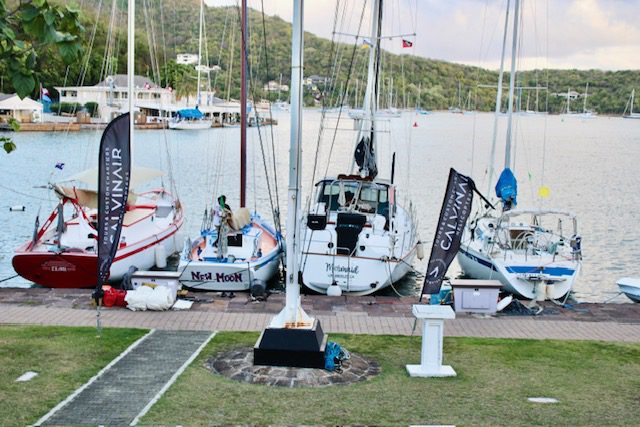
New Moon, the Carriacou sloop crewed by a young Antiguan team, has carried that instinct with a lighter touch. Agile and unforced, she seems to find her rhythm easily, her crew working with the kind of ease that comes from time on the water rather than time chasing rules.
For some, the experience has been entirely new. First-time racer on New Moon, Demario, captured it perfectly: “It felt like we were fighting the sea — and it was so wet!” Around him, nothing but broad smiles. Others, more seasoned, said it more simply: “This is our water. You feel it differently when you’ve grown up here.”
Ashore, the regatta unfolds in much the same way — unhurried, sociable and deeply rooted in place. Nelson’s Dockyard provides its usual backdrop of stone and history, but it is the people who bring the atmosphere to life. Conversations drift easily from dock to bar to cockpit, and the day’s racing is replayed not with analysis, but with stories.
Organisers are the first to point out that this is part of the appeal. The event has never tried to compete with larger, more technical regattas. Instead, it has leaned into what it does best: creating a space where good sailing and good company carry equal weight. The result is an event that feels as much like a gathering as a competition. Everyone knows that evenings ashore are as much fun as the sailing.
That may also explain why more crews are returning — and why some are already making plans for future years before this one has fully closed. The regatta is gaining a reputation, certainly, but more than that, it is building a rhythm people want to come back to. More than one sailor has declared that “the regatta should be on everyone’s bucket list.”
There is, inevitably, a wider context. Across the region, regattas are adjusting to shifting expectations and tighter realities. Against that backdrop, the steady growth of the Classics does not go unnoticed. But here, it feels less like a strategy and more like a by-product of getting the balance right.
As the final parade of sail makes its way into the Dockyard, 48 boats moving in quiet procession, the impression is not of scale, but of presence. Of boats that belong here, and an event that understands exactly what it is.
In a changing Caribbean sailing scene, that clarity may be its greatest strength.
The Antigua Classic Yacht Regatta is not trying to reinvent the formula. It is simply sailing its own course — and, for now at least, that course is holding true.