




Story and photos by David H. Lyman
In 1979, I was on a two-week bareboat charter in the Virgin Islands. The boat, a Morgan Out Islander, was a floating Winnebago, but it came with a complimentary gallon jug of rum punch.
It’s been rum for me ever since.
Rum is native to the Caribbean, made from West Indian sugar cane or molasses, a distillate of sugar cane — so rum tastes Caribbean. West Indian rum is available clear or in shades ranging from gold to amber to black. Mix the amber with pineapple and orange juice, add a splash of grenadine, and the drink takes on all the colors of a West Indian sunset.
Back in the ’80s, when you could buy a 750 ml bottle of Mount Gay on St. Barts, duty free, for $2, the universal choice was Mount Gay and OJ. In more recent times, Cruzan Dark has supplied my daily ration — a reasonably priced amber rum distilled on the island of St. Croix in the United States Virgin Islands. My daily ration starts with a 24-ounce insulated Yeti coffee mug — it keeps the morning coffee hot and the evening rum chilled, both for hours. Drop in four cubes of ice, four ounces of rum, and top it off with 18 ounces of tonic water — a squeeze of lime is optional and a dash of nutmeg is nice.

These are reasonably priced, but they’re for mixing, not sipping. I also keep a few bottles of sipping rum in my locker, for those evenings of indulging my gourmet taste.
As you cruise the island chain, you’ll get to sample a variety of rums, as each island has a distillery or two. Some of these island rums are excellent, most are good — and a few are better used as dinghy fuel. Here are a few I’d recommend.
There are two distilleries on Grenada — Clarks Court and River Antoine; both continue to produce their own rums. On Bequia, I found Sparrow’s, a rum from St. Vincent, was just right for mixing my evening libation. Farther into the Atlantic, beyond the Caribbean, lies Bermuda, where Goslings makes a dark rum, which, when combined with ginger beer, becomes a Dark and Stormy. I mention it because it’s quite popular in the islands. Both Guadeloupe and Martinique boast their own distilleries, producing robust French-style rums. There are two distilleries on St. Maarten: Guavaberry Rhum and all its relatives and Topper’s Rhum, offering a dozen spiced and gussied-up varieties for the tourist trade. The Callwood Family distillery, in Cane Garden Bay on Tortola, in the British Virign Islands, has been making rum for 200 years. Its 80-proof, cane-based rum, Panty Dropper, is as renowned for its label as for the rum.
English Harbour, a distillery on Antigua, offers a variety of sipping rums; the affordable Cavalier Gold is a fine choice for any West Indian rum punch.
If you find yourself there, try to get invited to the local Tot Club, the subject of an article on page 4 of the April 2025 issue of Caribbean Compass (https://caribbeancompass.com/the-royal-naval-tot-club-of-antigua-and-barbuda). It’s a band of expats who assemble each evening at a local pub to listen to a reading of the Royal Navy’s exploits from 200 years ago. This is followed by a toast to the king. The toast is not complete until a full tot of rum, measuring half a gill, is downed, in one gulp (everyone there is traditional enough to know what a tot and a gill are, so you’d better be too — it’s about 2.4 ounces). This is usually followed immediately with a Heineken beer chaser. The Saturday toast is: “To our wives and sweethearts … may they never meet.”
Years ago, as a writer on assignment in Cuba, I went in search of Ernest Hemingway’s haunts, for this great writer was also a great rum drinker. I found one of his favorite bars a few blocks behind the Capitola in Central Havana. El Floridita is a pink, one-story restaurant and bar, on the corner of Obispo and Avenue Belgica. It’s just eight blocks in a straight line down Obispo Street to the Hotel Ambos Mundos, where Hemingway lived before buying an estate outside Havana — so he could walk home, if not always in a straight line.

It was here, at El Floridita, that Hemingway would drink a dozen daiquiris in one sitting — all the while chatting with fellow writers who dropped in: Ezra Pound and John Dos Passos, Graham Greene, Jean-Paul Sartre, Gabriel García Márquez, and Tennessee Williams. The photographs on the walls tell a more complete story of El Floridita in the 1930s–50s.
Tourists crowded the place when I dropped by in 1999. A long bar stretched along the back wall, three musicians were jamming in a corner; waiters were circling; a red-aproned bartender was lining up a dozen glasses on the bar, as another was keeping time to the rumba beat from the house band with a cocktail shaker over his shoulder. He stopped, tapped the shaker on the bar edge to loosen the top, and, with a strainer holding back the ice cubes, poured out the cocktail for which the Floridita is famous, the daiquiri.
According to William Grimes’s book Straight Up or On the Rocks: The Story of the American Cocktail, you make this traditional cocktail with Bacardi white rum, fresh lime, grapefruit juice, and sugar syrup. Shaken, not stirred, with ice, and served in large goblets. You can add six drops of maraschino liqueur for more color. If you tell the bartender to skip the sugar, you have the “Hemingway Daiquiri.”
Bacardi rum is not available in Cuba now, yet the name is still there in Havana, carved into a granite facade on an art deco building just two blocks away — the family’s former headquarters. The Bacardi family was kicked out when Castro and his ragtag army arrived to take over. Today, the rum in Cuba is Havana Club. The Bacardi family set up shop in nearby Puerto Rico and is doing just fine.
At the resorts that line the beaches of many Caribbean islands, a favorite is the Piña Colada — a concoction of white rum, coconut milk, lime juice, pineapple juice, and ice, all crammed into a blender and beaten into a frothy mass, poured into hourglass-shaped tumblers, and garnished with a miniature umbrella. Just the thing for the Caribbean resort crowd down to the islands for a week in the sun.
For sailors there’s Navy Grog, made with Pusser’s Rum, water and lime juice. This daily tot of rum was first doled out to British crews in 1655 and then stopped in 1970. The Royal New Zealand Navy continues the tradition.
In the BVI, it’s the Pain Killer, a lethal concoction of pineapple juice, 85-proof Pusser’s rum, freshly squeezed orange juice, and cream of coconut (in a 4, 2, 1 ratio) shaken vigorously in a cocktail shaker and served with a dash of nutmeg. No ice is needed.
The Soggy Dollar Bar on White Beach on the island of Jost van Dyke is where the Pain Killer originated. There’s no dock here, and the beach is not ideal for landing dinghies, forcing sailors to swim ashore with dollar bills stuffed in their bathing trunks. When I frequented White Beach in the late ’70s and ’80s, there was no ice available as there was no electricity. This powerful rum drink goes down real easy, so watch your intake. They come in grades: one, two, three, and four; the fourth should be outlawed.

On the island of Bequia, a rum punch goes like this: one of sour, two of sweet, three of strong, and four of weak: lime juice, sugar syrup, rum, and tonic water in that order.
The mojito is Cuba’s contribution to the rum drinker’s delight, so while on my Hemingway Pub Crawl, I went searching for the bar that makes the best one. Heading down Obispo Street, I was on my way to the Ambos Mundos Hotel, another of Hemingway’s bars and his Havana residence.
Walking the narrow streets of Old Havana I felt as if I had just stepped back into ancient Spain. Built in the 1500s and 1600s, Old Havana preserves much of its Spanish Baroque architecture, columns and arches, colonnades and ornate carvings. Government buildings are in fine shape, hotels have had a facelift, and churches are restored, even if the Catholic religion is not. There are abandoned and dilapidated buildings next to recently renovated ones.
Most of Old Havana looked a bit worn out when I was there. But the people I encountered were anything but worn out. The narrow streets were filled with people going about their lives, chatting, and shouting to each other across the alley. Commerce went on as I passed pastry and bread shops and ice cream stands. A tank truck parked on the curb, providing water for local residents whose apartments lack running water. An eighty-year-old woman struggled with a blue pail of sloshing water on her way to her third-floor walk-up. Three men were working on a Bicitaxi; two more bent over the engine compartment of a 1958 Chevy, the hood up, while others lingered nearby, offering free advice and criticism.
Rum punch, on the other hand, is a rum drinker’s drink. The recipe starts with ice in a tall glass, followed by the addition of white or amber rum, a mixture of various tropical citrus fruit juices such as lime, lemon, papaya, mango, pomegranate, and even orange juice. I prefer pineapple and orange juice, with a splash of grenadine syrup for color and taste.
I arrived at the Ambos Mundos Hotel, where Hemingway wrote Death in the Afternoon (1932), about the Spanish bullfights. He started writing The Green Hills of Africa here, published in 1935, and worked on To Have and Have Not, published in 1937. The bar in the lobby makes a wicked mojito, so I seated myself among tourists and locals and ordered one. The bartender placed a tall, narrow glass in front of me, cramming in what appears to be a sprig of mint, complete with stalk, leaves and all (the locals refer to this as “grass”), along with a wedge of lime. With a well-worn wooden mallet, he smashed the lime and grass into a pulp to release their oils and essence. To this he added ice, simple syrup, a liberal helping of Havana Club white rum, and a splash of club soda, sticks in a straw, and with a smile, pushes the glass in my direction.
The mojito is a refreshing drink, the fiery taste of rum, now tamed with sugar, lime, and the grass. One usually leads to two.
Back on the Hemingway Pub Crawl, I went in search of the mojito’s birthplace. A few blocks away, I found La Bodeguita del Medio on Empedrado Street. You can’t miss it — the bar is practically on the street. When I arrived, people were out on the sidewalk, dancing in the street to a house trio inside. The blue walls inside were covered with people’s names and expressions handwritten with sharpies; a mural of Ernest filled the wall behind the bar; framed photographs told a story. The graffiti-covered walls led to a cluster of small dining rooms deeper inside, then extended up the stairs to yet more of the rooms above.
I decided to return when it’s not as busy.

As I sail among the islands this winter, I’ll be looking forward to dropping the hook at the end of each day in some cove or harbor. After rigging the snubbing line, I’ll go below, mix up my daily ration, and kick back in the cockpit, rum and tonic close at hand, observing the sun as it sinks into the Caribbean Sea — continuing my research into the rums of the Caribbean.
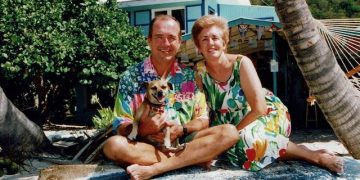
For over 20 years, author and photojournalist David H. Lyman has sailed the Eastern Caribbean islands. His Hemingway Pub Crawl is from a chapter in his forthcoming book, A Maine Yankee in Castro’s Cuba. Find his writing and photographs at DHLyman.com. A version of this story was originally published in Cruising World magazine.